Updates

  1. Person pages list letters, writing, profiles and links as sortable tables with filters, and show each person's companies as links; Fund letters show each letter's description in its own column.
  2. Experts show a checked job title and a short description of each person; 30 more people have photographs.
  3. Every company, fund, university and publication the experts work for has a page listing the people there.
  4. Fund letters show each letter's thesis and filter by it; 225 person pages list the essays, columns and newsletter issues the person wrote.
  5. Person pages list every essay and newsletter issue a person wrote, and their own books as a table in List view.
  6. Recommends shows the five largest kinds of book and the rest under More; browse pictures load sooner.
  7. Podcasts and talks link the original episode, filter by Audio and video or Press, and list each publisher once.
  8. Pages are wider, Recommends has List and Grid, and a filter clicked again turns off.
  9. Book cards sit in a ruled grid with Open Library and Goodreads links and each book's one-line note.
  10. Funds is now Investors; each investor's styles are buttons that filter the table.
  11. Podcasts and talks on a person's page filter by year and publisher and show as a list or a grid of pictures.
  12. Quotes show only people's own words: 472 summaries written by list sites are gone.
  13. Country pages open from Browse again, and every link on the shelf lands on a page.
  14. Subject and person pages show their sections as tabs, and each book appears once on a person's page.
  15. Book cards show the quote, who said it and the source; grids show five cards to a row.
  16. On a phone, a menu holds the sections, search, Updates, Feedback and dark mode.
  17. Feedback takes a screenshot of the page with no browser prompt, opens a screenshot full size when you click it, and clears itself once sent.
  18. Book cards are centred, search names the topic each book sits in, and any text cut short shows whole on hover.
  19. Search groups its results by kind: people, companies, geographies, subjects, topics, books, funds, fund letters and papers.
  20. The Books table lists who recommended each book by name, and the browser tab names the section you are in.
  21. Feedback can take a screenshot of the page, or one you paste or choose, and opens in the corner beside Updates.
  22. Each rail button reopens its section where you left it, and Browse, Table and People show on every book and subject page.
  23. Filters grey out choices that hold nothing instead of hiding them, and Books › People filters by authors or recommenders.
  24. Feedback takes a subject line and up to three screenshots.
  25. Biographies are grouped by the person they are about: 41 new pages, from Abraham Lincoln to Lee Kuan Yew.
  26. Sport splits into 23 sports, and Religion into one topic per faith.
  27. Book lists show as cards: the cover, one recommendation quote and every recommender by name.
  28. Seventeen subjects that had two or three pages under different names now have one page each.
  29. Every page lists its Experts as authors and recommenders, with a link to them on the Experts tab.
  30. Economics, Financial history, Financial panics and Accounting are subjects of their own, with one page per financial crisis.
  31. Book, person and subject pages open inside the app, so the tabs stay in view.
  32. 996 more book covers, and photographs or logos for 227 more people and companies.
  33. Books › Browse shows every subject as cards, and the rail holds Fund letters, Papers, Experts, Books and Funds.
  34. Every topic over 150 books splits into narrower topics, each with a page of its own.

Send feedback

What is it?
Screenshots, up to 3 (optional)
or paste one with Ctrl+V

We use your email only to reply to you.

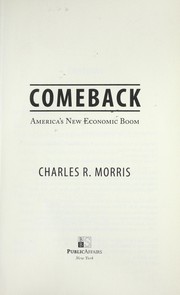
Comeback: America's New Economic Boom

Comeback: America's New Economic Boom

Charles R. Morris
2013
T3 179 pages · about 2h 59m to read Open Librarygoodreads

Summary

Morris argues that the United States was positioned for an industrial revival in the early 2010s, driven by cheap natural gas from shale, by rising Chinese wages narrowing the manufacturing cost gap, by the productivity of American manufacturing, and by the energy-intensive industries that would relocate to take advantage of the gas price.

His specific case rests on petrochemicals and heavy industry. Cheap ethane from shale gas gave American chemical producers a feedstock cost advantage over European and Asian competitors using naphtha, which he argued would draw investment in crackers, fertiliser plants and related capacity. He extends this to steel, aluminium and other energy-intensive production, and argues that total landed cost comparisons including shipping, inventory and quality would shift more assembly work back to North America.

He also argues that the American fiscal position was less alarming than the deficit debate of the period assumed, and that manufacturing employment statistics understated the sector's health because productivity growth reduced headcount while output rose.

The book is short and was written as an intervention in a specific debate. Its forecasts have partly come true: the petrochemical investment happened, gas prices stayed low, and North American reshoring accelerated later for reasons Morris did not anticipate, including tariffs and pandemic supply disruption. The broader manufacturing employment revival he expected did not occur on the scale described. The reference has not verified the specific projections and figures in the book, which are drawn from 2012 and 2013 data.

Key takeaways 7

  1. Cheap ethane from shale gas gave American petrochemical producers a durable feedstock cost advantage over competitors using oil-based naphtha.
  2. Energy-intensive industry relocates toward cheap energy, and the shale price differential was large enough to move investment decisions.
  3. Rising Chinese wages narrowed the manufacturing cost gap enough that total landed cost, including shipping and inventory, favoured North American production for some goods.
  4. Manufacturing employment statistics understate the sector's health because productivity growth reduces headcount while output rises.
  5. The American fiscal position in the early 2010s was less alarming than the deficit debate assumed, because growth and healthcare cost moderation changed the projections.
  6. Comparative advantage in manufacturing is determined by total landed cost rather than by hourly wage rates.
  7. Domestic energy abundance changes a country's industrial competitiveness within a few years, faster than most structural economic changes operate.

Who should read it

Investors in industrials and energy who want the reshoring and feedstock-advantage argument as it was made in 2013, checked against what followed.

About Charles R. Morris

Lawyer, banker and author on American finance and industrial history; died in 2021.

The Tycoons recounts how Carnegie, Rockefeller, Gould and Morgan assembled the industrial and financial structures of the American economy, with unusual attention to the financing and accounting they used to do it. The Sages compares the working methods of Buffett, Soros and Volcker against the crisis each of them read early.

Who recommended it 1 · 1 direct

Similar books 6

Chosen by shared topics, the entries that hold them, and the people who recommended both.
Tyler Cowen · 2019

A defence of American business on fraud, CEO pay, monopoly and tech, issue by issue.

Colins Mayer

Recommended by: Satya Nadella

Peter F. Drucker · 1969

Four breaks with the postwar world, from a global economy to knowledge as capital.

Recommended by: Patrick Collison

Ulrike Schaede · 2020

Japanese firms after 1990 moved into hidden upstream niches rather than stagnate.
Where it sits in the reference 4

Journalists
Business themes
Business themes
Economics

Topics

EconomicsBusiness and Management