Updates

  1. Person pages list letters, writing, profiles and links as sortable tables with filters, and show each person's companies as links; Fund letters show each letter's description in its own column.
  2. Experts show a checked job title and a short description of each person; 30 more people have photographs.
  3. Every company, fund, university and publication the experts work for has a page listing the people there.
  4. Fund letters show each letter's thesis and filter by it; 225 person pages list the essays, columns and newsletter issues the person wrote.
  5. Person pages list every essay and newsletter issue a person wrote, and their own books as a table in List view.
  6. Recommends shows the five largest kinds of book and the rest under More; browse pictures load sooner.
  7. Podcasts and talks link the original episode, filter by Audio and video or Press, and list each publisher once.
  8. Pages are wider, Recommends has List and Grid, and a filter clicked again turns off.
  9. Book cards sit in a ruled grid with Open Library and Goodreads links and each book's one-line note.
  10. Funds is now Investors; each investor's styles are buttons that filter the table.
  11. Podcasts and talks on a person's page filter by year and publisher and show as a list or a grid of pictures.
  12. Quotes show only people's own words: 472 summaries written by list sites are gone.
  13. Country pages open from Browse again, and every link on the shelf lands on a page.
  14. Subject and person pages show their sections as tabs, and each book appears once on a person's page.
  15. Book cards show the quote, who said it and the source; grids show five cards to a row.
  16. On a phone, a menu holds the sections, search, Updates, Feedback and dark mode.
  17. Feedback takes a screenshot of the page with no browser prompt, opens a screenshot full size when you click it, and clears itself once sent.
  18. Book cards are centred, search names the topic each book sits in, and any text cut short shows whole on hover.
  19. Search groups its results by kind: people, companies, geographies, subjects, topics, books, funds, fund letters and papers.
  20. The Books table lists who recommended each book by name, and the browser tab names the section you are in.
  21. Feedback can take a screenshot of the page, or one you paste or choose, and opens in the corner beside Updates.
  22. Each rail button reopens its section where you left it, and Browse, Table and People show on every book and subject page.
  23. Filters grey out choices that hold nothing instead of hiding them, and Books › People filters by authors or recommenders.
  24. Feedback takes a subject line and up to three screenshots.
  25. Biographies are grouped by the person they are about: 41 new pages, from Abraham Lincoln to Lee Kuan Yew.
  26. Sport splits into 23 sports, and Religion into one topic per faith.
  27. Book lists show as cards: the cover, one recommendation quote and every recommender by name.
  28. Seventeen subjects that had two or three pages under different names now have one page each.
  29. Every page lists its Experts as authors and recommenders, with a link to them on the Experts tab.
  30. Economics, Financial history, Financial panics and Accounting are subjects of their own, with one page per financial crisis.
  31. Book, person and subject pages open inside the app, so the tabs stay in view.
  32. 996 more book covers, and photographs or logos for 227 more people and companies.
  33. Books › Browse shows every subject as cards, and the rail holds Fund letters, Papers, Experts, Books and Funds.
  34. Every topic over 150 books splits into narrower topics, each with a page of its own.

Send feedback

What is it?
Screenshots, up to 3 (optional)
or paste one with Ctrl+V

We use your email only to reply to you.

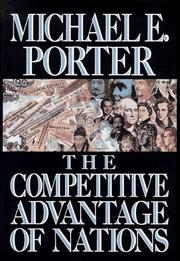
The Competitive Advantage of Nations

The Competitive Advantage of Nations

Michael E. Porter
1990
T3 855 pages · about 14h 15m to read Open Librarygoodreads

Summary

Porter extended his firm-level competitive strategy work to explain why particular countries become the home base for internationally successful firms in particular industries. The research covered ten nations and many industries over four years.

His central framework is the diamond, comprising four interacting determinants. Factor conditions, meaning not inherited resources but created and specialised factors such as skilled labour and research infrastructure. Demand conditions, where he argues that sophisticated and demanding home customers push firms to improve faster than complacent home markets do. Related and supporting industries, meaning the presence of internationally competitive suppliers and adjacent industries in the same location. And firm strategy, structure and rivalry, where he makes the counterintuitive claim that intense domestic rivalry, rather than national champions protected from competition, is what produces internationally competitive firms.

From this he derives an argument about clusters: competitive industries concentrate geographically because the four determinants reinforce each other locally, and the cluster rather than the firm or the nation is the correct unit of analysis. He also argues that government's role is to improve the determinants rather than to protect firms or pick winners.

The book is very long and the case material is exhaustive. Its influence on economic development policy has been enormous, and cluster policy is now standard practice worldwide. Economists have criticised the framework as unfalsifiable, as inconsistent with trade theory, and as derived from cases selected to fit. The empirical evidence that cluster policies work as intended is weak.

Key takeaways 7

  1. National competitive advantage in an industry arises from four interacting local conditions rather than from inherited resources or macroeconomic policy.
  2. Intense domestic rivalry produces internationally competitive firms, while protected national champions produce firms that cannot compete abroad.
  3. Demanding and sophisticated home customers push firms to improve faster than large but undemanding home markets do.
  4. Created and specialised factors, such as skilled labour and research institutions, matter far more than inherited endowments of land or basic labour.
  5. Competitive industries concentrate geographically because the determinants reinforce each other within a location, which makes the cluster the correct unit of analysis.
  6. Government should improve the determinants through education, infrastructure and standards rather than protect firms or select winners.
  7. Disadvantages in basic factors can produce advantage by forcing innovation, which is why resource-poor countries sometimes lead resource-intensive industries.

Who should read it

Executives choosing where to locate operations and policy readers assessing cluster and industrial strategy, treated as an influential framework rather than settled economics.

About Michael E. Porter

Bishop William Lawrence University Professor Emeritus, Harvard Business School; founder, Institute for Strategy and Competitiveness

Competitive Strategy and the five-forces framework are the primary source for industry analysis, and Competitive Advantage supplied the value-chain vocabulary the field still uses.

Harvard Business School, Institute for Strategy and Competitiveness

Similar books 6

Chosen by shared topics, the entries that hold them, and the people who recommended both.
Michael E. Porter · 1985

The value chain: how to find where a firm's cost or differentiation advantage lies.
Michael E. Porter · 1980

Techniques for Analyzing Industries and Competitors

Michael E. Porter · 1998

Collected HBR articles; expanded edition 2008
Michael E. Porter, Elizabeth Olmsted Teisberg · 2006

Creating Value-Based Competition on Results

Where it sits in the reference 4

Strategists
Business themes
Business themes
Economics

Topics

EconomicsBusiness and Management