Updates

  1. Person pages list letters, writing, profiles and links as sortable tables with filters, and show each person's companies as links; Fund letters show each letter's description in its own column.
  2. Experts show a checked job title and a short description of each person; 30 more people have photographs.
  3. Every company, fund, university and publication the experts work for has a page listing the people there.
  4. Fund letters show each letter's thesis and filter by it; 225 person pages list the essays, columns and newsletter issues the person wrote.
  5. Person pages list every essay and newsletter issue a person wrote, and their own books as a table in List view.
  6. Recommends shows the five largest kinds of book and the rest under More; browse pictures load sooner.
  7. Podcasts and talks link the original episode, filter by Audio and video or Press, and list each publisher once.
  8. Pages are wider, Recommends has List and Grid, and a filter clicked again turns off.
  9. Book cards sit in a ruled grid with Open Library and Goodreads links and each book's one-line note.
  10. Funds is now Investors; each investor's styles are buttons that filter the table.
  11. Podcasts and talks on a person's page filter by year and publisher and show as a list or a grid of pictures.
  12. Quotes show only people's own words: 472 summaries written by list sites are gone.
  13. Country pages open from Browse again, and every link on the shelf lands on a page.
  14. Subject and person pages show their sections as tabs, and each book appears once on a person's page.
  15. Book cards show the quote, who said it and the source; grids show five cards to a row.
  16. On a phone, a menu holds the sections, search, Updates, Feedback and dark mode.
  17. Feedback takes a screenshot of the page with no browser prompt, opens a screenshot full size when you click it, and clears itself once sent.
  18. Book cards are centred, search names the topic each book sits in, and any text cut short shows whole on hover.
  19. Search groups its results by kind: people, companies, geographies, subjects, topics, books, funds, fund letters and papers.
  20. The Books table lists who recommended each book by name, and the browser tab names the section you are in.
  21. Feedback can take a screenshot of the page, or one you paste or choose, and opens in the corner beside Updates.
  22. Each rail button reopens its section where you left it, and Browse, Table and People show on every book and subject page.
  23. Filters grey out choices that hold nothing instead of hiding them, and Books › People filters by authors or recommenders.
  24. Feedback takes a subject line and up to three screenshots.
  25. Biographies are grouped by the person they are about: 41 new pages, from Abraham Lincoln to Lee Kuan Yew.
  26. Sport splits into 23 sports, and Religion into one topic per faith.
  27. Book lists show as cards: the cover, one recommendation quote and every recommender by name.
  28. Seventeen subjects that had two or three pages under different names now have one page each.
  29. Every page lists its Experts as authors and recommenders, with a link to them on the Experts tab.
  30. Economics, Financial history, Financial panics and Accounting are subjects of their own, with one page per financial crisis.
  31. Book, person and subject pages open inside the app, so the tabs stay in view.
  32. 996 more book covers, and photographs or logos for 227 more people and companies.
  33. Books › Browse shows every subject as cards, and the rail holds Fund letters, Papers, Experts, Books and Funds.
  34. Every topic over 150 books splits into narrower topics, each with a page of its own.

Send feedback

What is it?
Screenshots, up to 3 (optional)
or paste one with Ctrl+V

We use your email only to reply to you.

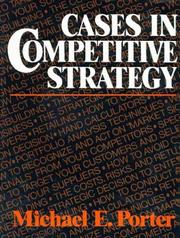
Cases in Competitive Strategy

Cases in Competitive Strategy

Michael E. Porter
1983
T4 541 pages · about 9h 1m to read Open Librarygoodreads

Summary

The reference has not verified this book in detail; the summary states only what the title, author and subject establish.

Porter compiled this casebook to accompany Competitive Strategy, providing teaching cases through which students could apply the analytical framework.

The reference has not verified the specific cases included. The purpose of such a volume is to supply the raw material against which the framework is exercised: industry situations described in enough detail that a reader can perform the five forces analysis, identify the sources of competitive advantage, assess competitor behaviour and evaluate strategic options.

The framework being applied is Porter's: analysis of industry structure through the threat of entry, the bargaining power of buyers and suppliers, the threat of substitutes and rivalry among existing competitors; the generic strategies of cost leadership, differentiation and focus; competitor analysis examining a rival's goals, assumptions, current strategy and capabilities in order to predict its behaviour; and the analysis of industry evolution, of fragmented industries, of emerging industries, of mature industry transitions and of declining industries.

Cases from 1983 describe industries as they existed then, and every industry covered has changed since. The teaching value of a case does not depend on its currency, since the point is to exercise the analysis rather than to learn the industry, but readers using it for anything other than teaching should recognise this.

Porter's analytical works, Competitive Strategy and Competitive Advantage, and Magretta's summary, which is also in this reference, contain the framework itself. This volume is supplementary teaching material.

Key takeaways 6

  1. Industry structure analysed through entry threat, buyer and supplier power, substitutes and rivalry explains differences in profitability across industries.
  2. Competitor analysis should examine a rival's goals, assumptions, current strategy and capabilities in order to predict its behaviour.
  3. Different industry conditions, including fragmentation, emergence, maturity and decline, require different strategic approaches.
  4. Applying the framework to a described situation is a different skill from understanding the framework, which is why cases exist.
  5. The cases describe industries as they existed in the early 1980s and every one has since changed.
  6. This is supplementary teaching material and the framework itself is set out in Porter's analytical works.

Who should read it

Instructors and students working through Porter's framework who need case material for exercising the analysis.

About Michael E. Porter

Bishop William Lawrence University Professor Emeritus, Harvard Business School; founder, Institute for Strategy and Competitiveness

Competitive Strategy and the five-forces framework are the primary source for industry analysis, and Competitive Advantage supplied the value-chain vocabulary the field still uses.

Harvard Business School, Institute for Strategy and Competitiveness

Similar books 6

Chosen by shared topics, the entries that hold them, and the people who recommended both.

Michael E. Porter · 1985

The value chain: how to find where a firm's cost or differentiation advantage lies.
Michael E. Porter · 1980

Techniques for Analyzing Industries and Competitors

Michael E. Porter · 1998

Collected HBR articles; expanded edition 2008

Michael E. Porter, Elizabeth Olmsted Teisberg · 2006

Creating Value-Based Competition on Results
Where it sits in the reference 3

Strategists
Business themes
Business themes

Topics

Business and ManagementReference WorksFinance, accounting and economics references