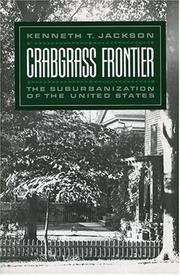
Crabgrass Frontier
How Americans chose separate suburban houses and how that shaped the country.
Suburbanization of the United States; the standard history.
Summary
Jackson writes the first full history of the American suburb, explaining how the good life in America came to mean a house of one's own on a grassy lot far from the workplace. He traces the growth of suburbs from the middle of the nineteenth century, combining social history with economic and architectural analysis, treats communities in every part of the country and compares American housing patterns with those of Japan and Europe.
Jackson argues that the arrangement of housing conditions behaviour, and that suburbia reflects a deliberate American choice to emphasise separateness. It expresses conspicuous consumption, reliance on the private car, upward mobility, the nuclear family, a widening split between work and leisure, and a tendency toward racial and economic exclusion. The recurring causes he identifies are land developers, cheap lots, inexpensive building methods, better transport, abundant energy, government subsidies and racial tension. He concludes that suburbanisation was as much a governmental process as a natural one, and predicts that future deconcentration will differ from its past.
Key takeaways 4
- American suburbs grew from cheap land, cheap construction, better transport and abundant energy.
- Government subsidies drove suburbanisation as much as market forces did.
- Suburban living reflects reliance on the car and a preference for separation.
- Suburbs have tended toward racial and economic exclusion.
Who should read it
Investors in housing and real estate who want the standard history of how American suburbs were built and financed.
Similar books 6
Chosen by shared topics, the entries that hold them, and the people who recommended both.
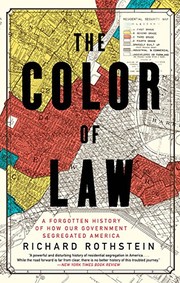
How federal housing policy created racial segregation in American cities.
150 essays on the events that shaped the city of Chicago.
Recommended by: Mohnish Pabrai

San Francisco from the late 1960s to the early 1980s, through its people.
Recommended by: Patrick Collison

The Florida land boom of the 1920s and how its collapse fed the Depression.
“The telling of America's first modern bubble: the Florida real estate boom of the 1920s.” — Morgan Housel
Source: A Few Good Books · Collaborative Fund
Recommended by: Morgan Housel
How English regional cultures shaped early American society and its regions.
Recommended by: Balaji S. Srinivasan

The eleven rival regional cultures, or nations, that make up North America.
Recommended by: Jack Dorsey