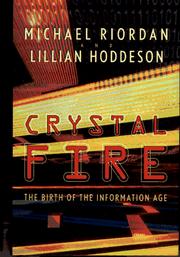
Crystal Fire
How the Bell Labs team of Shockley, Bardeen and Brattain invented the transistor.
The transistor at Bell Labs and the birth of the information age.
Summary
Riordan and Hoddeson tell the story of the transistor, which they call the most important artefact of the twentieth century and the nerve cell of the electronic age. On 16 December 1947 John Bardeen and Walter Brattain, physicists at Bell Laboratories, pressed two electrodes into a sliver of germanium; the power that flowed out far exceeded the power that went in, and the transistor was born. The transistor and the microchip that grew from it now sit inside phones, cash machines, watches, calculators, computers, cars, televisions and thousands of other devices.
The authors follow the Bell Labs team led by William Shockley, who shared the Nobel Prize with Bardeen and Brattain. While his colleagues moved to other research, Shockley grew obsessed with the device and founded his own firm, the first semiconductor company in what became Silicon Valley, which spawned hundreds of other businesses and a multi-billion-dollar industry. Above all, the authors present the invention as a human story: pride, jealousy, competition and scientific and economic ambition drove the creation of modern microelectronics.
Key takeaways 4
- Bardeen and Brattain built the first transistor at Bell Labs on 16 December 1947.
- The transistor and the microchip it led to underlie almost every electronic device.
- Shockley's own firm was the first semiconductor company in what became Silicon Valley.
- Rivalry and ambition among the inventors shaped the course of the technology.
Who should read it
Investors in semiconductors and readers who want the origin of the transistor and of Silicon Valley's first chip company.
Who recommended it 1 · 1 direct
Similar books 6
Chosen by shared topics, the entries that hold them, and the people who recommended both.
How Kilby and Noyce each invented the integrated circuit in 1958 and 1959.
Recommended by: Patrick Collison
How chips became the key to economic and military power, made in a few chokepoints.
Recommended by: Andrew Wilkinson
Portraits of the scientists, engineers and founders behind new technology.
The chief engineer on designing, building, testing and flying the lunar module.
Recommended by: Patrick Collison
A history of information, from African talking drums to the theory that measures it.
Recommended by: Patrick Collison, Marc Andreessen and 2 others