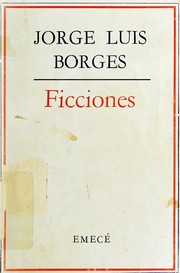
Ficciones
Short stories that use the labyrinth to explore ideas about human life.
Summary
Jorge Luis Borges wrote the stories in Spanish between 1941 and 1956. His 1941 collection The Garden of Forking Paths held eight stories; in 1944 he added a section called Artifices with six more and gave the whole the title Ficciones, adding three stories to Artifices in the 1956 edition. Grove Press published the full English translation in 1962, edited by Anthony Kerrigan. It became Borges's most famous book and made him known around the world.
The stories include "Tlön, Uqbar, Orbis Tertius", "Pierre Menard, Author of the Quixote", "The Circular Ruins", "The Lottery in Babylon", "The Library of Babel", "The Garden of Forking Paths", "Funes the Memorious", "Death and the Compass", "The Secret Miracle", "Three Versions of Judas" and "The South". They draw attention to their own fictional nature and make their literary devices conspicuous; Borges regarded the effort to make a story seem natural as an impoverishment of fiction. The labyrinth recurs throughout, standing for the complexity of worlds and systems, human undertakings, the body and mind, and abstractions such as time. Borges often gives his first-person narrators his own name.
Key takeaways 4
- Borges's stories call attention to the fact that they are fiction.
- The labyrinth recurs as an image of complex worlds, systems and time.
- Several stories treat imaginary books, libraries and encyclopaedias as if they were real.
- Ficciones became the book that made Borges famous worldwide.
Who should read it
Readers of literary fiction and philosophy who enjoy short stories built on ideas and paradoxes.
Who recommended it 1
“His short story collection Ficciones, or Labyrinths, is amazing. Borges is probably still the most powerful author I have read who wasn't just outright writing philosophy.”
Similar books 6
Chosen by shared topics, the entries that hold them, and the people who recommended both.
A collection of short stories and essays.
“I think the best book of his to start with is Labyrinths. And it's so much about the internet.” — Caterina Fake
Source: The Tim Ferriss Show Transcripts: Caterina Fake (#360)
Recommended by: Caterina Fake, Patrick Collison and 1 other
The last of a trilogy, centred on a man's life with his second wife, Mona.
Recommended by: Naval Ravikant
A novel of a Brahmin's son in ancient India who seeks understanding his own way.
Recommended by: Jim Collins, Mohnish Pabrai, Naval Ravikant and 6 others
A story of a library that holds all knowledge, an allegory of the universe.
Recommended by: Naval Ravikant

A short story that holds most of its author's philosophical preoccupations.
Recommended by: Naval Ravikant

A bookish narrator and Zorba, a zestful Greek working man, on Crete.
“It doesn't have to be the best. But for instance, Zorba the Greek, I think, is a standout for me.” — Tim Ferriss
Recommended by: Naval Ravikant, Tim Ferriss