
Updates

  1. Person pages list letters, writing, profiles and links as sortable tables with filters, and show each person's companies as links; Fund letters show each letter's description in its own column.
  2. Experts show a checked job title and a short description of each person; 30 more people have photographs.
  3. Every company, fund, university and publication the experts work for has a page listing the people there.
  4. Fund letters show each letter's thesis and filter by it; 225 person pages list the essays, columns and newsletter issues the person wrote.
  5. Person pages list every essay and newsletter issue a person wrote, and their own books as a table in List view.
  6. Recommends shows the five largest kinds of book and the rest under More; browse pictures load sooner.
  7. Podcasts and talks link the original episode, filter by Audio and video or Press, and list each publisher once.
  8. Pages are wider, Recommends has List and Grid, and a filter clicked again turns off.
  9. Book cards sit in a ruled grid with Open Library and Goodreads links and each book's one-line note.
  10. Funds is now Investors; each investor's styles are buttons that filter the table.
  11. Podcasts and talks on a person's page filter by year and publisher and show as a list or a grid of pictures.
  12. Quotes show only people's own words: 472 summaries written by list sites are gone.
  13. Country pages open from Browse again, and every link on the shelf lands on a page.
  14. Subject and person pages show their sections as tabs, and each book appears once on a person's page.
  15. Book cards show the quote, who said it and the source; grids show five cards to a row.
  16. On a phone, a menu holds the sections, search, Updates, Feedback and dark mode.
  17. Feedback takes a screenshot of the page with no browser prompt, opens a screenshot full size when you click it, and clears itself once sent.
  18. Book cards are centred, search names the topic each book sits in, and any text cut short shows whole on hover.
  19. Search groups its results by kind: people, companies, geographies, subjects, topics, books, funds, fund letters and papers.
  20. The Books table lists who recommended each book by name, and the browser tab names the section you are in.
  21. Feedback can take a screenshot of the page, or one you paste or choose, and opens in the corner beside Updates.
  22. Each rail button reopens its section where you left it, and Browse, Table and People show on every book and subject page.
  23. Filters grey out choices that hold nothing instead of hiding them, and Books › People filters by authors or recommenders.
  24. Feedback takes a subject line and up to three screenshots.
  25. Biographies are grouped by the person they are about: 41 new pages, from Abraham Lincoln to Lee Kuan Yew.
  26. Sport splits into 23 sports, and Religion into one topic per faith.
  27. Book lists show as cards: the cover, one recommendation quote and every recommender by name.
  28. Seventeen subjects that had two or three pages under different names now have one page each.
  29. Every page lists its Experts as authors and recommenders, with a link to them on the Experts tab.
  30. Economics, Financial history, Financial panics and Accounting are subjects of their own, with one page per financial crisis.
  31. Book, person and subject pages open inside the app, so the tabs stay in view.
  32. 996 more book covers, and photographs or logos for 227 more people and companies.
  33. Books › Browse shows every subject as cards, and the rail holds Fund letters, Papers, Experts, Books and Funds.
  34. Every topic over 150 books splits into narrower topics, each with a page of its own.

Send feedback

What is it?
Screenshots, up to 3 (optional)
or paste one with Ctrl+V

We use your email only to reply to you.

Financial Derivatives: Pricing, Applications

Financial Derivatives: Pricing, Applications, and Mathematics

Jamil Baz, George Chacko
2003
T4 350 pages · about 5h 50m to read Open Librarygoodreads

Compact mathematical treatment of derivative pricing and its applications

Summary

Baz and Chacko, both practitioners with academic backgrounds, wrote a compact treatment of derivatives pricing aimed at readers who need the mathematics but not a full textbook.

The structure covers the mathematical preliminaries first, including stochastic calculus, Ito's lemma, Brownian motion and the partial differential equations that pricing requires, then the pricing frameworks: the binomial model, Black-Scholes and its derivation, risk-neutral valuation and the martingale approach, and the equivalence between them. Applications cover equity, currency, commodity and interest rate derivatives, with treatment of term structure models including Vasicek, Cox-Ingersoll-Ross and Heath-Jarrow-Morton, and credit derivatives.

The book is deliberately concise, which is its distinguishing feature relative to Hull and other standard texts. It assumes a reader who wants the derivations and the intuition without the exhaustive coverage, and it explains why each mathematical result is needed rather than presenting the mathematics first.

It is aimed at practitioners in trading, risk and portfolio management and at graduate students, and it requires calculus and probability. It is not an introduction to derivatives as instruments; readers wanting that need a market-structure text first. The 2003 publication means it predates the credit crisis and the subsequent developments in counterparty valuation adjustment, collateral discounting and the multi-curve framework that changed derivatives pricing practice substantially. The core mathematics is unaffected.

Key takeaways 7

  1. Derivative pricing rests on replication, meaning constructing a portfolio of traded assets that reproduces the derivative's payoff, which determines its price by no-arbitrage.
  2. Risk-neutral valuation is a computational device rather than an assumption about preferences, since the resulting price holds regardless of any investor's risk aversion.
  3. Ito's lemma is the essential tool because it gives the dynamics of a function of a stochastic process, which is what a derivative is.
  4. The binomial model and the Black-Scholes equation give the same answer in the limit, and the binomial version makes the replication argument visible.
  5. Interest rate derivatives require modelling the whole term structure rather than a single price, which is why they need a different class of model.
  6. A model's parameters must be calibrated to observed prices, and calibration demonstrates flexibility rather than validity.
  7. The treatment predates the credit crisis, so counterparty valuation adjustment, collateral discounting and multi-curve frameworks are absent.

Who should read it

Practitioners and graduate students who need derivatives pricing mathematics concisely, with post-crisis developments sought elsewhere.

Who recommended it 1

Similar books 6

Chosen by shared topics, the entries that hold them, and the people who recommended both.

Elie Ayache · 2010

Philosophical treatment of contingency and the practice of option trading

Recommended by: Nassim Nicholas Taleb
Richard M. Bookstaber · 2007

How financial innovation made markets more crisis-prone, from a risk manager.
Nassim Nicholas Taleb · 1997

Technical manual on managing vanilla and exotic options
Frank Partnoy · 1997

An insider's account of how Morgan Stanley built and sold derivatives in the 1990s.

“F.I.A.S.C.O.: The Inside Story of a Wall Street Trader by Frank Partnoy. Another great writer and great read.” — Christopher Bloomstran

Source: Semper Augustus 2023 Letter to Clients, 'Worldly Wisdom', p. 81

Recommended by: Charlie Munger, Christopher Bloomstran and 1 other
Perry Mehrling · 2005

Fischer Black's life and ideas, from option pricing on, that shaped modern finance.

Recommended by: Mohnish Pabrai
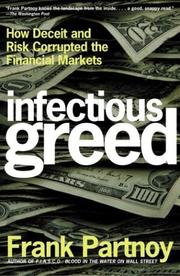
Frank Partnoy · 2003

How finance used complexity to hide risk from the 1980s through Enron.

Where it sits in the reference 1

Assets

Topics

Finance and MarketsMathematics and StatisticsGames, gambling and quantitative finance