Updates

  1. Person pages list letters, writing, profiles and links as sortable tables with filters, and show each person's companies as links; Fund letters show each letter's description in its own column.
  2. Experts show a checked job title and a short description of each person; 30 more people have photographs.
  3. Every company, fund, university and publication the experts work for has a page listing the people there.
  4. Fund letters show each letter's thesis and filter by it; 225 person pages list the essays, columns and newsletter issues the person wrote.
  5. Person pages list every essay and newsletter issue a person wrote, and their own books as a table in List view.
  6. Recommends shows the five largest kinds of book and the rest under More; browse pictures load sooner.
  7. Podcasts and talks link the original episode, filter by Audio and video or Press, and list each publisher once.
  8. Pages are wider, Recommends has List and Grid, and a filter clicked again turns off.
  9. Book cards sit in a ruled grid with Open Library and Goodreads links and each book's one-line note.
  10. Funds is now Investors; each investor's styles are buttons that filter the table.
  11. Podcasts and talks on a person's page filter by year and publisher and show as a list or a grid of pictures.
  12. Quotes show only people's own words: 472 summaries written by list sites are gone.
  13. Country pages open from Browse again, and every link on the shelf lands on a page.
  14. Subject and person pages show their sections as tabs, and each book appears once on a person's page.
  15. Book cards show the quote, who said it and the source; grids show five cards to a row.
  16. On a phone, a menu holds the sections, search, Updates, Feedback and dark mode.
  17. Feedback takes a screenshot of the page with no browser prompt, opens a screenshot full size when you click it, and clears itself once sent.
  18. Book cards are centred, search names the topic each book sits in, and any text cut short shows whole on hover.
  19. Search groups its results by kind: people, companies, geographies, subjects, topics, books, funds, fund letters and papers.
  20. The Books table lists who recommended each book by name, and the browser tab names the section you are in.
  21. Feedback can take a screenshot of the page, or one you paste or choose, and opens in the corner beside Updates.
  22. Each rail button reopens its section where you left it, and Browse, Table and People show on every book and subject page.
  23. Filters grey out choices that hold nothing instead of hiding them, and Books › People filters by authors or recommenders.
  24. Feedback takes a subject line and up to three screenshots.
  25. Biographies are grouped by the person they are about: 41 new pages, from Abraham Lincoln to Lee Kuan Yew.
  26. Sport splits into 23 sports, and Religion into one topic per faith.
  27. Book lists show as cards: the cover, one recommendation quote and every recommender by name.
  28. Seventeen subjects that had two or three pages under different names now have one page each.
  29. Every page lists its Experts as authors and recommenders, with a link to them on the Experts tab.
  30. Economics, Financial history, Financial panics and Accounting are subjects of their own, with one page per financial crisis.
  31. Book, person and subject pages open inside the app, so the tabs stay in view.
  32. 996 more book covers, and photographs or logos for 227 more people and companies.
  33. Books › Browse shows every subject as cards, and the rail holds Fund letters, Papers, Experts, Books and Funds.
  34. Every topic over 150 books splits into narrower topics, each with a page of its own.

Send feedback

What is it?
Screenshots, up to 3 (optional)
or paste one with Ctrl+V

We use your email only to reply to you.

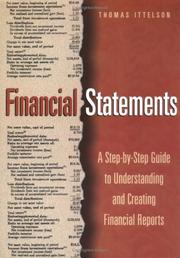
Financial Statements

Financial Statements

Thomas R. Ittelson
1998
T4 254 pages · about 4h 14m to read Open Librarygoodreads

Plain-language guide to reading the three financial statements.

Summary

Ittelson wrote this as an introduction to financial statements for people with no accounting background, and it has been through several editions.

The distinguishing method is the middle section. Ittelson takes a hypothetical company from formation through product development, manufacturing, sales and expansion, and records each of the thirty-three transactions on all three financial statements simultaneously, showing after every entry how the balance sheet, income statement and cash flow statement each change and how they remain connected. The reader sees directly why the statements articulate: why net income flows to retained earnings, why a sale on credit increases income and receivables but not cash, why buying inventory consumes cash without affecting income, why depreciation reduces income without consuming cash, and why a profitable company can run out of money.

The first section explains each statement's structure and each line item. The third section covers ratio analysis, break-even analysis, the difference between cost accounting for inventory valuation and for decision-making, and the specific distortions to watch for.

The book teaches no advanced material: it does not cover consolidation, deferred tax, leases, derivatives, pensions or the accounting standards themselves. It is a primer and does not pretend otherwise.

Its value is that the transaction-by-transaction construction produces genuine understanding of the relationship between the three statements, which most introductory treatments assert rather than demonstrate. Anyone who works through the middle section will not thereafter confuse profit with cash, which is the single most common error among non-financial managers.

Key takeaways 7

  1. The three financial statements are connected, and every transaction affects them simultaneously in ways that must reconcile.
  2. A sale on credit increases income and receivables without producing any cash, which is why profitable companies run out of money.
  3. Buying inventory consumes cash without affecting reported income until the inventory is sold.
  4. Depreciation reduces reported income without consuming cash, which is why cash flow and profit diverge.
  5. Working through transactions on all three statements simultaneously produces understanding that studying each separately does not.
  6. Growth consumes cash, because receivables and inventory must be funded before the resulting sales are collected.
  7. Profit is an accounting judgement while cash is a fact, and confusing them is the most common error among non-financial managers.

Who should read it

Founders, managers and anyone without accounting training who needs to understand why profit and cash differ and how the statements connect.

Similar books 6

Chosen by shared topics, the entries that hold them, and the people who recommended both.
Karen Berman, Joe Knight · 2006

How non-financial managers can read income statements, balance sheets and cash flow.

Recommended by: Nat Eliason
Howard M. Schilit, Jeremy Perler · 1993

The tricks companies use to inflate earnings, cash flow and key metrics, by case.

“Some of my favorites include Howard M. Schilit and Jeremy Perler, Financial Shenanigans” — Michael Mauboussin

Source: Thirty Years: Reflections on the Ten Attributes of Great Investors (Credit Suisse)

Recommended by: Michael Mauboussin, Anu Hariharan

Where it sits in the reference 2

Investment styles
Accounting

Topics

AccountingReference WorksFinance, accounting and economics references