Updates

  1. Person pages list letters, writing, profiles and links as sortable tables with filters, and show each person's companies as links; Fund letters show each letter's description in its own column.
  2. Experts show a checked job title and a short description of each person; 30 more people have photographs.
  3. Every company, fund, university and publication the experts work for has a page listing the people there.
  4. Fund letters show each letter's thesis and filter by it; 225 person pages list the essays, columns and newsletter issues the person wrote.
  5. Person pages list every essay and newsletter issue a person wrote, and their own books as a table in List view.
  6. Recommends shows the five largest kinds of book and the rest under More; browse pictures load sooner.
  7. Podcasts and talks link the original episode, filter by Audio and video or Press, and list each publisher once.
  8. Pages are wider, Recommends has List and Grid, and a filter clicked again turns off.
  9. Book cards sit in a ruled grid with Open Library and Goodreads links and each book's one-line note.
  10. Funds is now Investors; each investor's styles are buttons that filter the table.
  11. Podcasts and talks on a person's page filter by year and publisher and show as a list or a grid of pictures.
  12. Quotes show only people's own words: 472 summaries written by list sites are gone.
  13. Country pages open from Browse again, and every link on the shelf lands on a page.
  14. Subject and person pages show their sections as tabs, and each book appears once on a person's page.
  15. Book cards show the quote, who said it and the source; grids show five cards to a row.
  16. On a phone, a menu holds the sections, search, Updates, Feedback and dark mode.
  17. Feedback takes a screenshot of the page with no browser prompt, opens a screenshot full size when you click it, and clears itself once sent.
  18. Book cards are centred, search names the topic each book sits in, and any text cut short shows whole on hover.
  19. Search groups its results by kind: people, companies, geographies, subjects, topics, books, funds, fund letters and papers.
  20. The Books table lists who recommended each book by name, and the browser tab names the section you are in.
  21. Feedback can take a screenshot of the page, or one you paste or choose, and opens in the corner beside Updates.
  22. Each rail button reopens its section where you left it, and Browse, Table and People show on every book and subject page.
  23. Filters grey out choices that hold nothing instead of hiding them, and Books › People filters by authors or recommenders.
  24. Feedback takes a subject line and up to three screenshots.
  25. Biographies are grouped by the person they are about: 41 new pages, from Abraham Lincoln to Lee Kuan Yew.
  26. Sport splits into 23 sports, and Religion into one topic per faith.
  27. Book lists show as cards: the cover, one recommendation quote and every recommender by name.
  28. Seventeen subjects that had two or three pages under different names now have one page each.
  29. Every page lists its Experts as authors and recommenders, with a link to them on the Experts tab.
  30. Economics, Financial history, Financial panics and Accounting are subjects of their own, with one page per financial crisis.
  31. Book, person and subject pages open inside the app, so the tabs stay in view.
  32. 996 more book covers, and photographs or logos for 227 more people and companies.
  33. Books › Browse shows every subject as cards, and the rail holds Fund letters, Papers, Experts, Books and Funds.
  34. Every topic over 150 books splits into narrower topics, each with a page of its own.

Send feedback

What is it?
Screenshots, up to 3 (optional)
or paste one with Ctrl+V

We use your email only to reply to you.

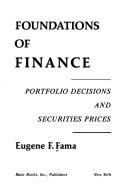
Foundations of Finance

Foundations of Finance

Eugene F. Fama
1976
T4 395 pages · about 6h 35m to read Open Librarygoodreads

Summary

Fama wrote this in 1976 as a graduate text setting out the theory and the empirical evidence of financial economics as the field then stood, and it is the compact statement of the framework he had built.

The theoretical content covers portfolio theory and the derivation of efficient portfolios, the capital asset pricing model and the market model, the mathematics of return distributions and the assumptions required for mean-variance analysis, the term structure of interest rates, and the theory of efficient markets.

The efficient markets material is the core of Fama's contribution. He defines efficiency in terms of information: a market is efficient with respect to an information set if prices fully reflect it, and he sets out the weak, semi-strong and strong forms according to whether the information set is past prices, all public information, or all information including private. His methodological insight is that efficiency cannot be tested alone: any test requires a model of expected returns, so a rejection could mean either that the market is inefficient or that the asset pricing model is wrong. This joint hypothesis problem is the reason the efficiency debate has never been settled empirically, and it is Fama's own formulation.

The empirical chapters present the evidence available then: the near absence of serial correlation in returns, the failure of trading rules to produce excess returns after costs, the speed with which prices adjust to public announcements established through event studies, and the absence of persistent outperformance among mutual funds.

The book predates Fama's own later work with French on the size and value factors, which complicated the single-factor model presented here, and predates the behavioural literature entirely. It remains the clearest statement of the framework's logic by the person who built it.

Key takeaways 7

  1. A market is efficient with respect to an information set if prices fully reflect that information, which requires specifying the set.
  2. Efficiency cannot be tested alone, because every test requires a model of expected returns that might itself be wrong.
  3. The joint hypothesis problem means a rejection could mean market inefficiency or an incorrect asset pricing model, and the two cannot be separated.
  4. Stock returns show near-zero serial correlation, so past prices contain little information about future ones.
  5. Event studies show prices adjust to public announcements quickly enough that acting on the news produces no excess return.
  6. Mutual fund performance shows no persistence beyond what chance would produce, which is consistent with efficiency.
  7. Mean-variance portfolio analysis requires distributional assumptions that must be stated, since the results depend on them.

Who should read it

Readers with quantitative training who want the efficient markets framework and the joint hypothesis problem stated by the economist who formulated them.

About Eugene F. Fama

Robert R. McCormick Distinguished Service Professor of Finance, University of Chicago Booth School of Business; Nobel laureate in economics 2013

The efficient-markets framework and the Fama-French factor models are the primary sources on which most modern empirical asset pricing is built.

University of Chicago Booth School of Business

Similar books 6

Chosen by shared topics, the entries that hold them, and the people who recommended both.
Eugene F. Fama, Merton H. Miller · 1972
Peter L. Bernstein · 1992

How Markowitz, Sharpe, Fama, Black and Scholes built the theory of modern finance.

Where it sits in the reference 2

Academics
Mental models

Topics

Finance and MarketsInvesting