Updates

  1. Person pages list letters, writing, profiles and links as sortable tables with filters, and show each person's companies as links; Fund letters show each letter's description in its own column.
  2. Experts show a checked job title and a short description of each person; 30 more people have photographs.
  3. Every company, fund, university and publication the experts work for has a page listing the people there.
  4. Fund letters show each letter's thesis and filter by it; 225 person pages list the essays, columns and newsletter issues the person wrote.
  5. Person pages list every essay and newsletter issue a person wrote, and their own books as a table in List view.
  6. Recommends shows the five largest kinds of book and the rest under More; browse pictures load sooner.
  7. Podcasts and talks link the original episode, filter by Audio and video or Press, and list each publisher once.
  8. Pages are wider, Recommends has List and Grid, and a filter clicked again turns off.
  9. Book cards sit in a ruled grid with Open Library and Goodreads links and each book's one-line note.
  10. Funds is now Investors; each investor's styles are buttons that filter the table.
  11. Podcasts and talks on a person's page filter by year and publisher and show as a list or a grid of pictures.
  12. Quotes show only people's own words: 472 summaries written by list sites are gone.
  13. Country pages open from Browse again, and every link on the shelf lands on a page.
  14. Subject and person pages show their sections as tabs, and each book appears once on a person's page.
  15. Book cards show the quote, who said it and the source; grids show five cards to a row.
  16. On a phone, a menu holds the sections, search, Updates, Feedback and dark mode.
  17. Feedback takes a screenshot of the page with no browser prompt, opens a screenshot full size when you click it, and clears itself once sent.
  18. Book cards are centred, search names the topic each book sits in, and any text cut short shows whole on hover.
  19. Search groups its results by kind: people, companies, geographies, subjects, topics, books, funds, fund letters and papers.
  20. The Books table lists who recommended each book by name, and the browser tab names the section you are in.
  21. Feedback can take a screenshot of the page, or one you paste or choose, and opens in the corner beside Updates.
  22. Each rail button reopens its section where you left it, and Browse, Table and People show on every book and subject page.
  23. Filters grey out choices that hold nothing instead of hiding them, and Books › People filters by authors or recommenders.
  24. Feedback takes a subject line and up to three screenshots.
  25. Biographies are grouped by the person they are about: 41 new pages, from Abraham Lincoln to Lee Kuan Yew.
  26. Sport splits into 23 sports, and Religion into one topic per faith.
  27. Book lists show as cards: the cover, one recommendation quote and every recommender by name.
  28. Seventeen subjects that had two or three pages under different names now have one page each.
  29. Every page lists its Experts as authors and recommenders, with a link to them on the Experts tab.
  30. Economics, Financial history, Financial panics and Accounting are subjects of their own, with one page per financial crisis.
  31. Book, person and subject pages open inside the app, so the tabs stay in view.
  32. 996 more book covers, and photographs or logos for 227 more people and companies.
  33. Books › Browse shows every subject as cards, and the rail holds Fund letters, Papers, Experts, Books and Funds.
  34. Every topic over 150 books splits into narrower topics, each with a page of its own.

Send feedback

What is it?
Screenshots, up to 3 (optional)
or paste one with Ctrl+V

We use your email only to reply to you.

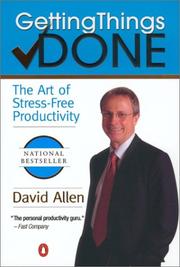
Getting Things Done

Getting Things Done

David Allen
2001
279 pages · about 4h 39m to read Open Librarygoodreads

Summary

Allen presents a system for managing commitments based on the argument that the mind is a poor storage device and a good processing device, and that unresolved commitments held in memory consume attention regardless of whether they are being worked on. His term for that is open loops, and his objective is what he calls mind like water, meaning a state where nothing is held mentally because everything is captured in a trusted external system.

The workflow has five stages: capture everything into inboxes, clarify each item by deciding whether it is actionable and what the next physical action is, organise the results into project lists, next action lists by context, a calendar for time-specific items, waiting-for lists and a someday list, reflect through a weekly review, and engage by choosing what to do based on context, time available, energy and priority.

The operational specifics are what distinguish it. The two-minute rule says anything that takes under two minutes should be done immediately rather than tracked. A project is anything requiring more than one action. The next action must be a physical visible activity rather than a category, which Allen identifies as the most common failure since a list item like plan the offsite is not actionable. The weekly review is the component people most often skip and the one the system depends on.

The book is dated in its technology assumptions, describing filing systems and paper inboxes, and later editions update this awkwardly. The system carries real overhead and many people abandon it. Allen offers no research, only his consulting practice. The capture principle and the next action definition have entered general practice independent of the full method.

Key takeaways 8

  1. The mind holds unresolved commitments regardless of whether they can be acted on, which consumes attention until they are captured externally.
  2. Everything requiring attention must be captured out of the head into a trusted system, and the trust is what makes the capture effective.
  3. Every item must be clarified into a specific physical next action, and lists containing categories rather than actions are the most common reason systems fail.
  4. Anything that takes under two minutes should be done immediately rather than tracked, because tracking costs more than doing.
  5. Anything requiring more than one action is a project and needs both an outcome statement and a defined next action.
  6. Actions should be organised by context, since what can be done depends on where you are and what tools are available.
  7. A weekly review is required to keep the system trustworthy, and skipping it is what causes the whole method to collapse.
  8. Priorities can only be set usefully after the complete inventory of commitments is visible, which is why capture precedes prioritisation.

Who should read it

Operators with large numbers of simultaneous commitments who need a complete capture and review system rather than a prioritisation technique.

Who recommended it 8 · 2 direct

Ali Abdaalreported
David Kadavyreported
Ev Williamsreported

Similar books 6

Chosen by shared topics, the entries that hold them, and the people who recommended both.
T4 24/6
Tiffany Shlain · 2019

Recommended by: Arianna Huffington

Brent D. Peterson, Gaylan W. Nielson

Recommended by: Tony Hsieh

David Allen · 2003

52 principles for getting things done with less stress: mindset, priorities, action.

Recommended by: Ev Williams

Where it sits in the reference 0

No entry holds this book yet. It reached the reference because someone recommended it.

Topics

Productivity and HabitsTime management and focus