Updates

  1. Person pages list letters, writing, profiles and links as sortable tables with filters, and show each person's companies as links; Fund letters show each letter's description in its own column.
  2. Experts show a checked job title and a short description of each person; 30 more people have photographs.
  3. Every company, fund, university and publication the experts work for has a page listing the people there.
  4. Fund letters show each letter's thesis and filter by it; 225 person pages list the essays, columns and newsletter issues the person wrote.
  5. Person pages list every essay and newsletter issue a person wrote, and their own books as a table in List view.
  6. Recommends shows the five largest kinds of book and the rest under More; browse pictures load sooner.
  7. Podcasts and talks link the original episode, filter by Audio and video or Press, and list each publisher once.
  8. Pages are wider, Recommends has List and Grid, and a filter clicked again turns off.
  9. Book cards sit in a ruled grid with Open Library and Goodreads links and each book's one-line note.
  10. Funds is now Investors; each investor's styles are buttons that filter the table.
  11. Podcasts and talks on a person's page filter by year and publisher and show as a list or a grid of pictures.
  12. Quotes show only people's own words: 472 summaries written by list sites are gone.
  13. Country pages open from Browse again, and every link on the shelf lands on a page.
  14. Subject and person pages show their sections as tabs, and each book appears once on a person's page.
  15. Book cards show the quote, who said it and the source; grids show five cards to a row.
  16. On a phone, a menu holds the sections, search, Updates, Feedback and dark mode.
  17. Feedback takes a screenshot of the page with no browser prompt, opens a screenshot full size when you click it, and clears itself once sent.
  18. Book cards are centred, search names the topic each book sits in, and any text cut short shows whole on hover.
  19. Search groups its results by kind: people, companies, geographies, subjects, topics, books, funds, fund letters and papers.
  20. The Books table lists who recommended each book by name, and the browser tab names the section you are in.
  21. Feedback can take a screenshot of the page, or one you paste or choose, and opens in the corner beside Updates.
  22. Each rail button reopens its section where you left it, and Browse, Table and People show on every book and subject page.
  23. Filters grey out choices that hold nothing instead of hiding them, and Books › People filters by authors or recommenders.
  24. Feedback takes a subject line and up to three screenshots.
  25. Biographies are grouped by the person they are about: 41 new pages, from Abraham Lincoln to Lee Kuan Yew.
  26. Sport splits into 23 sports, and Religion into one topic per faith.
  27. Book lists show as cards: the cover, one recommendation quote and every recommender by name.
  28. Seventeen subjects that had two or three pages under different names now have one page each.
  29. Every page lists its Experts as authors and recommenders, with a link to them on the Experts tab.
  30. Economics, Financial history, Financial panics and Accounting are subjects of their own, with one page per financial crisis.
  31. Book, person and subject pages open inside the app, so the tabs stay in view.
  32. 996 more book covers, and photographs or logos for 227 more people and companies.
  33. Books › Browse shows every subject as cards, and the rail holds Fund letters, Papers, Experts, Books and Funds.
  34. Every topic over 150 books splits into narrower topics, each with a page of its own.

Send feedback

What is it?
Screenshots, up to 3 (optional)
or paste one with Ctrl+V

We use your email only to reply to you.

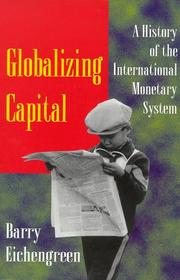
Globalizing Capital

Globalizing Capital

Barry Eichengreen
1996
T1 234 pages · about 3h 54m to read Open Librarygoodreads

Short history of the international monetary system; the standard survey.

Summary

Eichengreen wrote a compact history of the international monetary system from the classical gold standard through Bretton Woods to floating rates and the euro. It is the standard short treatment.

His organising argument concerns the political preconditions for each regime. The classical gold standard worked because governments were not held responsible for employment, so central banks could raise rates to defend a parity without political consequence. Once suffrage widened, labour organised and governments accepted responsibility for unemployment, the credibility that made the gold standard work disappeared. The interwar attempt to restore it therefore failed, and Eichengreen argues, developing the work of his Golden Fetters, that adherence to gold transmitted and deepened the Depression internationally, with countries that left earlier recovering earlier.

Bretton Woods worked because capital controls insulated domestic policy from external pressure, and it collapsed when capital mobility returned and made the fixed parities indefensible. The subsequent floating regime, and the European move to monetary union, both reflect the trilemma: a country can have at most two of fixed exchange rates, free capital movement and independent monetary policy.

The book is short, analytically clear and requires little technical background. Editions have been updated to cover the euro crisis. It is the standard reference on why monetary regimes fail, and the trilemma framing is the single most useful tool it supplies for reading any exchange rate arrangement.

Key takeaways 7

  1. A country can have at most two of fixed exchange rates, free capital movement and independent monetary policy, and every monetary regime is a choice among the three.
  2. The classical gold standard worked because governments were not held politically responsible for employment, so defending a parity carried no political cost.
  3. Widening suffrage and organised labour destroyed the credibility that the gold standard required, which is why the interwar restoration failed.
  4. Adherence to gold transmitted the Depression internationally, and countries that abandoned the parity earlier recovered earlier.
  5. Bretton Woods depended on capital controls to insulate domestic policy, and it collapsed when capital mobility returned.
  6. Exchange rate regimes fail for political reasons rather than technical ones, because the commitment they require becomes politically unsustainable.
  7. European monetary union was a political project that resolved the trilemma by abolishing independent national monetary policy.

Who should read it

Macro investors who want the standard short history of monetary regimes and the trilemma framework for assessing any exchange rate arrangement.

About Barry Eichengreen

Professor of economics and political science at the University of California, Berkeley, and economic historian of international monetary systems.

Golden Fetters established the standard account of the interwar gold standard: fixed exchange rates transmitted deflation across borders, and recovery began in each country only after it left the peg. The later books apply that monetary-history method to reserve-currency status, the euro, sovereign debt capacity and the 2008 policy response.

University of California, Berkeley

Similar books 6

Chosen by shared topics, the entries that hold them, and the people who recommended both.
Barry Eichengreen · 2011

How the dollar became the world's currency, what it gives the US, what may follow.

Barry Eichengreen · 1992

How the gold standard spread the Depression, and why leaving it early meant recovery.

Barry Eichengreen, Asmaa El-Ganainy, Rui Esteves, Kris James Mitchener · 2021

Sovereign borrowing from Italian city-states to the pandemic, and what it paid for.

Barry Eichengreen, Marc Flandreau · 1997

Key academic papers on how the gold standard worked and why it broke down.

James Rickards · 2011

Popular account of competitive devaluation as policy.
Marc Chandler · 2009

Working FX strategist on what actually moves the dollar.

Where it sits in the reference 3

Academics
Assets
Financial history

Topics

Financial HistoryEconomics