Updates

  1. Person pages list letters, writing, profiles and links as sortable tables with filters, and show each person's companies as links; Fund letters show each letter's description in its own column.
  2. Experts show a checked job title and a short description of each person; 30 more people have photographs.
  3. Every company, fund, university and publication the experts work for has a page listing the people there.
  4. Fund letters show each letter's thesis and filter by it; 225 person pages list the essays, columns and newsletter issues the person wrote.
  5. Person pages list every essay and newsletter issue a person wrote, and their own books as a table in List view.
  6. Recommends shows the five largest kinds of book and the rest under More; browse pictures load sooner.
  7. Podcasts and talks link the original episode, filter by Audio and video or Press, and list each publisher once.
  8. Pages are wider, Recommends has List and Grid, and a filter clicked again turns off.
  9. Book cards sit in a ruled grid with Open Library and Goodreads links and each book's one-line note.
  10. Funds is now Investors; each investor's styles are buttons that filter the table.
  11. Podcasts and talks on a person's page filter by year and publisher and show as a list or a grid of pictures.
  12. Quotes show only people's own words: 472 summaries written by list sites are gone.
  13. Country pages open from Browse again, and every link on the shelf lands on a page.
  14. Subject and person pages show their sections as tabs, and each book appears once on a person's page.
  15. Book cards show the quote, who said it and the source; grids show five cards to a row.
  16. On a phone, a menu holds the sections, search, Updates, Feedback and dark mode.
  17. Feedback takes a screenshot of the page with no browser prompt, opens a screenshot full size when you click it, and clears itself once sent.
  18. Book cards are centred, search names the topic each book sits in, and any text cut short shows whole on hover.
  19. Search groups its results by kind: people, companies, geographies, subjects, topics, books, funds, fund letters and papers.
  20. The Books table lists who recommended each book by name, and the browser tab names the section you are in.
  21. Feedback can take a screenshot of the page, or one you paste or choose, and opens in the corner beside Updates.
  22. Each rail button reopens its section where you left it, and Browse, Table and People show on every book and subject page.
  23. Filters grey out choices that hold nothing instead of hiding them, and Books › People filters by authors or recommenders.
  24. Feedback takes a subject line and up to three screenshots.
  25. Biographies are grouped by the person they are about: 41 new pages, from Abraham Lincoln to Lee Kuan Yew.
  26. Sport splits into 23 sports, and Religion into one topic per faith.
  27. Book lists show as cards: the cover, one recommendation quote and every recommender by name.
  28. Seventeen subjects that had two or three pages under different names now have one page each.
  29. Every page lists its Experts as authors and recommenders, with a link to them on the Experts tab.
  30. Economics, Financial history, Financial panics and Accounting are subjects of their own, with one page per financial crisis.
  31. Book, person and subject pages open inside the app, so the tabs stay in view.
  32. 996 more book covers, and photographs or logos for 227 more people and companies.
  33. Books › Browse shows every subject as cards, and the rail holds Fund letters, Papers, Experts, Books and Funds.
  34. Every topic over 150 books splits into narrower topics, each with a page of its own.

Send feedback

What is it?
Screenshots, up to 3 (optional)
or paste one with Ctrl+V

We use your email only to reply to you.

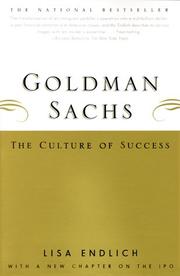
Goldman Sachs: The Culture of Success

Goldman Sachs: The Culture of Success

Lisa Endlich
1999
T2 336 pages · about 5h 36m to read Open Librarygoodreads

By a former Goldman VP; sympathetic pre-IPO institutional history.

Summary

Endlich, a former Goldman Sachs vice president, wrote a history of the firm covering its founding through the 1999 initial public offering, with particular attention to the partnership culture and to the decade-long internal argument about whether to go public.

The cultural material is the substance. Endlich describes the recruitment process, the partnership selection that occurred every two years and consumed enormous senior time, the requirement that partners keep the great majority of their wealth in the firm, the unlimited liability, and the compensation structure that paid people well below what they could earn elsewhere until they made partner and then extraordinarily well afterwards. She argues these produced the behaviour the firm was known for: long tenure, internal cooperation, willingness to subordinate individual credit, and a risk posture disciplined by the fact that partners' own money was at stake.

The flotation argument is the book's spine. Endlich covers the repeated votes, the arguments on both sides, the 1994 trading losses that nearly forced the issue and caused partner withdrawals, and the eventual decision. The case for going public was capital: principal risk-taking and international expansion required more capital than partners could supply, and the partnership structure meant capital left whenever a partner did.

The book was published in 1999 and predates everything the firm is now argued about. Endlich is sympathetic and had access. Cohan's Money and Power is the more critical and better documented treatment of the same institution.

Key takeaways 7

  1. Partners kept the great majority of their wealth in the firm and bore unlimited liability, which disciplined risk-taking in a way no policy could.
  2. The partnership structure meant capital left whenever a partner retired, which made the capital base unstable as the business became more capital-intensive.
  3. Partner selection every two years consumed enormous senior management time and was the mechanism through which the culture was transmitted.
  4. Compensation well below market until partnership and extraordinarily above it afterwards selected for people willing to accept a long deferred payoff.
  5. The 1994 trading losses caused partner withdrawals and demonstrated that the partnership capital structure could not support the risks the firm was taking.
  6. Going public was driven by the capital requirements of principal risk-taking and international expansion rather than by partners seeking liquidity.
  7. Subordinating individual credit to the firm's was enforced socially rather than formally, and it was what allowed cooperation across a competitive organisation.

Who should read it

Finance readers interested in how partnership economics shape behaviour and why the structure became unsustainable, with Cohan as the critical counterpart.

Who recommended it 1 · 1 direct

Similar books 6

Chosen by shared topics, the entries that hold them, and the people who recommended both.
Steven G. Mandis · 2013

Ex-banker turned sociologist on organizational drift.
William D. Cohan · 2011

Goldman Sachs from Marcus Goldman to the 2008 crisis, from internal documents.

Recommended by: Mohnish Pabrai
Charles D. Ellis · 2008

Goldman Sachs from Marcus Goldman's commercial paper to its 1999 public offering.

Recommended by: Mohnish Pabrai
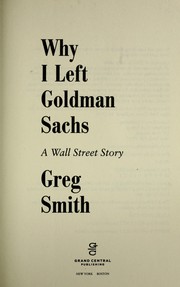
Greg Smith · 2012

Insider resignation memoir that began as an op-ed.

Where it sits in the reference 2

Companies
Financial history

Topics

Company HistoriesFinance and Markets