Updates

  1. Person pages list letters, writing, profiles and links as sortable tables with filters, and show each person's companies as links; Fund letters show each letter's description in its own column.
  2. Experts show a checked job title and a short description of each person; 30 more people have photographs.
  3. Every company, fund, university and publication the experts work for has a page listing the people there.
  4. Fund letters show each letter's thesis and filter by it; 225 person pages list the essays, columns and newsletter issues the person wrote.
  5. Person pages list every essay and newsletter issue a person wrote, and their own books as a table in List view.
  6. Recommends shows the five largest kinds of book and the rest under More; browse pictures load sooner.
  7. Podcasts and talks link the original episode, filter by Audio and video or Press, and list each publisher once.
  8. Pages are wider, Recommends has List and Grid, and a filter clicked again turns off.
  9. Book cards sit in a ruled grid with Open Library and Goodreads links and each book's one-line note.
  10. Funds is now Investors; each investor's styles are buttons that filter the table.
  11. Podcasts and talks on a person's page filter by year and publisher and show as a list or a grid of pictures.
  12. Quotes show only people's own words: 472 summaries written by list sites are gone.
  13. Country pages open from Browse again, and every link on the shelf lands on a page.
  14. Subject and person pages show their sections as tabs, and each book appears once on a person's page.
  15. Book cards show the quote, who said it and the source; grids show five cards to a row.
  16. On a phone, a menu holds the sections, search, Updates, Feedback and dark mode.
  17. Feedback takes a screenshot of the page with no browser prompt, opens a screenshot full size when you click it, and clears itself once sent.
  18. Book cards are centred, search names the topic each book sits in, and any text cut short shows whole on hover.
  19. Search groups its results by kind: people, companies, geographies, subjects, topics, books, funds, fund letters and papers.
  20. The Books table lists who recommended each book by name, and the browser tab names the section you are in.
  21. Feedback can take a screenshot of the page, or one you paste or choose, and opens in the corner beside Updates.
  22. Each rail button reopens its section where you left it, and Browse, Table and People show on every book and subject page.
  23. Filters grey out choices that hold nothing instead of hiding them, and Books › People filters by authors or recommenders.
  24. Feedback takes a subject line and up to three screenshots.
  25. Biographies are grouped by the person they are about: 41 new pages, from Abraham Lincoln to Lee Kuan Yew.
  26. Sport splits into 23 sports, and Religion into one topic per faith.
  27. Book lists show as cards: the cover, one recommendation quote and every recommender by name.
  28. Seventeen subjects that had two or three pages under different names now have one page each.
  29. Every page lists its Experts as authors and recommenders, with a link to them on the Experts tab.
  30. Economics, Financial history, Financial panics and Accounting are subjects of their own, with one page per financial crisis.
  31. Book, person and subject pages open inside the app, so the tabs stay in view.
  32. 996 more book covers, and photographs or logos for 227 more people and companies.
  33. Books › Browse shows every subject as cards, and the rail holds Fund letters, Papers, Experts, Books and Funds.
  34. Every topic over 150 books splits into narrower topics, each with a page of its own.

Send feedback

What is it?
Screenshots, up to 3 (optional)
or paste one with Ctrl+V

We use your email only to reply to you.

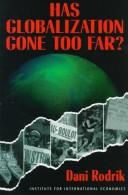
Has Globalization Gone Too Far?

Has Globalization Gone Too Far?

Dani Rodrik
1997
T4 108 pages · about 1h 48m to read Open Librarygoodreads

The 1997 warning that the political backlash was coming.

Summary

Rodrik wrote this short book in 1997, arguing that trade liberalisation was creating social tensions that its advocates were not addressing and that the political backlash was predictable.

His argument had three parts. Trade increases the elasticity of demand for labour, which means workers bear more of the burden of any cost increase and have less bargaining power, independent of any effect on wage levels. Trade brings into competition societies with different norms about labour standards, environmental protection and social insurance, and the resulting conflicts are about legitimate differences in social arrangements rather than about protectionism. And trade openness increases the demand for social insurance while simultaneously eroding the tax base that funds it, which is a structural tension that liberalisation programmes did not address.

He was careful that he supported trade and was arguing about how it should be managed rather than whether it should occur, a distinction that was widely ignored at the time.

The book was dismissed by most economists when published and Rodrik has described the reception. Its predictions about political backlash were substantially confirmed twenty years later, and the empirical work on the China shock by Autor and others documented labour market effects of the magnitude Rodrik anticipated. Later work of his, particularly The Globalization Paradox and its trilemma between democracy, national sovereignty and deep economic integration, develops the argument further. This remains the compact early statement.

Key takeaways 7

  1. Trade increases the elasticity of demand for labour, which reduces worker bargaining power independently of any effect on wage levels.
  2. Trade brings into competition societies with different norms about labour, environment and social insurance, and the resulting conflicts are legitimate rather than protectionist.
  3. Openness raises the demand for social insurance while eroding the tax base that funds it, which is a structural tension liberalisation did not address.
  4. The political backlash against trade liberalisation was predictable from its distributional effects and was predicted.
  5. The gains from further trade liberalisation are small relative to the distributional consequences, which changes the balance of the argument.
  6. Economists dismissed distributional concerns as protectionism, which removed the profession from a debate it was needed in.
  7. Managing the domestic consequences of trade is a precondition for sustaining trade politically, rather than a concession to opponents.

Who should read it

Investors and policy readers who want the early and largely confirmed statement of the case that trade's distributional politics would not hold.

Who recommended it 1 · 1 direct

Similar books 6

Chosen by shared topics, the entries that hold them, and the people who recommended both.
Joseph E. Stiglitz · 2002

An attack on the IMF's one-size-fits-all policies in the crises of the 1990s.

Recommended by: Patrick Collison

Rana Foroohar · 2022

The case for localisation after the pandemic supply shocks.

Dani Rodrik · 2017

For trade, but against hyperglobalisation that overrides national choices.

Matthew C. Klein, Michael Pettis · 2020

Trade imbalances come from how income is shared within countries.
Where it sits in the reference 2

Secular themes
Economics

Topics

EconomicsPolitics and GovernmentGlobalisation, development and offshore money