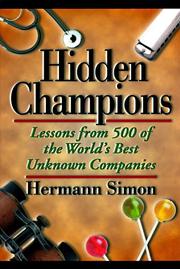
Hidden Champions
Little-known mid-sized firms, mostly German, that lead world niche markets.
Mittelstand niche leaders: narrow markets, deep moats, patient owners.
Summary
Simon, a German academic and consultant, identified several hundred mid-sized companies that hold the leading world market share in narrow product categories while remaining almost unknown to the public. Most are German, family-owned and located outside major cities. He studied them systematically through surveys, financial data and interviews, and the work has continued through several expanded editions.
The defining pattern is narrow scope combined with global reach. These companies define their market extremely tightly, often as a single component or process, and then serve it everywhere in the world rather than diversifying at home. Simon argues that this combination produces market shares that would be impossible in broader categories, and that the resulting volume in a narrow niche funds research spending per unit of revenue that far exceeds industry norms.
The other recurring features he documents include ownership by families with very long time horizons and no external equity, chief executives with unusually long tenures, close and technically detailed relationships with a small number of demanding customers, manufacturing kept in high-cost home countries because the process knowledge is the advantage, deliberate avoidance of publicity, very low employee turnover in regions where the company is the main employer, and a preference for organic growth and self-financing over acquisition and leverage.
The study is essentially cross-sectional and selected on success, so it cannot show how many companies pursued the same strategy and failed. The German institutional context matters more than Simon allows: the apprenticeship training system, the local bank relationships and the tax treatment of family firms support this model and do not exist elsewhere in the same form. Later editions address globalisation, digitalisation and the rise of Chinese competitors in these niches, which is the principal threat to the model.
Key takeaways 7
- Defining a market extremely narrowly and then serving it worldwide produces market shares unattainable in broader categories.
- Concentrated volume in a narrow niche funds research spending per unit of revenue far above industry norms.
- Family ownership without external equity permits decision horizons measured in decades rather than quarters.
- Manufacturing stays in high-cost home countries because the process knowledge, not the labour, is the advantage.
- Close technical relationships with a small number of demanding customers substitute for market research.
- Deliberate avoidance of publicity keeps competitors from identifying attractive niches.
- Very low employee turnover preserves the accumulated process knowledge on which the competitive position depends.
Who should read it
Founders and investors in industrial and business-to-business niches who want an alternative growth model to venture-funded scale.
Similar books 6
Chosen by shared topics, the entries that hold them, and the people who recommended both.
Seven sources of lasting advantage, each a benefit plus a barrier to rivals.
Recommended by: Keith Rabois, Alex Lieberman, Brett Adcock and 6 others

The deal is shaped before the table: set up the parties, interests and options first.
How to create new market space instead of fighting rivals over existing demand.
“It's the epitome of Blue Ocean Strategy. To find a breakthrough angle in commerce, it's as important to decide where you will not compete, as it is to decide where you will compete.” — David Heinemeier Hansson
Source: Turns out nobody cared about panel gaps
Recommended by: David Heinemeier Hansson, Mohnish Pabrai and 6 others
What eighteen long-lived companies did differently from close rivals in their fields.
“Drucker), Commander Watson noted that “people are driven by an intrinsic need to connect with a purpose larger than themselves,” and even quotes the authors of two best-selling business books: First hear Jim Collins, author of Built To Last: “The best executives aspire to create something bigger and more lasting than themselves—an on-going institution rooted in a set of timeless core values that exists for a purpose beyond …” — John C. Bogle
Source: Helping Others, page 4
Recommended by: John C. Bogle, Mohnish Pabrai, Drew Houston and 4 others
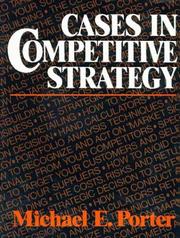
Teaching cases for applying the framework of Competitive Strategy.
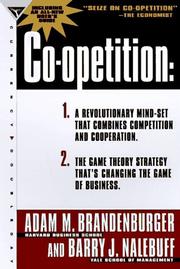
Game theory applied to business, which is cooperative and competitive at once.
“Adam M. Brandenburger and Barry J. Nalebuff, Co-opetition (New York: Currency Doubleday, 1996)” — Michael Mauboussin
Source: The Ecosystem Edge, page 10
Recommended by: Michael Mauboussin, Mohnish Pabrai
Where it sits in the reference 4
Topics 1
As an Amazon Associate I earn from qualifying purchases.