Updates

  1. Person pages list letters, writing, profiles and links as sortable tables with filters, and show each person's companies as links; Fund letters show each letter's description in its own column.
  2. Experts show a checked job title and a short description of each person; 30 more people have photographs.
  3. Every company, fund, university and publication the experts work for has a page listing the people there.
  4. Fund letters show each letter's thesis and filter by it; 225 person pages list the essays, columns and newsletter issues the person wrote.
  5. Person pages list every essay and newsletter issue a person wrote, and their own books as a table in List view.
  6. Recommends shows the five largest kinds of book and the rest under More; browse pictures load sooner.
  7. Podcasts and talks link the original episode, filter by Audio and video or Press, and list each publisher once.
  8. Pages are wider, Recommends has List and Grid, and a filter clicked again turns off.
  9. Book cards sit in a ruled grid with Open Library and Goodreads links and each book's one-line note.
  10. Funds is now Investors; each investor's styles are buttons that filter the table.
  11. Podcasts and talks on a person's page filter by year and publisher and show as a list or a grid of pictures.
  12. Quotes show only people's own words: 472 summaries written by list sites are gone.
  13. Country pages open from Browse again, and every link on the shelf lands on a page.
  14. Subject and person pages show their sections as tabs, and each book appears once on a person's page.
  15. Book cards show the quote, who said it and the source; grids show five cards to a row.
  16. On a phone, a menu holds the sections, search, Updates, Feedback and dark mode.
  17. Feedback takes a screenshot of the page with no browser prompt, opens a screenshot full size when you click it, and clears itself once sent.
  18. Book cards are centred, search names the topic each book sits in, and any text cut short shows whole on hover.
  19. Search groups its results by kind: people, companies, geographies, subjects, topics, books, funds, fund letters and papers.
  20. The Books table lists who recommended each book by name, and the browser tab names the section you are in.
  21. Feedback can take a screenshot of the page, or one you paste or choose, and opens in the corner beside Updates.
  22. Each rail button reopens its section where you left it, and Browse, Table and People show on every book and subject page.
  23. Filters grey out choices that hold nothing instead of hiding them, and Books › People filters by authors or recommenders.
  24. Feedback takes a subject line and up to three screenshots.
  25. Biographies are grouped by the person they are about: 41 new pages, from Abraham Lincoln to Lee Kuan Yew.
  26. Sport splits into 23 sports, and Religion into one topic per faith.
  27. Book lists show as cards: the cover, one recommendation quote and every recommender by name.
  28. Seventeen subjects that had two or three pages under different names now have one page each.
  29. Every page lists its Experts as authors and recommenders, with a link to them on the Experts tab.
  30. Economics, Financial history, Financial panics and Accounting are subjects of their own, with one page per financial crisis.
  31. Book, person and subject pages open inside the app, so the tabs stay in view.
  32. 996 more book covers, and photographs or logos for 227 more people and companies.
  33. Books › Browse shows every subject as cards, and the rail holds Fund letters, Papers, Experts, Books and Funds.
  34. Every topic over 150 books splits into narrower topics, each with a page of its own.

Send feedback

What is it?
Screenshots, up to 3 (optional)
or paste one with Ctrl+V

We use your email only to reply to you.

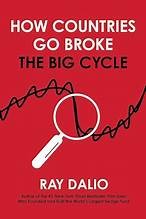
How Countries Go Broke: The Big Cycle

How Countries Go Broke: The Big Cycle

Ray Dalio
2025
T4 400 pages · about 6h 40m to read Open Librarygoodreads

Summary

Ray Dalio applies the debt-cycle framework he developed in earlier books specifically to sovereign borrowers. He describes a long cycle, running roughly fifty to a hundred years, in which a government's debt service grows faster than its income, private lenders stop absorbing new issuance at acceptable yields, and the central bank moves from setting short rates to buying government paper directly. Dalio treats the central bank and treasury balance sheets as a single consolidated position and argues that most conventional debt analysis misses the point by looking at them separately.

The book combines mechanical accounting with historical cases. Dalio walks through the arithmetic of debt-to-income ratios, interest costs and the share of new issuance that must be absorbed, and applies it to the United States, where he argues that deficits near seven per cent of GDP are unsustainable and proposes cutting the deficit to about three per cent through a mix of spending cuts, tax rises and interest-cost reduction. He also sets the financial cycle alongside internal political conflict, great-power rivalry, natural disruption and technology, the five forces from his earlier work.

The framework is easier to state than to use. Dalio's timing indicators are qualitative, and his critics point out that similar warnings about United States debt have been issued repeatedly since the 1980s without the predicted outcome. He is also describing conditions he trades on, which is worth noting though not disqualifying. The mechanical sections on how central bank purchases translate into currency depreciation and real bondholder losses are the most useful part for a working investor.

Key takeaways 7

  1. Sovereign debt crises resolve through currency depreciation and financial repression far more often than through explicit default.
  2. Analysts should consolidate central bank and treasury balance sheets, because the central bank is a subsidiary of the government for solvency purposes.
  3. The warning sign is not the debt level but the point at which debt service grows faster than income and free-market buyers withdraw.
  4. The United States needs to reduce its deficit to roughly three per cent of GDP, and delay makes the required adjustment larger.
  5. Holders of long-dated government bonds bear the cost of the adjustment through negative real returns.
  6. Reserve-currency status delays the reckoning and thereby permits a larger debt build-up before it arrives.
  7. Financial cycles interact with domestic political conflict, so debt problems typically surface alongside institutional stress rather than in isolation.

Who should read it

Investors setting long-horizon allocations across government bonds, gold and foreign currencies who want an explicit mechanical account of how sovereign debt burdens get resolved.

About Ray Dalio

Founder and former co-CIO, Bridgewater Associates 1975-2022

Principles and the debt-cycle template are primary sources that a large secondary literature now builds on.

Bridgewater Associates

Similar books 6

Chosen by shared topics, the entries that hold them, and the people who recommended both.
Ray Dalio · 2018

Free PDF at economicprinciples.org; first issued as A Template for Understanding Big Debt Crises.

Recommended by: Ray Dalio

Murray N. Rothbard · 1963

The Austrian account of 1929 and the policy response that followed

Ray Dalio · 2018

A template for how big debt crises unfold, with detailed case studies.
Lars Tvede · 1997

The history of business cycle theory and how credit cycles drive asset prices.
Adam Tooze · 2018

The 2008 crash, the eurozone crisis and the politics after as one connected story.

Where it sits in the reference 2

Investors
Economics

Topics

EconomicsFinancial History