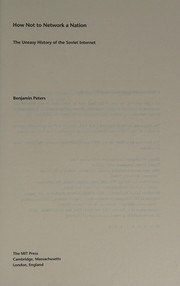
How Not to Network a Nation: The Uneasy History of the Soviet Internet (Information Policy)
Why the Soviet Union's attempts to build a national computer network failed.
Summary
Benjamin Peters examines the mid-twentieth-century rise of cybernetics, the science of self-governing systems, and the emergence of economic cybernetics in the Soviet Union, and chronicles the various Soviet attempts to build a "unified information network". Drawing on previously unknown archival material, he concentrates on the last and most ambitious of these projects, the All-State Automated System of Management, OGAS, and its main promoter, Viktor M. Glushkov.
Peters describes the rise and fall of OGAS: its theoretical and practical reach, its vision of a national economy managed by computer network, the bureaucratic obstacles it met and the institutional stalemate that killed it. He complicates the irony he identifies, that the capitalist United States built a collaborative network while the socialist Soviet Union could not, and he closes by considering what the Soviet experience means for today's networked world.
Key takeaways 4
- Soviet planners hoped cybernetics and computer networks could run the national economy.
- OGAS, led by Viktor Glushkov, was the most ambitious of these projects.
- Bureaucratic rivalry and institutional stalemate, not technology, killed it.
- The Soviet failure offers lessons for networks today.
Who should read it
Readers interested in the history of computing, the internet and the Soviet economy.
Who recommended it 1 · 1 direct
Similar books 6
Chosen by shared topics, the entries that hold them, and the people who recommended both.
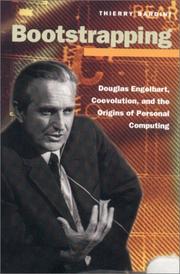
Douglas Engelbart and the origins of personal computing and its interfaces.
Recommended by: Patrick Collison

How the Bell Labs team of Shockley, Bardeen and Brattain invented the transistor.
Recommended by: Patrick Collison

The mathematicians whose logic led to the computer.
Recommended by: Patrick Collison

How computers went from tools of the Cold War to symbols of the counterculture.
Recommended by: Patrick Collison

San Francisco's counterculture and its links to Silicon Valley.
Recommended by: Patrick Collison
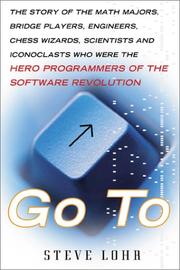
The history of software and the programmers who wrote it.
Recommended by: Patrick Collison, Keith Rabois