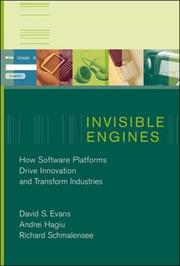
Invisible Engines
Software platforms as two-sided markets, and how they price and grow.
Software platforms as the multi-sided engines under other industries.
Summary
David Evans, Andrei Hagiu and Richard Schmalensee analyse software platforms as two-sided markets, applying the economics that Rochet and Tirole had recently formalised. A platform serves two or more distinct groups whose value to each other depends on both being present, and the pricing problem is therefore different from that of an ordinary product: the platform must decide which side to subsidise.
The cases run across the history of computing and adjacent industries. The authors cover mainframe and personal computer operating systems, video game consoles, payment cards, personal digital assistants and mobile phones, digital media players and the software behind them. In each they trace the pricing structure and its consequences. Video game consoles are sold below cost and the money is made on developer royalties. Adobe gave away the reader and charged for the authoring tool. Microsoft's Windows charged the hardware maker rather than the developer, which produced a large third-party software base.
The analytical claims are that platforms compete on the total price level across both sides rather than on either price separately, that the side with more elastic demand and greater cross-side externality should be subsidised, and that platform markets tend toward concentration without necessarily tending toward monopoly, because multi-homing and differentiation persist. The book predates the app store model, the mobile duopoly and the current antitrust arguments, so its policy chapter reads as a period document. The framework it supplies remains the standard one, and the historical cases are unusually well researched.
Key takeaways 7
- A platform must choose which side of its market to subsidise, and getting that choice wrong is the most common reason platforms fail.
- The side with more elastic demand and larger cross-side effects should receive the lower price, regardless of which side appears to be the customer.
- Platform competition takes place on the total price level across both sides, so comparing one side's prices across platforms tells you little.
- Software platforms bundle features that were previously separate products, and this absorption of adjacent functions is the normal way they evolve.
- Multi-homing by developers or users limits the tendency of platform markets toward a single winner.
- Vertical integration into applications by the platform owner is usually a response to insufficient third-party supply rather than an attempt to foreclose.
- Free distribution of a complement, such as a document reader, can be the profit-maximising price rather than a promotional tactic.
Who should read it
Founders and investors in platform businesses who want the underlying two-sided market economics with historical cases showing how pricing structure determined outcomes.
Similar books 6
Chosen by shared topics, the entries that hold them, and the people who recommended both.
Economics for information goods: pricing, versioning, lock-in and network effects.
“Carl Shapiro and Hal R. Varian, Information Rules (Boston, MA: Harvard Business School Press, 1999), 174” — Michael Mauboussin
Source: The Ecosystem Edge, page 10
Recommended by: Michael Mauboussin, Mohnish Pabrai and 1 other
How platforms create value by matching groups, unlike linear pipeline businesses.
Recommended by: Reid Hoffman

How multi-sided platforms such as card networks get both sides on board at once.
“David S. Evans and Richard Schmalensee, Matchmakers: The New Economics of Multisided Platforms (Boston, MA: Harvard Business Review Press, 2016)” — Michael Mauboussin
Source: Measuring the Moat: Assessing the Magnitude and Sustainability of Value Creation
Recommended by: Michael Mauboussin
Essays by consultants and executives on restructuring businesses for the internet.
Recommended by: Mohnish Pabrai

Digital costs near zero mean goods can be given away, which changes whole industries.
“During the month I read Chris Anderson’s excellent 2009 book “Free” and found in it a lot of sense about the way the business world is today and where it’s going – certainly more sense than I get from watching a Bloomberg scr” — Nick Train
Source: April 2016 Monthly Manager Report, page 2
Recommended by: Nick Train

How 1980s changes turned the US patent system from aid to obstacle for innovation.