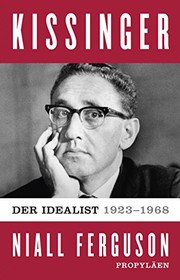
Kissinger: 1923-1968: The Idealist
The first volume of Henry Kissinger's life, before he joined Nixon's White House.
Summary
Ferguson argues that the picture of Henry Kissinger as a ruthless arch-realist rests on a profound misunderstanding. In this first of two volumes he covers Kissinger's life before he became Richard Nixon's national security adviser, a period usually skimmed as a story of the Jewish refugee from Hitler's Germany who made it to the White House, and shows that what Kissinger achieved in those years was remarkable in its own right.
Ferguson draws on Kissinger's private papers, previously closed, and on documents from more than a hundred archives around the world. He presents the book as the story of one of America's most important strategic thinkers and as a political coming-of-age story explaining how Kissinger ended up as adviser to a politician he had long disliked. It was published in 2015.
Key takeaways 4
- Ferguson argues that the young Kissinger was an idealist, not the realist of his reputation.
- Kissinger's work before 1969 was significant on its own terms.
- Private papers and over a hundred archives give a fuller record of his early life.
- Kissinger came to serve Nixon, a politician he had long opposed.
Who should read it
Readers of Cold War history who want a revisionist, archive-based account of Kissinger's early life and thought.
About Niall Ferguson
Historian and senior fellow at the Hoover Institution, Stanford; previously taught at Oxford, Harvard and NYU Stern.
The Ascent of Money traces credit, bond markets, joint-stock equity, insurance and property finance from their origins, giving investors the institutional history behind instruments they price every day. The House of Rothschild and High Financier examine how two banking houses actually made money and managed sovereign and political risk over long periods.
Who recommended it 1 · 1 direct
Similar books 6
Chosen by shared topics, the entries that hold them, and the people who recommended both.
Kissinger's life and years in power, where realism, secrecy and strategy met.
Recommended by: Andrew Wilkinson, Scott Belsky
Sergio Vieira de Mello, the UN diplomat, and his work in the world's conflicts.
Recommended by: Patrick Collison
A British diplomat's memoir of thirty years of embassy life.
Recommended by: Paul Graham
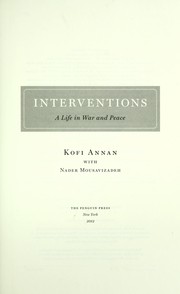
A UN leader's account of forty years of war and peace, from Rwanda to Iraq.
Recommended by: Bill Gates
Singapore's founding leader's strategic judgements, edited into a short reference.
“If you're not familiar with Lee Kuan Yew, he's the "Father of Modern Singapore," the man who took a small, poor island just north of the equator in Southeast Asia with GDP per capita of ~$500 in 1965 and turned it into a modern powerhouse with GDP per capita of over $70,000 as of 2014, with some of the lowest rates of corruption and highest rates of economic freedom in the world.” — Shane Parrish
Source: Shane Parrish: The Sixteen Best Books I read in 2016
Recommended by: Shane Parrish
Lee Kuan Yew's views on China, the United States and world strategy, by topic.
Recommended by: Mohnish Pabrai, Shane Parrish