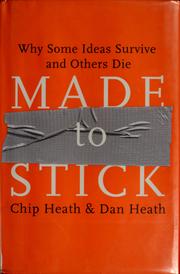
Made to Stick
Six traits of memorable ideas, from simple and unexpected to emotional stories.
Why some ideas are remembered and repeated; six sticky attributes
Summary
The Heath brothers analyse why some ideas are remembered and acted on while better ideas are forgotten, and identify six properties under the acronym SUCCESs: simple, unexpected, concrete, credible, emotional, and stories. They argue that the main obstacle is the curse of knowledge, meaning that once a person knows something they cannot reconstruct what it is like not to know it, which makes experts systematically bad at explaining their own subjects.
Each principle is developed with cases. Simple means finding the core and expressing it compactly, illustrated by Southwest Airlines' commitment to being the low-fare airline as a decision rule. Unexpected means breaking a pattern to create a knowledge gap that the audience wants closed. Concrete means using specific sensory detail rather than abstraction, which they demonstrate with the difference between statements about nutrition and the claim that a large popcorn contains more saturated fat than several meals combined. Credible uses details, statistics reframed at human scale, and testable claims, such as Reagan's question about whether voters were better off than four years earlier.
The research draws on urban legend studies, on Chip Heath's academic work on idea transmission, and on a wide set of business and public health examples. The Sinatra test and the Velcro theory of memory are their two additional devices.
The book is prescriptive rather than empirical, and the framework was reverse-engineered from memorable examples rather than tested. The curse of knowledge is the best-supported element. The acronym is contrived and the six elements overlap. It works as a practical editing checklist for anyone writing pitches, memos or product messaging.
Key takeaways 8
- Experts cannot explain their own subjects well because knowing something removes the ability to imagine not knowing it.
- An idea must be stripped to a single core proposition, and stripping requires deciding what to leave out rather than compressing everything.
- Concrete sensory detail is remembered and abstraction is not, so a claim should be expressed in things a person can picture.
- Breaking an expected pattern creates a gap in the audience's knowledge that they will stay engaged to close.
- Statistics persuade only when rescaled to human terms, and the number itself carries almost no weight.
- People give to identified individuals and not to statistical populations, which is why abstraction reduces the emotional response.
- A story functions as a simulation that prepares a listener to act, which is why stories transmit procedural knowledge better than instructions do.
- Credibility can come from a detail a listener can test themselves rather than from the authority of the speaker.
Who should read it
Founders and marketers writing pitches, positioning and internal communication who want a concrete checklist for why their message is not landing.
Who recommended it 13 · 5 direct
“…books I've recommended, highlighted to death, or forced on friends.”
“Actually analyzing what makes certain ideas or stories more memorable than others! Fascinating. Apply this wisdom to your songs, bio/story, communication with fans, etc.”
Similar books 6
Chosen by shared topics, the entries that hold them, and the people who recommended both.
How to use seven elements of stories to make a business's message clear to customers.
Recommended by: Nat Eliason, Ran Segall

Six principles that make products and ideas spread by word of mouth.
Recommended by: Nat Eliason, Tony Hsieh, Changpeng Zhao and 1 other
Marketing happens in the buyer's mind: find an open position there and own it.
“This and Influence: The Psychology of Persuasion are the best books on Marketing.” — David Cancel
Source: The Books Every Startup CEO Should Read — David Cancel, Medium
Recommended by: David Cancel, Patrick Collison, Aaron Levie and 4 others
Why tech products stall between early adopters and the mainstream, and how to cross.
“I figured there was probably a formula in some of the best business books out there, and so I re-read Lean Startup, Crossing the Chasm, Innovator's Dilemma, and many others.” — Andrew Chen
Source: How to write a business book — behind the scenes from THE COLD START PROBLEM
Recommended by: Andrew Chen, Andrew Wilkinson, Bill Gurley and 14 others
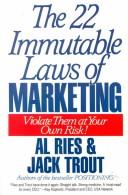
Twenty-two rules of marketing, such as being first is better than being better.
“Then, within The 22 Immutable Laws of Marketing, there's one chapter called "The Law of Category," and it gives old examples, so don't get the for-the-internet, because it was written in like '97 or something, get the old version.” — Tim Ferriss
Recommended by: Brian Armstrong, Mohnish Pabrai, Nat Eliason and 3 others

How to win and keep agency clients and write advertising that sells.
Recommended by: Mohnish Pabrai, David Cancel, Sam Parr