Updates

  1. Person pages list letters, writing, profiles and links as sortable tables with filters, and show each person's companies as links; Fund letters show each letter's description in its own column.
  2. Experts show a checked job title and a short description of each person; 30 more people have photographs.
  3. Every company, fund, university and publication the experts work for has a page listing the people there.
  4. Fund letters show each letter's thesis and filter by it; 225 person pages list the essays, columns and newsletter issues the person wrote.
  5. Person pages list every essay and newsletter issue a person wrote, and their own books as a table in List view.
  6. Recommends shows the five largest kinds of book and the rest under More; browse pictures load sooner.
  7. Podcasts and talks link the original episode, filter by Audio and video or Press, and list each publisher once.
  8. Pages are wider, Recommends has List and Grid, and a filter clicked again turns off.
  9. Book cards sit in a ruled grid with Open Library and Goodreads links and each book's one-line note.
  10. Funds is now Investors; each investor's styles are buttons that filter the table.
  11. Podcasts and talks on a person's page filter by year and publisher and show as a list or a grid of pictures.
  12. Quotes show only people's own words: 472 summaries written by list sites are gone.
  13. Country pages open from Browse again, and every link on the shelf lands on a page.
  14. Subject and person pages show their sections as tabs, and each book appears once on a person's page.
  15. Book cards show the quote, who said it and the source; grids show five cards to a row.
  16. On a phone, a menu holds the sections, search, Updates, Feedback and dark mode.
  17. Feedback takes a screenshot of the page with no browser prompt, opens a screenshot full size when you click it, and clears itself once sent.
  18. Book cards are centred, search names the topic each book sits in, and any text cut short shows whole on hover.
  19. Search groups its results by kind: people, companies, geographies, subjects, topics, books, funds, fund letters and papers.
  20. The Books table lists who recommended each book by name, and the browser tab names the section you are in.
  21. Feedback can take a screenshot of the page, or one you paste or choose, and opens in the corner beside Updates.
  22. Each rail button reopens its section where you left it, and Browse, Table and People show on every book and subject page.
  23. Filters grey out choices that hold nothing instead of hiding them, and Books › People filters by authors or recommenders.
  24. Feedback takes a subject line and up to three screenshots.
  25. Biographies are grouped by the person they are about: 41 new pages, from Abraham Lincoln to Lee Kuan Yew.
  26. Sport splits into 23 sports, and Religion into one topic per faith.
  27. Book lists show as cards: the cover, one recommendation quote and every recommender by name.
  28. Seventeen subjects that had two or three pages under different names now have one page each.
  29. Every page lists its Experts as authors and recommenders, with a link to them on the Experts tab.
  30. Economics, Financial history, Financial panics and Accounting are subjects of their own, with one page per financial crisis.
  31. Book, person and subject pages open inside the app, so the tabs stay in view.
  32. 996 more book covers, and photographs or logos for 227 more people and companies.
  33. Books › Browse shows every subject as cards, and the rail holds Fund letters, Papers, Experts, Books and Funds.
  34. Every topic over 150 books splits into narrower topics, each with a page of its own.

Send feedback

What is it?
Screenshots, up to 3 (optional)
or paste one with Ctrl+V

We use your email only to reply to you.

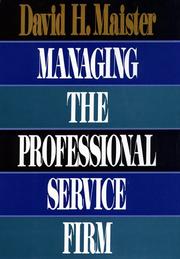
Managing the Professional Service Firm

Managing the Professional Service Firm

David H. Maister
1993
T1 372 pages · about 6h 12m to read Open Librarygoodreads

Leverage, utilisation and the partnership arithmetic. Still the core text.

Summary

Maister wrote the standard text on running firms whose product is expertise, covering consultancies, law firms, accounting practices, agencies and similar businesses. It is organised as essays on the specific management problems these firms face.

His central analytical device is that professional firm economics are determined by leverage, meaning the ratio of junior to senior staff, and that the appropriate leverage is determined by the mix of work. He divides engagements into three types: brains work, which requires new solutions and can carry little leverage; grey hair work, which applies previous experience and carries moderate leverage; and procedure work, which is well understood and can carry high leverage. A firm must match its staffing pyramid to its work mix, and the most common failure is a pyramid built for one type of work while selling another.

The financial material shows that profit per partner decomposes into margin, productivity and leverage, and that improving leverage is usually the largest available lever and the one firms neglect.

The other themes are client relationships, where he argues that existing clients are the cheapest source of new work and are systematically under-served; practice development, where he argues marketing to strangers is the least efficient use of partner time; and people management, where he argues the firm's asset walks out every evening and the retention of good people is the binding constraint on growth.

The book is dated in its examples and predates the current structure of several of the industries it covers. Its economics remain correct and it is still the standard reference.

Key takeaways 7

  1. Professional firm profitability is determined by leverage, meaning the ratio of junior to senior staff, more than by billing rates.
  2. Work divides into brains, grey hair and procedure categories, each supporting a different leverage ratio, and a firm must match its pyramid to its work mix.
  3. The most common structural failure is a staffing pyramid built for one type of work while the firm sells another.
  4. Profit per partner decomposes into margin, productivity and leverage, and leverage is usually the largest available improvement and the least examined.
  5. Existing clients are the cheapest source of new work and are systematically under-served because partner time goes to pursuing strangers.
  6. The firm's assets leave the building every evening, which makes retention of capable people the binding constraint on growth.
  7. A professional firm cannot simultaneously be excellent at brains work and efficient at procedure work, because the two require incompatible economics and cultures.

Who should read it

Anyone running or building a firm that sells expertise, who needs the economics of leverage, work mix and client development.

Similar books 6

Chosen by shared topics, the entries that hold them, and the people who recommended both.
Alan Weiss · 1992

Value pricing for solo and boutique consultancies.

Recommended by: Nat Eliason, Noah Kagan
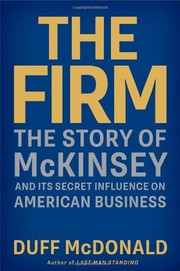
Duff McDonald · 2013

How the modern consulting partnership was invented and priced.

Recommended by: Andrew Chen

Walter Kiechel · 2010

How BCG, Bain and McKinsey created the market for strategy itself.
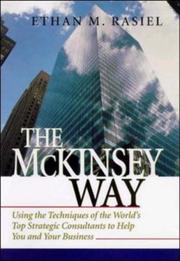
Ethan M. Rasiel · 1999

The delivery method behind the fee.

David H. Maister, Charles H. Green, Robert M. Galford · 2000

The trust equation: credibility, reliability and intimacy over self-orientation.

Recommended by: Nat Eliason
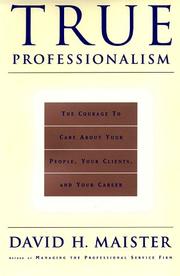
David H. Maister · 1997

Essays on what makes professional work truly professional, beyond competence.

Where it sits in the reference 5

Business models
Business models
Business themes
Industries
Business themes

Topics

Business and Management