Updates

  1. Person pages list letters, writing, profiles and links as sortable tables with filters, and show each person's companies as links; Fund letters show each letter's description in its own column.
  2. Experts show a checked job title and a short description of each person; 30 more people have photographs.
  3. Every company, fund, university and publication the experts work for has a page listing the people there.
  4. Fund letters show each letter's thesis and filter by it; 225 person pages list the essays, columns and newsletter issues the person wrote.
  5. Person pages list every essay and newsletter issue a person wrote, and their own books as a table in List view.
  6. Recommends shows the five largest kinds of book and the rest under More; browse pictures load sooner.
  7. Podcasts and talks link the original episode, filter by Audio and video or Press, and list each publisher once.
  8. Pages are wider, Recommends has List and Grid, and a filter clicked again turns off.
  9. Book cards sit in a ruled grid with Open Library and Goodreads links and each book's one-line note.
  10. Funds is now Investors; each investor's styles are buttons that filter the table.
  11. Podcasts and talks on a person's page filter by year and publisher and show as a list or a grid of pictures.
  12. Quotes show only people's own words: 472 summaries written by list sites are gone.
  13. Country pages open from Browse again, and every link on the shelf lands on a page.
  14. Subject and person pages show their sections as tabs, and each book appears once on a person's page.
  15. Book cards show the quote, who said it and the source; grids show five cards to a row.
  16. On a phone, a menu holds the sections, search, Updates, Feedback and dark mode.
  17. Feedback takes a screenshot of the page with no browser prompt, opens a screenshot full size when you click it, and clears itself once sent.
  18. Book cards are centred, search names the topic each book sits in, and any text cut short shows whole on hover.
  19. Search groups its results by kind: people, companies, geographies, subjects, topics, books, funds, fund letters and papers.
  20. The Books table lists who recommended each book by name, and the browser tab names the section you are in.
  21. Feedback can take a screenshot of the page, or one you paste or choose, and opens in the corner beside Updates.
  22. Each rail button reopens its section where you left it, and Browse, Table and People show on every book and subject page.
  23. Filters grey out choices that hold nothing instead of hiding them, and Books › People filters by authors or recommenders.
  24. Feedback takes a subject line and up to three screenshots.
  25. Biographies are grouped by the person they are about: 41 new pages, from Abraham Lincoln to Lee Kuan Yew.
  26. Sport splits into 23 sports, and Religion into one topic per faith.
  27. Book lists show as cards: the cover, one recommendation quote and every recommender by name.
  28. Seventeen subjects that had two or three pages under different names now have one page each.
  29. Every page lists its Experts as authors and recommenders, with a link to them on the Experts tab.
  30. Economics, Financial history, Financial panics and Accounting are subjects of their own, with one page per financial crisis.
  31. Book, person and subject pages open inside the app, so the tabs stay in view.
  32. 996 more book covers, and photographs or logos for 227 more people and companies.
  33. Books › Browse shows every subject as cards, and the rail holds Fund letters, Papers, Experts, Books and Funds.
  34. Every topic over 150 books splits into narrower topics, each with a page of its own.

Send feedback

What is it?
Screenshots, up to 3 (optional)
or paste one with Ctrl+V

We use your email only to reply to you.

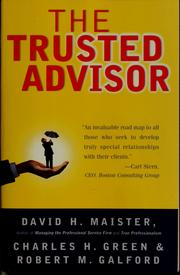
The Trusted Advisor

The Trusted Advisor

David H. Maister, Charles H. Green, Robert M. Galford
2000
T2 240 pages · about 4h to read Open Librarygoodreads

How relationship capital converts into billable work.

Summary

Maister, Green and Galford analyse what makes a professional trusted by a client, and set out how to build that position deliberately. Their central device is the trust equation: trust equals credibility plus reliability plus intimacy, all divided by self-orientation.

Each term is defined operationally. Credibility concerns words and expertise, and is the easiest to demonstrate and the least differentiating. Reliability concerns actions and predictability, built through repeated small commitments met. Intimacy concerns emotional safety, meaning whether the client can say something difficult to you, and the authors argue it is the term most professionals neglect and the one that moves trust fastest. Self-orientation, the denominator, concerns whether the professional's attention is on themselves, and it is the term that does the most damage, since any perceived focus on your own revenue, reputation or need to appear clever divides everything above it.

The practical material covers the stages of trust building, being engage, listen, frame, envision and commit, with the observation that professionals routinely skip listening and framing to arrive at a recommendation. They also cover the specific moves that build trust quickly, including naming the difficult issue, admitting uncertainty, and giving advice against your own commercial interest.

The book has no empirical base and rests on the authors' consulting experience. It is written for professional services and much of it presumes an advisory relationship. Its formulation of self-orientation as the denominator is the idea that transfers most widely, and it is genuinely useful to anyone selling judgement.

Key takeaways 7

  1. Trust equals credibility, reliability and intimacy divided by self-orientation, and the denominator does more damage than any of the numerator terms contribute.
  2. Any perceived focus on your own revenue, reputation or need to appear clever reduces trust regardless of how competent you are.
  3. Intimacy, meaning whether the client can raise something difficult with you, is the term professionals neglect and the one that moves trust fastest.
  4. Credibility is the easiest term to demonstrate and the least differentiating, since every competing adviser can demonstrate it.
  5. Professionals skip listening and framing to arrive at a recommendation, which is the most common failure in advisory relationships.
  6. Giving advice against your own commercial interest is the single most effective demonstration that your attention is on the client.
  7. Naming the difficult issue that everyone is avoiding builds more trust than any amount of well-executed analysis.

Who should read it

Anyone who sells judgement rather than product, including advisers, consultants, founders selling to enterprises and investors dealing with management teams.

Who recommended it 1 · 1 direct

Similar books 6

Chosen by shared topics, the entries that hold them, and the people who recommended both.
David H. Maister · 1993

How firms that sell expertise set their ratio of juniors to partners, and price.
Don Peppers, Martha Rogers · 1996

Recommended by: Mohnish Pabrai

Mark Sanborn · 2013

Recommended by: Tony Hsieh

Mark Sanborn · 2002

Recommended by: Tony Hsieh

Where it sits in the reference 4

Business models
Business themes
Industries
Business themes

Topics

Business and ManagementSales and MarketingSelling and customer service