Updates

  1. Person pages list letters, writing, profiles and links as sortable tables with filters, and show each person's companies as links; Fund letters show each letter's description in its own column.
  2. Experts show a checked job title and a short description of each person; 30 more people have photographs.
  3. Every company, fund, university and publication the experts work for has a page listing the people there.
  4. Fund letters show each letter's thesis and filter by it; 225 person pages list the essays, columns and newsletter issues the person wrote.
  5. Person pages list every essay and newsletter issue a person wrote, and their own books as a table in List view.
  6. Recommends shows the five largest kinds of book and the rest under More; browse pictures load sooner.
  7. Podcasts and talks link the original episode, filter by Audio and video or Press, and list each publisher once.
  8. Pages are wider, Recommends has List and Grid, and a filter clicked again turns off.
  9. Book cards sit in a ruled grid with Open Library and Goodreads links and each book's one-line note.
  10. Funds is now Investors; each investor's styles are buttons that filter the table.
  11. Podcasts and talks on a person's page filter by year and publisher and show as a list or a grid of pictures.
  12. Quotes show only people's own words: 472 summaries written by list sites are gone.
  13. Country pages open from Browse again, and every link on the shelf lands on a page.
  14. Subject and person pages show their sections as tabs, and each book appears once on a person's page.
  15. Book cards show the quote, who said it and the source; grids show five cards to a row.
  16. On a phone, a menu holds the sections, search, Updates, Feedback and dark mode.
  17. Feedback takes a screenshot of the page with no browser prompt, opens a screenshot full size when you click it, and clears itself once sent.
  18. Book cards are centred, search names the topic each book sits in, and any text cut short shows whole on hover.
  19. Search groups its results by kind: people, companies, geographies, subjects, topics, books, funds, fund letters and papers.
  20. The Books table lists who recommended each book by name, and the browser tab names the section you are in.
  21. Feedback can take a screenshot of the page, or one you paste or choose, and opens in the corner beside Updates.
  22. Each rail button reopens its section where you left it, and Browse, Table and People show on every book and subject page.
  23. Filters grey out choices that hold nothing instead of hiding them, and Books › People filters by authors or recommenders.
  24. Feedback takes a subject line and up to three screenshots.
  25. Biographies are grouped by the person they are about: 41 new pages, from Abraham Lincoln to Lee Kuan Yew.
  26. Sport splits into 23 sports, and Religion into one topic per faith.
  27. Book lists show as cards: the cover, one recommendation quote and every recommender by name.
  28. Seventeen subjects that had two or three pages under different names now have one page each.
  29. Every page lists its Experts as authors and recommenders, with a link to them on the Experts tab.
  30. Economics, Financial history, Financial panics and Accounting are subjects of their own, with one page per financial crisis.
  31. Book, person and subject pages open inside the app, so the tabs stay in view.
  32. 996 more book covers, and photographs or logos for 227 more people and companies.
  33. Books › Browse shows every subject as cards, and the rail holds Fund letters, Papers, Experts, Books and Funds.
  34. Every topic over 150 books splits into narrower topics, each with a page of its own.

Send feedback

What is it?
Screenshots, up to 3 (optional)
or paste one with Ctrl+V

We use your email only to reply to you.

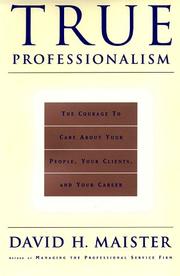
True Professionalism

True Professionalism

David H. Maister
1997
T2 217 pages · about 3h 37m to read Open Librarygoodreads

The follow-on: what sustains a firm whose assets go home at night.

Summary

David Maister consulted to professional service firms for decades and wrote this collection of essays on what distinguishes genuinely professional practice from competent commercial delivery.

His central distinction is between a professional and a technician: both may be equally skilled, but the professional cares about the client's outcome and the technician performs the work. Maister argues that this difference is visible to clients, determines whether relationships endure, and cannot be produced by incentive systems, since it depends on what the individual actually wants.

The essays cover several levels. On the individual, he addresses career management, the choice of what work to pursue, the discipline of specialising, and what he calls the trusted adviser relationship, in which the client brings problems before they are defined rather than after. On client relationships, he covers the difference between doing the work and managing the relationship, the economics of client retention against acquisition, and the practice of investing unbilled time in clients. On firm management, he covers partner compensation and what different systems produce, the tension between short-term profitability and long-term capability, the management of underperformers, and the argument that most firms say they value quality while measuring and paying for utilisation. The book is essays rather than a system and is repetitive. It is the standard reference in professional services and its arguments about compensation and about what firms actually measure are the most useful.

Key takeaways 7

  1. A professional cares about the client's outcome while a technician performs the work, and clients can tell the difference.
  2. Firms state that they value quality and long-term relationships while measuring and paying for billable utilisation.
  3. Partner compensation systems determine behaviour more than any stated strategy or value statement does.
  4. The trusted adviser relationship is one in which clients bring problems before they are defined, and it is worth more than any project.
  5. Client retention economics dominate acquisition economics in professional services, which most firms manage backward.
  6. Investing unbilled time in a client relationship is the mechanism by which the adviser position is earned.
  7. Maister argues that caring about the outcome cannot be produced by incentives, because it depends on what the individual actually wants.

Who should read it

Partners and managers in professional service firms who want the standard treatment of what distinguishes advisory practice from technical delivery.

Similar books 6

Chosen by shared topics, the entries that hold them, and the people who recommended both.

David H. Maister · 1993

How firms that sell expertise set their ratio of juniors to partners, and price.

Jack Stack, Bo Burlingham · 2002

Building an ownership culture in which employees think and act like owners.

William Poundstone · 2012

Tech firms' puzzle interview questions, and whether they pick good hires.

Recommended by: Sophie Bakalar

Where it sits in the reference 3

Business models
Business themes
Business themes

Topics

Business and Management