Updates

  1. Person pages list letters, writing, profiles and links as sortable tables with filters, and show each person's companies as links; Fund letters show each letter's description in its own column.
  2. Experts show a checked job title and a short description of each person; 30 more people have photographs.
  3. Every company, fund, university and publication the experts work for has a page listing the people there.
  4. Fund letters show each letter's thesis and filter by it; 225 person pages list the essays, columns and newsletter issues the person wrote.
  5. Person pages list every essay and newsletter issue a person wrote, and their own books as a table in List view.
  6. Recommends shows the five largest kinds of book and the rest under More; browse pictures load sooner.
  7. Podcasts and talks link the original episode, filter by Audio and video or Press, and list each publisher once.
  8. Pages are wider, Recommends has List and Grid, and a filter clicked again turns off.
  9. Book cards sit in a ruled grid with Open Library and Goodreads links and each book's one-line note.
  10. Funds is now Investors; each investor's styles are buttons that filter the table.
  11. Podcasts and talks on a person's page filter by year and publisher and show as a list or a grid of pictures.
  12. Quotes show only people's own words: 472 summaries written by list sites are gone.
  13. Country pages open from Browse again, and every link on the shelf lands on a page.
  14. Subject and person pages show their sections as tabs, and each book appears once on a person's page.
  15. Book cards show the quote, who said it and the source; grids show five cards to a row.
  16. On a phone, a menu holds the sections, search, Updates, Feedback and dark mode.
  17. Feedback takes a screenshot of the page with no browser prompt, opens a screenshot full size when you click it, and clears itself once sent.
  18. Book cards are centred, search names the topic each book sits in, and any text cut short shows whole on hover.
  19. Search groups its results by kind: people, companies, geographies, subjects, topics, books, funds, fund letters and papers.
  20. The Books table lists who recommended each book by name, and the browser tab names the section you are in.
  21. Feedback can take a screenshot of the page, or one you paste or choose, and opens in the corner beside Updates.
  22. Each rail button reopens its section where you left it, and Browse, Table and People show on every book and subject page.
  23. Filters grey out choices that hold nothing instead of hiding them, and Books › People filters by authors or recommenders.
  24. Feedback takes a subject line and up to three screenshots.
  25. Biographies are grouped by the person they are about: 41 new pages, from Abraham Lincoln to Lee Kuan Yew.
  26. Sport splits into 23 sports, and Religion into one topic per faith.
  27. Book lists show as cards: the cover, one recommendation quote and every recommender by name.
  28. Seventeen subjects that had two or three pages under different names now have one page each.
  29. Every page lists its Experts as authors and recommenders, with a link to them on the Experts tab.
  30. Economics, Financial history, Financial panics and Accounting are subjects of their own, with one page per financial crisis.
  31. Book, person and subject pages open inside the app, so the tabs stay in view.
  32. 996 more book covers, and photographs or logos for 227 more people and companies.
  33. Books › Browse shows every subject as cards, and the rail holds Fund letters, Papers, Experts, Books and Funds.
  34. Every topic over 150 books splits into narrower topics, each with a page of its own.

Send feedback

What is it?
Screenshots, up to 3 (optional)
or paste one with Ctrl+V

We use your email only to reply to you.

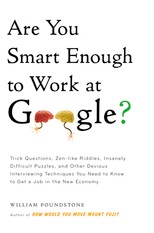
Are You Smart Enough to Work at Google?

Are You Smart Enough to Work at Google?

William Poundstone
2012
T2 300 pages · about 5h to read Open Librarygoodreads

Summary

Poundstone examines the hiring practices of technology companies, particularly the puzzle and brainteaser interview questions Google and others became known for, and assesses whether they work.

The evidence he presents is largely negative. Google's own internal research, which the company published, found that brainteaser interview performance had no correlation with subsequent job performance, and the company substantially abandoned the practice. Poundstone covers the wider literature on selection methods, which consistently finds that unstructured interviews predict performance poorly, that structured interviews with consistent questions and scoring do better, that work sample tests and general cognitive ability tests do better still, and that interviewer confidence in their own judgement is unrelated to its accuracy.

The book also contains a large collection of the actual questions and worked solutions, covering estimation problems, logic puzzles, algorithmic questions and the deliberately strange ones. Poundstone treats these as intellectually interesting independent of their validity as selection instruments.

His broader argument is that hiring practices spread by imitation of prestigious firms rather than by evidence, which is why a method Google abandoned continued to be used elsewhere for years afterward.

The book straddles two purposes and does neither completely. As a puzzle collection it is enjoyable, as an analysis of hiring it is a survey rather than original work, and the two halves interrupt each other. It is from 2012 and technology hiring has changed substantially since.

Key takeaways 7

  1. Google's own research found that brainteaser interview performance had no correlation with subsequent job performance, and the company abandoned the practice.
  2. Unstructured interviews predict job performance poorly, while structured interviews with consistent questions and scoring predict substantially better.
  3. Work sample tests and general cognitive ability measures predict performance better than any interview format.
  4. Interviewer confidence in their own judgement is unrelated to the accuracy of that judgement, which is why experienced interviewers do not outperform.
  5. Hiring practices spread by imitation of prestigious firms rather than by evidence, which is why abandoned methods persist elsewhere.
  6. Estimation questions test a real and useful skill, which is decomposing an unknown quantity into components that can be bounded.
  7. Selection methods should be validated against actual performance data, which almost no organisation does even when the data exists.

Who should read it

Operators designing hiring processes who want the evidence on interview validity, alongside a collection of the puzzles themselves.

About William Poundstone

American science and business writer covering game theory, probability, pricing psychology and decision-making.

Fortune's Formula traces the Kelly criterion from Bell Labs information theory to Ed Thorp's blackjack and hedge-fund bet sizing, and it remains the standard entry point to position sizing under an edge. Priceless collects the experimental work on how buyers anchor and compare prices, which transfers straight into pricing decisions.

Who recommended it 1

Similar books 6

Chosen by shared topics, the entries that hold them, and the people who recommended both.

Patrick Lencioni · 2002

A fable of a failing executive team and a five-level model of what goes wrong.

Jack Stack, Bo Burlingham · 2002

Building an ownership culture in which employees think and act like owners.

David Erdal · 2011

An owner who converted his own firm, on employee ownership in practice.

Where it sits in the reference 3

Journalists
Business themes
Business themes

Topics

Games and PuzzlesBusiness and Management