Updates

  1. Person pages list letters, writing, profiles and links as sortable tables with filters, and show each person's companies as links; Fund letters show each letter's description in its own column.
  2. Experts show a checked job title and a short description of each person; 30 more people have photographs.
  3. Every company, fund, university and publication the experts work for has a page listing the people there.
  4. Fund letters show each letter's thesis and filter by it; 225 person pages list the essays, columns and newsletter issues the person wrote.
  5. Person pages list every essay and newsletter issue a person wrote, and their own books as a table in List view.
  6. Recommends shows the five largest kinds of book and the rest under More; browse pictures load sooner.
  7. Podcasts and talks link the original episode, filter by Audio and video or Press, and list each publisher once.
  8. Pages are wider, Recommends has List and Grid, and a filter clicked again turns off.
  9. Book cards sit in a ruled grid with Open Library and Goodreads links and each book's one-line note.
  10. Funds is now Investors; each investor's styles are buttons that filter the table.
  11. Podcasts and talks on a person's page filter by year and publisher and show as a list or a grid of pictures.
  12. Quotes show only people's own words: 472 summaries written by list sites are gone.
  13. Country pages open from Browse again, and every link on the shelf lands on a page.
  14. Subject and person pages show their sections as tabs, and each book appears once on a person's page.
  15. Book cards show the quote, who said it and the source; grids show five cards to a row.
  16. On a phone, a menu holds the sections, search, Updates, Feedback and dark mode.
  17. Feedback takes a screenshot of the page with no browser prompt, opens a screenshot full size when you click it, and clears itself once sent.
  18. Book cards are centred, search names the topic each book sits in, and any text cut short shows whole on hover.
  19. Search groups its results by kind: people, companies, geographies, subjects, topics, books, funds, fund letters and papers.
  20. The Books table lists who recommended each book by name, and the browser tab names the section you are in.
  21. Feedback can take a screenshot of the page, or one you paste or choose, and opens in the corner beside Updates.
  22. Each rail button reopens its section where you left it, and Browse, Table and People show on every book and subject page.
  23. Filters grey out choices that hold nothing instead of hiding them, and Books › People filters by authors or recommenders.
  24. Feedback takes a subject line and up to three screenshots.
  25. Biographies are grouped by the person they are about: 41 new pages, from Abraham Lincoln to Lee Kuan Yew.
  26. Sport splits into 23 sports, and Religion into one topic per faith.
  27. Book lists show as cards: the cover, one recommendation quote and every recommender by name.
  28. Seventeen subjects that had two or three pages under different names now have one page each.
  29. Every page lists its Experts as authors and recommenders, with a link to them on the Experts tab.
  30. Economics, Financial history, Financial panics and Accounting are subjects of their own, with one page per financial crisis.
  31. Book, person and subject pages open inside the app, so the tabs stay in view.
  32. 996 more book covers, and photographs or logos for 227 more people and companies.
  33. Books › Browse shows every subject as cards, and the rail holds Fund letters, Papers, Experts, Books and Funds.
  34. Every topic over 150 books splits into narrower topics, each with a page of its own.

Send feedback

What is it?
Screenshots, up to 3 (optional)
or paste one with Ctrl+V

We use your email only to reply to you.

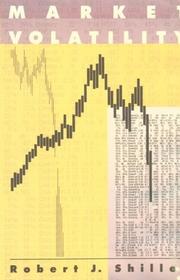
Market Volatility

Market Volatility

Robert J. Shiller
1989
T4 471 pages · about 7h 51m to read Open Librarygoodreads

Summary

Robert Shiller collected his research papers from the late 1970s and 1980s in this volume, along with connecting commentary. The central body of work is the variance bounds tests, which asked whether stock prices move more than the present value of subsequent dividends can justify.

The argument runs as follows. Under the efficient markets model, a stock price equals the expected present value of future dividends. Because a price is a forecast of that present value, and forecasts are less variable than what they forecast, price volatility should be bounded by the volatility of the realised discounted dividend stream. Shiller compared actual price series with the ex post rational price computed from realised dividends and found prices far more volatile than the bound allows. He drew the conclusion that something other than rational expectations about dividends drives prices, and proposed models in which fads, social dynamics and shifting popular opinion play a role.

The collection also contains work on bond market volatility, on real estate, on the term structure, and on survey evidence about investor expectations. The variance bounds tests were attacked heavily on econometric grounds, particularly for the treatment of non-stationarity in dividends and for the assumption of a constant discount rate; Marsh and Merton and others published rebuttals, and Shiller responds. The debate was never settled cleanly, and the modern position, associated with Cochrane, is that most price variation reflects changing discount rates rather than changing dividend expectations, which is consistent with Shiller's data and not with his interpretation. The papers remain the foundation of behavioural finance.

Key takeaways 7

  1. Stock prices move far more than the subsequent realised dividend stream can justify under a constant discount rate.
  2. Shiller argues that fashions and social dynamics in investor opinion contribute to price movements independently of fundamentals.
  3. Volatility tests provide a way to reject the efficient markets model that does not depend on identifying a profitable trading strategy.
  4. Survey evidence shows investor expectations extrapolate recent returns, which contradicts the rational expectations assumption directly.
  5. Bond and real estate markets show similar excess volatility relative to the fundamentals that should determine them.
  6. The debate over excess volatility turns on whether discount rates vary over time, and Shiller's tests assume they do not.
  7. Market prices can be informative about relative values while still being poor estimates of fundamental value in aggregate.

Who should read it

Investors and researchers who want the primary papers behind the excess volatility argument and the empirical origins of behavioural finance.

About Robert J. Shiller

Sterling Professor of Economics Emeritus, Yale University; co-creator of the Case-Shiller home price indices; Nobel laureate in economics 2013

Excess-volatility work and Irrational Exuberance are the primary sources for the empirical case that asset prices move far more than fundamentals justify.

Yale University

Similar books 6

Chosen by shared topics, the entries that hold them, and the people who recommended both.

Where it sits in the reference 2

Academics
Mental models

Topics

Finance and MarketsInvesting