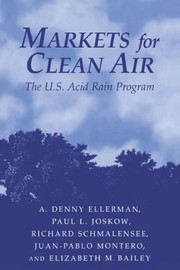
Markets for Clean Air
How the 1990 US sulphur dioxide allowance trading programme worked in practice.
The acid-rain programme: the one emissions market with a clean verdict.
Summary
Denny Ellerman, Paul Joskow, Richard Schmalensee, Juan-Pablo Montero and Elizabeth Bailey evaluate the sulphur dioxide allowance trading programme created by Title Four of the 1990 Clean Air Act Amendments. The programme capped emissions from American electricity generators and allowed them to trade allowances, and it was the first large-scale test of emissions trading.
The authors assemble plant-level data on emissions, fuel choices, scrubber installations and allowance transactions, and compare actual compliance costs with what command-and-control regulation would have cost. Their finding is that the programme cut emissions as required and did so at roughly half the cost of the prescriptive alternative, with most of the saving coming from the freedom to choose between switching to low-sulphur coal, installing scrubbers, or buying allowances. They also document that allowance prices came in far below the forecasts made when the programme was designed, and explain this through falling rail transport costs for Powder River Basin coal and through the general tendency of ex ante cost estimates to overstate.
The book is careful about what the result does and does not show. The authors note that the programme worked partly because emissions were measurable at the source through continuous monitoring, because the number of participants was manageable, and because a technological alternative existed. They are explicit that these conditions do not transfer automatically to other pollutants or to carbon dioxide. The programme was later substantially undone by court decisions and by subsequent regulation, which falls after the book.
Key takeaways 7
- Allowance trading achieved the required sulphur dioxide reductions at roughly half the cost of prescriptive regulation.
- Most of the cost saving came from letting each plant choose its compliance method rather than from trading between plants.
- Allowance prices came in far below the estimates made when the programme was designed, which is the normal pattern for regulatory cost forecasts.
- Continuous emissions monitoring at the source made the cap enforceable, and without it the market would not have functioned.
- Firms banked allowances heavily in the early years, which shows they expected future scarcity and were willing to overcomply early.
- Falling rail freight rates for low-sulphur western coal supplied an unanticipated compliance route that reduced costs further.
- The authors argue that the programme's success depended on conditions, including measurability and a small participant set, that do not transfer automatically to carbon.
Who should read it
Investors and policymakers assessing emissions trading who want the definitive evaluation of the programme all later schemes were modelled on.
Similar books 6
Chosen by shared topics, the entries that hold them, and the people who recommended both.
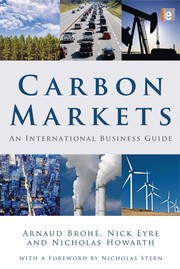
A guide to carbon markets: allowances, offsets, registries and schemes.

The economics of climate change, and why a universal carbon price works best.
How business lobbies made emissions trading the chosen climate policy.
Why climate policy failed to cut emissions as coal use kept rising.

Population and consumption face physical limits that economics ignores.
“In Living Within Limits, Hardin focuses on the neglected problem of overpopulation, making a forceful case for dramatically changing the way we live in and manage our world. Our world itself, he writes, is in the dilemma of the lifeboat: it can only hold a certain number of people before it sinks-not everyone can be saved.” — Shane Parrish
Source: What Books Would You Recommend Someone Read to Improve their General Knowledge of the World?
Recommended by: Charlie Munger, Mohnish Pabrai and 1 other
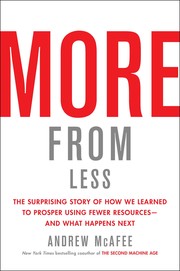
Evidence that rich economies now grow while using fewer physical resources.
“on how modern technological economies can build more outputs with less inputs” — Marc Andreessen
Source: @pmarca, companion thread to 'It's Time to Build'
Recommended by: Marc Andreessen