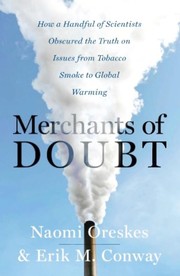
Merchants of Doubt
How a few scientists with ties to industry ran campaigns to deny settled science.
The tobacco playbook for manufacturing scientific uncertainty.
Summary
Oreskes and Conway, historians of science, tell how a loose group of senior scientists and scientific advisers, with close ties to politics and industry, ran campaigns over four decades to mislead the public and deny established science. The same people appear again and again: some of those who claimed the science of global warming was not settled had earlier denied the studies linking smoking to lung cancer, coal smoke to acid rain and CFCs to the hole in the ozone layer.
The authors set this group against the wider American scientific community, which produced landmark studies on the dangers of DDT, tobacco smoke, acid rain and global warming. They quote a tobacco executive who wrote that doubt is our product, and show how these experts supplied it. Oreskes and Conway argue that ideology and corporate interests, helped by a media too ready to present both sides, distorted public understanding of several of the most pressing issues of the era.
Key takeaways 4
- A small group of scientists manufactured doubt about well-established science for four decades.
- The same people opposed the science on tobacco, acid rain, the ozone layer and global warming.
- The tobacco industry treated doubt itself as its product.
- Media that present both sides of a settled question help spread that doubt.
Who should read it
Readers who want to recognise how industries manufacture scientific uncertainty, a pattern investors meet in regulated sectors.
Who recommended it 2 · 1 direct
Similar books 6
Chosen by shared topics, the entries that hold them, and the people who recommended both.
How valuable information is becoming private property and dangerous to acquire.
Recommended by: Sam Altman
A century of the American cigarette industry, from mass marketing to 1990s lawsuits.
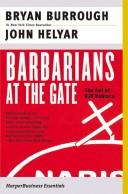
The 1988 bidding war for RJR Nabisco, the largest leveraged buyout to that date.
“Bryan Burroughs and John Helyar, Barbarians at the Gate: The Fall of RJR Nabisco (New York: Harper & Row, 1990), 133-138 and George Anders, Merchants o” — Michael Mauboussin
Source: Public to Private Equity in the United States: A Long-Term Look, page 62
Recommended by: Jim Collins, Michael Mauboussin and 2 others
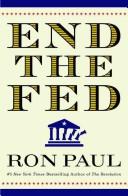
The case for challenging, and ending, the Federal Reserve.
Recommended by: Nat Eliason, Balaji S. Srinivasan
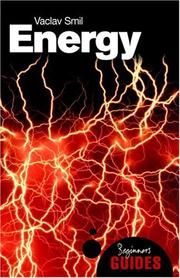
A short primer on energy: its forms, units and role in nature and economies.
Recommended by: Nat Eliason, Bill Gates, Mark Zuckerberg