
Updates

  1. Person pages list letters, writing, profiles and links as sortable tables with filters, and show each person's companies as links; Fund letters show each letter's description in its own column.
  2. Experts show a checked job title and a short description of each person; 30 more people have photographs.
  3. Every company, fund, university and publication the experts work for has a page listing the people there.
  4. Fund letters show each letter's thesis and filter by it; 225 person pages list the essays, columns and newsletter issues the person wrote.
  5. Person pages list every essay and newsletter issue a person wrote, and their own books as a table in List view.
  6. Recommends shows the five largest kinds of book and the rest under More; browse pictures load sooner.
  7. Podcasts and talks link the original episode, filter by Audio and video or Press, and list each publisher once.
  8. Pages are wider, Recommends has List and Grid, and a filter clicked again turns off.
  9. Book cards sit in a ruled grid with Open Library and Goodreads links and each book's one-line note.
  10. Funds is now Investors; each investor's styles are buttons that filter the table.
  11. Podcasts and talks on a person's page filter by year and publisher and show as a list or a grid of pictures.
  12. Quotes show only people's own words: 472 summaries written by list sites are gone.
  13. Country pages open from Browse again, and every link on the shelf lands on a page.
  14. Subject and person pages show their sections as tabs, and each book appears once on a person's page.
  15. Book cards show the quote, who said it and the source; grids show five cards to a row.
  16. On a phone, a menu holds the sections, search, Updates, Feedback and dark mode.
  17. Feedback takes a screenshot of the page with no browser prompt, opens a screenshot full size when you click it, and clears itself once sent.
  18. Book cards are centred, search names the topic each book sits in, and any text cut short shows whole on hover.
  19. Search groups its results by kind: people, companies, geographies, subjects, topics, books, funds, fund letters and papers.
  20. The Books table lists who recommended each book by name, and the browser tab names the section you are in.
  21. Feedback can take a screenshot of the page, or one you paste or choose, and opens in the corner beside Updates.
  22. Each rail button reopens its section where you left it, and Browse, Table and People show on every book and subject page.
  23. Filters grey out choices that hold nothing instead of hiding them, and Books › People filters by authors or recommenders.
  24. Feedback takes a subject line and up to three screenshots.
  25. Biographies are grouped by the person they are about: 41 new pages, from Abraham Lincoln to Lee Kuan Yew.
  26. Sport splits into 23 sports, and Religion into one topic per faith.
  27. Book lists show as cards: the cover, one recommendation quote and every recommender by name.
  28. Seventeen subjects that had two or three pages under different names now have one page each.
  29. Every page lists its Experts as authors and recommenders, with a link to them on the Experts tab.
  30. Economics, Financial history, Financial panics and Accounting are subjects of their own, with one page per financial crisis.
  31. Book, person and subject pages open inside the app, so the tabs stay in view.
  32. 996 more book covers, and photographs or logos for 227 more people and companies.
  33. Books › Browse shows every subject as cards, and the rail holds Fund letters, Papers, Experts, Books and Funds.
  34. Every topic over 150 books splits into narrower topics, each with a page of its own.

Send feedback

What is it?
Screenshots, up to 3 (optional)
or paste one with Ctrl+V

We use your email only to reply to you.

My Life and Work

My Life and Work

Henry Ford, Samuel Crowther
1922
T2 234 pages · about 3h 54m to read Open Librarygoodreads

Insider account: Henry Ford's own manifesto on mass production.

Summary

Henry Ford published this in 1922 with Samuel Crowther, at the height of the Model T's dominance, as a statement of his industrial philosophy. It combines autobiography with an argument about what manufacturing is for.

Ford's economic claim is that the purpose of business is to produce more goods at lower prices, that prices should be cut before costs are known to be reducible in order to force the organisation to find the reductions, and that wages should be high because workers are also customers. He describes the five-dollar day introduced in 1914 as a business decision rather than charity, arguing that it reduced turnover, raised productivity and expanded the market. He describes the moving assembly line, the standardisation of parts, the elimination of unnecessary motion, and his hostility to inventory, which he treated as money doing nothing.

He is contemptuous of finance, of accountants, of experts and of anyone who studies a problem rather than trying things. He argues that a business should be financed from its own earnings and never from banks, on the grounds that lenders will eventually control it. The book contains no acknowledgement of the human cost of the line, of the Sociological Department's surveillance of workers' private lives, or of the Service Department's violence against organising. Ford's antisemitism, published elsewhere in the same period, does not appear here but is part of the record. Read it as a primary document of mass production doctrine, stated by the person who did most to establish it.

Key takeaways 7

  1. Ford argues that a manufacturer should cut prices first and then force the organisation to find the cost reductions that make the price viable.
  2. High wages are a business investment because they reduce turnover, raise productivity and create customers for the product.
  3. Inventory is money doing nothing, and Ford treated the reduction of materials in process as a direct source of capital.
  4. A business should be financed from its own earnings, because borrowing transfers control to lenders who understand nothing about the work.
  5. Standardising a single product allows the manufacturing process itself to be engineered, which is where the cost reductions come from.
  6. Ford rejects expertise and formal study in favour of experiment, which he treats as the only source of industrial knowledge.
  7. Waste of any kind, in motion, material or time, is the manufacturer's central enemy and the source of all available savings.

Who should read it

Operators and investors in manufacturing who want the founding statement of mass production doctrine from its principal author, read with its omissions in mind.

Similar books 6

Chosen by shared topics, the entries that hold them, and the people who recommended both.
Robert Lacey · 1986

Three generations of Fords, Henry, Edsel and Henry II, and their company.

Richard Snow · 2013

Tight narrative of the Model T years; the best short account.

Recommended by: Mohnish Pabrai
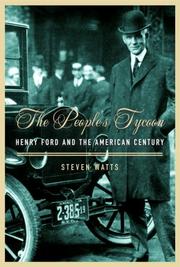
Steven Watts · 2005

Henry Ford as a shaper of American culture as much as of its industry.

Douglas Brinkley · 2003

The Ford Motor Company from 1903 to the end of the 20th century.

Recommended by: Paul Graham
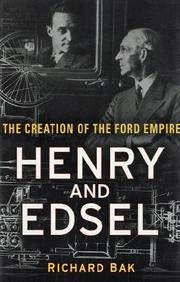
Richard Bak · 2003

Henry Ford and his son Edsel, and how the father undermined his own successor.

Peter Collier, David Horowitz · 1987

Four generations of the family and the succession that nearly sank the company.

Where it sits in the reference 3

Companies
Business models
Biographies

Topics

Biography and MemoirCompany HistoriesTycoons and Business Dynasties