Updates

  1. Person pages list letters, writing, profiles and links as sortable tables with filters, and show each person's companies as links; Fund letters show each letter's description in its own column.
  2. Experts show a checked job title and a short description of each person; 30 more people have photographs.
  3. Every company, fund, university and publication the experts work for has a page listing the people there.
  4. Fund letters show each letter's thesis and filter by it; 225 person pages list the essays, columns and newsletter issues the person wrote.
  5. Person pages list every essay and newsletter issue a person wrote, and their own books as a table in List view.
  6. Recommends shows the five largest kinds of book and the rest under More; browse pictures load sooner.
  7. Podcasts and talks link the original episode, filter by Audio and video or Press, and list each publisher once.
  8. Pages are wider, Recommends has List and Grid, and a filter clicked again turns off.
  9. Book cards sit in a ruled grid with Open Library and Goodreads links and each book's one-line note.
  10. Funds is now Investors; each investor's styles are buttons that filter the table.
  11. Podcasts and talks on a person's page filter by year and publisher and show as a list or a grid of pictures.
  12. Quotes show only people's own words: 472 summaries written by list sites are gone.
  13. Country pages open from Browse again, and every link on the shelf lands on a page.
  14. Subject and person pages show their sections as tabs, and each book appears once on a person's page.
  15. Book cards show the quote, who said it and the source; grids show five cards to a row.
  16. On a phone, a menu holds the sections, search, Updates, Feedback and dark mode.
  17. Feedback takes a screenshot of the page with no browser prompt, opens a screenshot full size when you click it, and clears itself once sent.
  18. Book cards are centred, search names the topic each book sits in, and any text cut short shows whole on hover.
  19. Search groups its results by kind: people, companies, geographies, subjects, topics, books, funds, fund letters and papers.
  20. The Books table lists who recommended each book by name, and the browser tab names the section you are in.
  21. Feedback can take a screenshot of the page, or one you paste or choose, and opens in the corner beside Updates.
  22. Each rail button reopens its section where you left it, and Browse, Table and People show on every book and subject page.
  23. Filters grey out choices that hold nothing instead of hiding them, and Books › People filters by authors or recommenders.
  24. Feedback takes a subject line and up to three screenshots.
  25. Biographies are grouped by the person they are about: 41 new pages, from Abraham Lincoln to Lee Kuan Yew.
  26. Sport splits into 23 sports, and Religion into one topic per faith.
  27. Book lists show as cards: the cover, one recommendation quote and every recommender by name.
  28. Seventeen subjects that had two or three pages under different names now have one page each.
  29. Every page lists its Experts as authors and recommenders, with a link to them on the Experts tab.
  30. Economics, Financial history, Financial panics and Accounting are subjects of their own, with one page per financial crisis.
  31. Book, person and subject pages open inside the app, so the tabs stay in view.
  32. 996 more book covers, and photographs or logos for 227 more people and companies.
  33. Books › Browse shows every subject as cards, and the rail holds Fund letters, Papers, Experts, Books and Funds.
  34. Every topic over 150 books splits into narrower topics, each with a page of its own.

Send feedback

What is it?
Screenshots, up to 3 (optional)
or paste one with Ctrl+V

We use your email only to reply to you.

Wheels for the World

Wheels for the World

Douglas Brinkley
2003
T2 858 pages · about 14h 18m to read Open Librarygoodreads

Company-authorized centennial history with archive access.

Summary

Brinkley, a historian, wrote a full-length history of the Ford Motor Company from its founding in 1903 to the end of the twentieth century, commissioned around the company's centennial and drawing on the Ford archives.

The early sections cover the technical and organisational innovations: the Model T, the moving assembly line at Highland Park, the five dollar day introduced in 1914 and its effect on turnover and on the labour market, and the River Rouge complex built for complete vertical integration from ore and rubber to finished vehicle. Brinkley documents both the productivity gains and the costs, including the Sociological Department that inspected workers' private lives as a condition of the higher wage.

The middle sections are harsher. Henry Ford's refusal to replace the Model T cost the company its lead to General Motors, which offered model variety, annual changes and instalment credit. Ford's antisemitic publishing through the Dearborn Independent, his admiration in Germany, his violent resistance to unionisation through Harry Bennett's Service Department, and his refusal to relinquish control as he declined are all covered. The company was near collapse when Henry Ford II took over in 1945 and brought in the Whiz Kids, including Robert McNamara, to install modern financial control.

The later sections cover the postwar recovery, the Mustang, the Pinto, the 1980s Taurus and the quality problems, and the family's continued control through the dual-class share structure.

The book is long, narrative rather than analytical, and its use of company archives produces a somewhat institutional perspective. Readers wanting a sharper analysis of Ford's decline against Japanese competition should read Halberstam's The Reckoning.

Key takeaways 7

  1. The moving assembly line cut Model T assembly time by an order of magnitude and made the low price possible rather than following from it.
  2. The five dollar day was introduced to reduce ruinous labour turnover, and it succeeded on that measure before it became a public relations asset.
  3. The higher wage came with intrusive inspection of workers' private conduct as a condition of eligibility.
  4. Complete vertical integration at River Rouge produced control over inputs but also fixed costs that punished the company in downturns.
  5. Ford lost market leadership to General Motors because he refused model variety and instalment credit, not because of manufacturing cost.
  6. Henry Ford's personal control extended past his competence, and the company had no functioning financial system by 1945.
  7. The dual-class share structure has preserved family control through every subsequent crisis.

Who should read it

Operators and investors who want the full institutional history of Ford, including how a manufacturing cost advantage failed to protect market position.

Who recommended it 1

Paul Grahamreported

Similar books 6

Chosen by shared topics, the entries that hold them, and the people who recommended both.
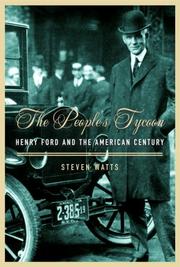
Steven Watts · 2005

Henry Ford as a shaper of American culture as much as of its industry.
Robert Lacey · 1986

Three generations of Fords, Henry, Edsel and Henry II, and their company.

Richard Snow · 2013

Tight narrative of the Model T years; the best short account.

Recommended by: Mohnish Pabrai

Henry Ford, Samuel Crowther · 1922

An industrial philosophy of mass production, written at the height of the Model T.
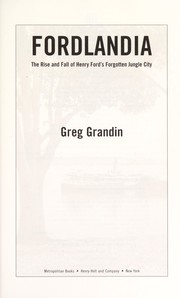
Greg Grandin · 2009

Henry Ford's failed attempt to build a small American town in the Amazon.
David Halberstam · 1986

Ford and Nissan side by side, showing why US carmakers lost to Japan.

Where it sits in the reference 2

Companies
Biographies

Topics

Company HistoriesGeneral HistoryEconomic and Business History