Updates

  1. Person pages list letters, writing, profiles and links as sortable tables with filters, and show each person's companies as links; Fund letters show each letter's description in its own column.
  2. Experts show a checked job title and a short description of each person; 30 more people have photographs.
  3. Every company, fund, university and publication the experts work for has a page listing the people there.
  4. Fund letters show each letter's thesis and filter by it; 225 person pages list the essays, columns and newsletter issues the person wrote.
  5. Person pages list every essay and newsletter issue a person wrote, and their own books as a table in List view.
  6. Recommends shows the five largest kinds of book and the rest under More; browse pictures load sooner.
  7. Podcasts and talks link the original episode, filter by Audio and video or Press, and list each publisher once.
  8. Pages are wider, Recommends has List and Grid, and a filter clicked again turns off.
  9. Book cards sit in a ruled grid with Open Library and Goodreads links and each book's one-line note.
  10. Funds is now Investors; each investor's styles are buttons that filter the table.
  11. Podcasts and talks on a person's page filter by year and publisher and show as a list or a grid of pictures.
  12. Quotes show only people's own words: 472 summaries written by list sites are gone.
  13. Country pages open from Browse again, and every link on the shelf lands on a page.
  14. Subject and person pages show their sections as tabs, and each book appears once on a person's page.
  15. Book cards show the quote, who said it and the source; grids show five cards to a row.
  16. On a phone, a menu holds the sections, search, Updates, Feedback and dark mode.
  17. Feedback takes a screenshot of the page with no browser prompt, opens a screenshot full size when you click it, and clears itself once sent.
  18. Book cards are centred, search names the topic each book sits in, and any text cut short shows whole on hover.
  19. Search groups its results by kind: people, companies, geographies, subjects, topics, books, funds, fund letters and papers.
  20. The Books table lists who recommended each book by name, and the browser tab names the section you are in.
  21. Feedback can take a screenshot of the page, or one you paste or choose, and opens in the corner beside Updates.
  22. Each rail button reopens its section where you left it, and Browse, Table and People show on every book and subject page.
  23. Filters grey out choices that hold nothing instead of hiding them, and Books › People filters by authors or recommenders.
  24. Feedback takes a subject line and up to three screenshots.
  25. Biographies are grouped by the person they are about: 41 new pages, from Abraham Lincoln to Lee Kuan Yew.
  26. Sport splits into 23 sports, and Religion into one topic per faith.
  27. Book lists show as cards: the cover, one recommendation quote and every recommender by name.
  28. Seventeen subjects that had two or three pages under different names now have one page each.
  29. Every page lists its Experts as authors and recommenders, with a link to them on the Experts tab.
  30. Economics, Financial history, Financial panics and Accounting are subjects of their own, with one page per financial crisis.
  31. Book, person and subject pages open inside the app, so the tabs stay in view.
  32. 996 more book covers, and photographs or logos for 227 more people and companies.
  33. Books › Browse shows every subject as cards, and the rail holds Fund letters, Papers, Experts, Books and Funds.
  34. Every topic over 150 books splits into narrower topics, each with a page of its own.

Send feedback

What is it?
Screenshots, up to 3 (optional)
or paste one with Ctrl+V

We use your email only to reply to you.

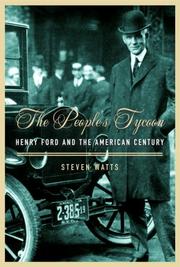
The People's Tycoon: Henry Ford and the Amer

The People's Tycoon: Henry Ford and the American Century

Steven Watts
2005
T2 614 pages · about 10h 14m to read Open Librarygoodreads

Scholarly biography placing Ford in American cultural history.

Summary

Steven Watts, a cultural historian, wrote this biography of Henry Ford treating him as a figure who shaped American culture as much as American industry.

The business material covers the founding of the Ford Motor Company, the Model T and the decision to make one product at continuously falling prices, the moving assembly line at Highland Park, the five-dollar day of 1914 and the Sociological Department that investigated employees' private lives to determine eligibility for it, the River Rouge complex and its vertical integration from ore to finished car, the refusal to change the Model T until share loss forced the Model A, and the labour conflict of the 1930s including the Service Department under Harry Bennett and the violence at the Battle of the Overpass.

The cultural material is Watts's distinctive contribution. He treats Ford as a figure who combined mass production with an ideology of rural virtue, whose public persona as a plain-speaking mechanic was constructed and enormously effective, and who used that standing to promote positions including pacifism, the peace ship, and the antisemitism published in the Dearborn Independent and in The International Jew, which Watts covers directly rather than in passing. He examines the contradiction between Ford's celebration of the individual craftsman and the work he actually created. The book is long and well researched and is the standard modern biography.

Key takeaways 7

  1. Ford's strategy was one product at continuously falling prices, which required engineering the manufacturing process rather than the car.
  2. The five-dollar day reduced turnover enough to pay for itself and came with intrusive investigation of employees' private lives.
  3. River Rouge integrated production from ore and rubber through to finished vehicles, which was the furthest extent of industrial vertical integration.
  4. Refusing to change the Model T cost Ford market leadership to General Motors, which offered variety and annual change.
  5. Ford's public persona as a plain-speaking mechanic was deliberately constructed and gave him standing to promote political positions.
  6. Ford published sustained antisemitic material in the Dearborn Independent, which Watts treats directly rather than as a footnote.
  7. Ford celebrated the individual craftsman while creating work that eliminated craft entirely, and Watts treats the contradiction as central.

Who should read it

Readers of business history who want a full account of Ford including the cultural and political dimensions that operating histories omit.

Similar books 6

Chosen by shared topics, the entries that hold them, and the people who recommended both.
Robert Lacey · 1986

Three generations of Fords, Henry, Edsel and Henry II, and their company.
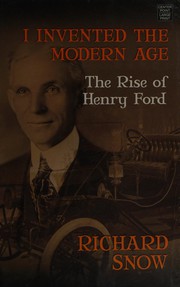
Richard Snow · 2013

Tight narrative of the Model T years; the best short account.

Recommended by: Mohnish Pabrai

Henry Ford, Samuel Crowther · 1922

An industrial philosophy of mass production, written at the height of the Model T.

Douglas Brinkley · 2003

The Ford Motor Company from 1903 to the end of the 20th century.

Recommended by: Paul Graham

Neil Baldwin · 2001

How Henry Ford published The International Jew, a book the Nazis spread.
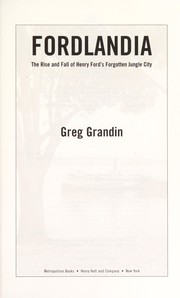
Greg Grandin · 2009

Henry Ford's failed attempt to build a small American town in the Amazon.

Where it sits in the reference 2

Companies
Biographies

Topics

Biography and MemoirGeneral HistoryTycoons and Business DynastiesEconomic and Business History