
Updates

  1. Person pages list letters, writing, profiles and links as sortable tables with filters, and show each person's companies as links; Fund letters show each letter's description in its own column.
  2. Experts show a checked job title and a short description of each person; 30 more people have photographs.
  3. Every company, fund, university and publication the experts work for has a page listing the people there.
  4. Fund letters show each letter's thesis and filter by it; 225 person pages list the essays, columns and newsletter issues the person wrote.
  5. Person pages list every essay and newsletter issue a person wrote, and their own books as a table in List view.
  6. Recommends shows the five largest kinds of book and the rest under More; browse pictures load sooner.
  7. Podcasts and talks link the original episode, filter by Audio and video or Press, and list each publisher once.
  8. Pages are wider, Recommends has List and Grid, and a filter clicked again turns off.
  9. Book cards sit in a ruled grid with Open Library and Goodreads links and each book's one-line note.
  10. Funds is now Investors; each investor's styles are buttons that filter the table.
  11. Podcasts and talks on a person's page filter by year and publisher and show as a list or a grid of pictures.
  12. Quotes show only people's own words: 472 summaries written by list sites are gone.
  13. Country pages open from Browse again, and every link on the shelf lands on a page.
  14. Subject and person pages show their sections as tabs, and each book appears once on a person's page.
  15. Book cards show the quote, who said it and the source; grids show five cards to a row.
  16. On a phone, a menu holds the sections, search, Updates, Feedback and dark mode.
  17. Feedback takes a screenshot of the page with no browser prompt, opens a screenshot full size when you click it, and clears itself once sent.
  18. Book cards are centred, search names the topic each book sits in, and any text cut short shows whole on hover.
  19. Search groups its results by kind: people, companies, geographies, subjects, topics, books, funds, fund letters and papers.
  20. The Books table lists who recommended each book by name, and the browser tab names the section you are in.
  21. Feedback can take a screenshot of the page, or one you paste or choose, and opens in the corner beside Updates.
  22. Each rail button reopens its section where you left it, and Browse, Table and People show on every book and subject page.
  23. Filters grey out choices that hold nothing instead of hiding them, and Books › People filters by authors or recommenders.
  24. Feedback takes a subject line and up to three screenshots.
  25. Biographies are grouped by the person they are about: 41 new pages, from Abraham Lincoln to Lee Kuan Yew.
  26. Sport splits into 23 sports, and Religion into one topic per faith.
  27. Book lists show as cards: the cover, one recommendation quote and every recommender by name.
  28. Seventeen subjects that had two or three pages under different names now have one page each.
  29. Every page lists its Experts as authors and recommenders, with a link to them on the Experts tab.
  30. Economics, Financial history, Financial panics and Accounting are subjects of their own, with one page per financial crisis.
  31. Book, person and subject pages open inside the app, so the tabs stay in view.
  32. 996 more book covers, and photographs or logos for 227 more people and companies.
  33. Books › Browse shows every subject as cards, and the rail holds Fund letters, Papers, Experts, Books and Funds.
  34. Every topic over 150 books splits into narrower topics, each with a page of its own.

Send feedback

What is it?
Screenshots, up to 3 (optional)
or paste one with Ctrl+V

We use your email only to reply to you.

The Reckoning

The Reckoning

David Halberstam
1986
T1 786 pages · about 13h 6m to read Open Librarygoodreads

Ford against Nissan; the canonical account of postwar Detroit's decline.

Summary

Halberstam wrote a comparative history of Ford and Nissan, using the two companies to explain why American automobile manufacturing lost its position to Japanese competitors.

The American side traces Ford from Henry Ford's manufacturing achievements through the postwar period, and locates the decline in the ascendancy of financial management. The Whiz Kids, brought in to install control systems a company without accounts desperately needed, became the company's leadership, and Halberstam argues that their successors managed by numbers without product knowledge. Decisions were made on cost reduction and on short-term return, product engineering lost authority to finance, and the company built cars designed to hit price points rather than to be good. He also covers the adversarial relationship with the United Auto Workers, which produced work rules and job classifications that prevented flexibility, and the shared assumption among American producers that consumers would not buy small cars.

The Japanese side traces Nissan from the postwar reconstruction, the labour conflict of the 1950s and the emergence of enterprise unions, the role of the Ministry of International Trade and Industry, the quality improvement programmes that drew on Deming's statistical methods, and the export push into the American market during the oil shocks.

Halberstam's argument is cultural as much as economic: American managers optimised for the quarterly result and lost the ability to make things, while Japanese managers retained engineering authority and long horizons.

The book is very long and Halberstam's method is extended narrative rather than analysis. His treatment of Japanese management was written at the peak of Japanese success and reads as more admiring than the subsequent decades justify, since Nissan itself required a rescue by Renault in 1999. The account of how financial management displaced product knowledge at Ford has held up well.

Key takeaways 7

  1. Financial control systems installed to save Ford in the 1940s produced a leadership that managed by numbers without product knowledge.
  2. Product engineering lost authority to finance, and the resulting cars were designed to hit cost targets rather than to be good.
  3. Adversarial labour relations produced work rules and job classifications that prevented the flexibility Japanese plants had.
  4. American producers shared an assumption that consumers would not buy small cars, which left the segment open to imports.
  5. Japanese manufacturers adopted statistical quality methods that American industry had developed and then ignored.
  6. Enterprise unions in Japan produced labour relations in which productivity improvement was not resisted as a threat.
  7. Short decision horizons produced by quarterly reporting made investments with long payback periods difficult to justify.

Who should read it

Operators and investors in manufacturing who want the case study of how financial management displaced product capability at an incumbent.

Similar books 6

Chosen by shared topics, the entries that hold them, and the people who recommended both.
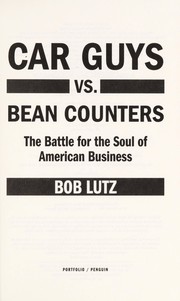
Bob Lutz · 2011

Insider account: Lutz on product culture versus finance control.

Recommended by: Mohnish Pabrai
Robert Lacey · 1986

Three generations of Fords, Henry, Edsel and Henry II, and their company.

Alfred P. Sloan Jr., Alfred D. Chandler Jr. · 1963

The decentralised structure and financial controls that ran General Motors.

Douglas Brinkley · 2003

The Ford Motor Company from 1903 to the end of the 20th century.

Recommended by: Paul Graham
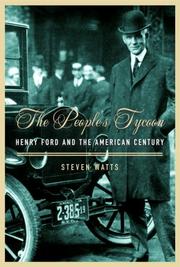
Steven Watts · 2005

Henry Ford as a shaper of American culture as much as of its industry.

Where it sits in the reference 3

Companies
Business models
Industries

Topics

Company HistoriesGeneral HistoryEconomic and Business History