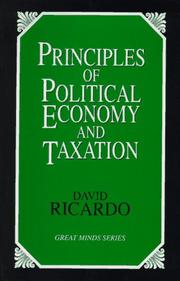
On the Principles of Political Economy and Taxation
Rent, wages, profit and comparative advantage, reasoned from first assumptions.
Summary
David Ricardo published this in 1817 and it established the deductive method in economics: state assumptions, reason rigorously from them, and derive conclusions without regard to whether they are comfortable. The book is difficult, compressed and organised badly, and it dominated economic thought for the following half century.
The two arguments everyone knows are comparative advantage and differential rent. Comparative advantage, illustrated with English cloth and Portuguese wine, shows that mutually beneficial trade arises from differences in relative production costs, so that a country less efficient at producing everything still gains from specialising in what it produces least inefficiently. Differential rent explains rent as the surplus arising from differences in land fertility: as population grows, less fertile land is cultivated, the price of corn rises to cover the cost on the worst land in use, and owners of better land collect the difference. Ricardo used this to argue against the Corn Laws, since protection raised food prices, raised rents, raised the wages manufacturers had to pay, and reduced profits and accumulation.
The book also contains the labour theory of value that Ricardo held in a qualified form and that Marx developed, the analysis of the effects of taxation on different classes, the argument later formalised as Ricardian equivalence about the equivalence of debt and tax finance, and a chapter added in the third edition conceding that machinery can reduce the demand for labour. Ricardo's system was superseded by marginalism in the 1870s, and his value theory is not used. Comparative advantage remains the foundation of trade theory, and his method of reasoning from explicit assumptions defined the discipline.
Key takeaways 7
- Trade benefits both parties when their relative production costs differ, even when one produces everything more efficiently.
- Rent is the surplus that accrues to owners of better land as inferior land is brought into cultivation, not a cost that raises prices.
- Protection of agriculture raises food prices and therefore wages, which reduces profits and slows capital accumulation.
- The interests of landowners are structurally opposed to those of manufacturers and workers under a growing population.
- Ricardo conceded that the introduction of machinery can reduce the demand for labour, contradicting his own earlier position.
- Government borrowing and taxation impose the same burden, since the debt must eventually be paid from taxes.
- Ricardo's method of reasoning deductively from stated assumptions defined how economics has been done since.
Who should read it
Investors and analysts who want the origin of comparative advantage and of rent theory in the author's own difficult words, and the method economics inherited from him.
Similar books 6
Chosen by shared topics, the entries that hold them, and the people who recommended both.
How the division of labour and free markets make a nation rich.
“In The Wealth of Nations (published in 1776) Smith noted that land prices had risen in recent decades, as interest rates declined.” — Howard Marks
Source: Easy Money
Recommended by: Howard Marks, John C. Bogle and 11 others
Books One to Three: division of labour, money, prices, wages, profit and capital.
“Adam Smith, An Inquiry into the Nature and Causes of the Wealth of Nations (London: W. Strahan and T. Cadell, 1776)” — Michael Mauboussin
Source: Increasing Returns: Identifying Forms of Increasing Returns and What Drives Them, page 15
Recommended by: Michael Mauboussin, Mohnish Pabrai and 1 other
Books Four and Five: the case against mercantilism, and the role of the state.
Recommended by: Mohnish Pabrai
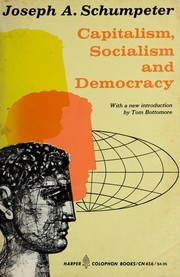
Capitalism runs on creative destruction, and its success may lead it to socialism.
“Joseph A Schumpeter, Capitalism, Socialism and Democracy (New York: Harper & Row, 1942)” — Michael Mauboussin
Source: Why Corporate Longevity Matters: What Index Turnover Tells Us about Corporate Results, page 14
Recommended by: Jim Collins, Michael Mauboussin, Li Lu
Essays on the Versailles treaty, the gold standard and Britain's currency.
Recommended by: Mohnish Pabrai, Warren Buffett
The first full Austrian school treatise on economics, built from individual action.
Recommended by: Charles Koch
Where it sits in the reference 2
Topics 3
As an Amazon Associate I earn from qualifying purchases.