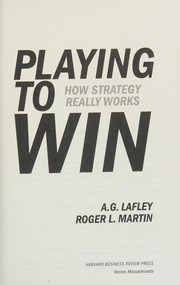
Playing to Win: How Strategy Really Works
Strategy as five linked choices, including where to play and how to win.
Insider account: Lafley's strategy framework drawn from P&G brands.
Summary
Lafley ran Procter and Gamble and Martin was dean of the Rotman School, and they present strategy as a set of five choices that must be made together and must reinforce each other.
The five questions are: what is our winning aspiration, meaning the purpose stated as a definition of winning rather than as an ambition; where will we play, meaning the specific markets, segments, channels, geographies and product categories chosen and, equally, those excluded; how will we win, meaning the specific way the company will create value in the chosen area, which reduces to cost leadership or differentiation; what capabilities must be in place, meaning the activities the company must perform distinctively well; and what management systems are required, meaning the structures, measures and processes that build and maintain those capabilities.
Their argument is that these choices form a cascade, so that a change in one requires changes in the others, and that most strategy failures come from making some choices and not others, particularly from defining an aspiration without specifying where to play and how to win. The cases come from Procter and Gamble under Lafley, including Olay's repositioning from a low-price mass brand to a masstige position competing with department store products, the Bounty and Tide brand decisions, and the Gillette acquisition.
The framework is straightforward and the cases are told by the executive responsible, which makes them favourable. The book does not address how to generate options, only how to choose among them, which Martin covers better in his other work. The insistence that strategy consists of specific excluding choices is the durable point.
Key takeaways 8
- Strategy is a set of five choices made together, and making some without the others produces no strategy at all.
- A winning aspiration must define what winning means specifically rather than stating an ambition or a purpose.
- The where to play choice requires naming what the company will not do, and a company competing everywhere has not chosen.
- How to win reduces to either cost leadership or differentiation in the chosen area, and claiming both usually means neither.
- Capabilities must be identified as the specific activities the company will perform distinctively well, not as general strengths.
- Management systems including measures and processes must be built to sustain the chosen capabilities, or the capabilities decay.
- The five choices form a cascade, so changing one requires revisiting the others rather than adjusting it in isolation.
- Most strategy documents state an aspiration without specifying where to play or how to win, which is why they produce no decisions.
Who should read it
Executives who need a simple structure that forces the excluding choices most strategy processes avoid.
Who recommended it 3
Similar books 6
Chosen by shared topics, the entries that hold them, and the people who recommended both.
How to create new market space instead of fighting rivals over existing demand.
“It's the epitome of Blue Ocean Strategy. To find a breakthrough angle in commerce, it's as important to decide where you will not compete, as it is to decide where you will compete.” — David Heinemeier Hansson
Source: Turns out nobody cared about panel gaps
Recommended by: David Heinemeier Hansson, Mohnish Pabrai and 6 others
How to spot a strategic inflection point, when a tenfold force changes a business.
“There's also a number of great books that just tell the narrative of one company, such as The New New Thing, Startup, eBoys, Only the Paranoid Survive, Breaking Windows, but I've left those off the list even though they are very fun to read.” — Andrew Chen
Source: Ten classic books that define tech
Recommended by: Andrew Chen, Charlie Munger, Jim Collins and 12 others

The deal is shaped before the table: set up the parties, interests and options first.
Seven sources of lasting advantage, each a benefit plus a barrier to rivals.
Recommended by: Keith Rabois, Alex Lieberman, Brett Adcock and 6 others
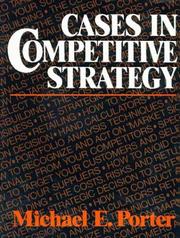
Teaching cases for applying the framework of Competitive Strategy.
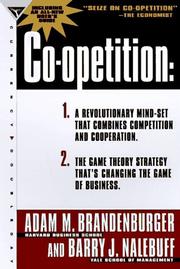
Game theory applied to business, which is cooperative and competitive at once.
“Adam M. Brandenburger and Barry J. Nalebuff, Co-opetition (New York: Currency Doubleday, 1996)” — Michael Mauboussin
Source: The Ecosystem Edge, page 10
Recommended by: Michael Mauboussin, Mohnish Pabrai
Where it sits in the reference 3
Topics 1
As an Amazon Associate I earn from qualifying purchases.