Updates

  1. Person pages list letters, writing, profiles and links as sortable tables with filters, and show each person's companies as links; Fund letters show each letter's description in its own column.
  2. Experts show a checked job title and a short description of each person; 30 more people have photographs.
  3. Every company, fund, university and publication the experts work for has a page listing the people there.
  4. Fund letters show each letter's thesis and filter by it; 225 person pages list the essays, columns and newsletter issues the person wrote.
  5. Person pages list every essay and newsletter issue a person wrote, and their own books as a table in List view.
  6. Recommends shows the five largest kinds of book and the rest under More; browse pictures load sooner.
  7. Podcasts and talks link the original episode, filter by Audio and video or Press, and list each publisher once.
  8. Pages are wider, Recommends has List and Grid, and a filter clicked again turns off.
  9. Book cards sit in a ruled grid with Open Library and Goodreads links and each book's one-line note.
  10. Funds is now Investors; each investor's styles are buttons that filter the table.
  11. Podcasts and talks on a person's page filter by year and publisher and show as a list or a grid of pictures.
  12. Quotes show only people's own words: 472 summaries written by list sites are gone.
  13. Country pages open from Browse again, and every link on the shelf lands on a page.
  14. Subject and person pages show their sections as tabs, and each book appears once on a person's page.
  15. Book cards show the quote, who said it and the source; grids show five cards to a row.
  16. On a phone, a menu holds the sections, search, Updates, Feedback and dark mode.
  17. Feedback takes a screenshot of the page with no browser prompt, opens a screenshot full size when you click it, and clears itself once sent.
  18. Book cards are centred, search names the topic each book sits in, and any text cut short shows whole on hover.
  19. Search groups its results by kind: people, companies, geographies, subjects, topics, books, funds, fund letters and papers.
  20. The Books table lists who recommended each book by name, and the browser tab names the section you are in.
  21. Feedback can take a screenshot of the page, or one you paste or choose, and opens in the corner beside Updates.
  22. Each rail button reopens its section where you left it, and Browse, Table and People show on every book and subject page.
  23. Filters grey out choices that hold nothing instead of hiding them, and Books › People filters by authors or recommenders.
  24. Feedback takes a subject line and up to three screenshots.
  25. Biographies are grouped by the person they are about: 41 new pages, from Abraham Lincoln to Lee Kuan Yew.
  26. Sport splits into 23 sports, and Religion into one topic per faith.
  27. Book lists show as cards: the cover, one recommendation quote and every recommender by name.
  28. Seventeen subjects that had two or three pages under different names now have one page each.
  29. Every page lists its Experts as authors and recommenders, with a link to them on the Experts tab.
  30. Economics, Financial history, Financial panics and Accounting are subjects of their own, with one page per financial crisis.
  31. Book, person and subject pages open inside the app, so the tabs stay in view.
  32. 996 more book covers, and photographs or logos for 227 more people and companies.
  33. Books › Browse shows every subject as cards, and the rail holds Fund letters, Papers, Experts, Books and Funds.
  34. Every topic over 150 books splits into narrower topics, each with a page of its own.

Send feedback

What is it?
Screenshots, up to 3 (optional)
or paste one with Ctrl+V

We use your email only to reply to you.

Power Failure: The Rise and Fall of an Ameri

Power Failure: The Rise and Fall of an American Icon

William D. Cohan
2022
T2 512 pages · about 8h 32m to read Open Librarygoodreads

Longest and most complete narrative history of the company.

Summary

Cohan wrote a long history of General Electric from its founding through its dismantling, based on extensive interviews including with Jack Welch before his death, Jeff Immelt, John Flannery and Larry Culp.

The central analytical claim concerns GE Capital. Cohan argues that by the end of Welch's tenure the finance arm was generating roughly half of the company's earnings, that its returns depended on GE's triple-A credit rating and on access to cheap commercial paper funding, and that this made an industrial conglomerate into a lightly regulated financial institution with a manufacturing business attached. The reported results that made Welch's record, including the consistent earnings that met analyst expectations quarter after quarter, were produced in substantial part by GE Capital's ability to time asset sales and reserve movements. Cohan documents the settled Securities and Exchange Commission accounting case and argues that the smoothness itself was the evidence.

The Immelt chapters cover the inheritance: a company whose funding model failed in 2008 and required government guarantees, and a chief executive who then made large acquisitions including Alstom, at the top of the thermal power cycle, just as gas turbine demand collapsed. The insurance liabilities from a long-exited business produced multi-billion dollar reserve charges years later.

Cohan is critical of Welch, which reverses the consensus of the 1990s, and generous to neither successor. The book is very long and the interview material sometimes substitutes for analysis. Its financial explanation of how the earnings were produced is the most valuable part, and it is the necessary counterweight to Tichy and Sherman's contemporaneous account, also in this reference.

Key takeaways 7

  1. GE Capital generated roughly half of the company's earnings, which made an industrial conglomerate largely a financial institution.
  2. GE Capital's returns depended on the parent's triple-A rating and on commercial paper funding that disappeared in 2008.
  3. Consistently meeting analyst expectations quarter after quarter was itself evidence that the earnings were being managed.
  4. The Alstom acquisition was completed as demand for thermal power generation was collapsing, which destroyed the value immediately.
  5. Long-term care insurance liabilities from an exited business produced reserve charges more than a decade after the exit.
  6. Conglomerate structure concealed which businesses were creating value, because the reported result was the sum.
  7. Welch's reputation rested on results whose composition was not understood by investors at the time.

Who should read it

Investors and directors who want the full account of how a celebrated conglomerate's earnings were actually produced and why it could not survive the funding market's closure.

About William D. Cohan

Financial journalist and former investment banker at Lazard, Merrill Lynch and JPMorgan Chase.

House of Cards reconstructs the ten days in which Bear Stearns lost its funding, hour by hour and from the people in the room, and remains the closest study of how a broker-dealer run actually proceeds. Money and Power and The Last Tycoons trace how Goldman Sachs and Lazard made money over decades, including the partnership economics and internal politics that decided who got paid.

Lazard, Merrill Lynch, JPMorgan Chase

Similar books 6

Chosen by shared topics, the entries that hold them, and the people who recommended both.
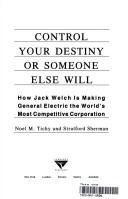
Noel M. Tichy, Stratford Sherman · 1993

The admiring contemporary account of Welch's restructuring.
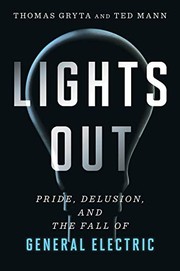
Thomas Gryta, Ted Mann · 2020

How GE fell from the world's most valuable company to a conglomerate split in three.

Recommended by: Andrew Wilkinson, Bill Gates
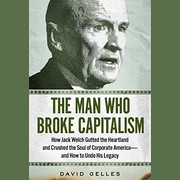
David Gelles · 2022

Polemic treating Welch's GE as the template for shareholder primacy.
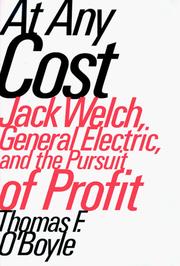
Thomas F. O'Boyle · 1998

The contemporaneous dissent, twenty years ahead of the consensus.
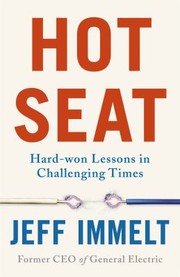
Jeff Immelt, Amy Wallace · 2021

Insider account: Immelt's defence of his sixteen years as CEO.
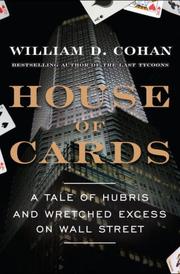
William D. Cohan · 2009

Bear Stearns's ten-day collapse in March 2008, and the firm's history before it.

Recommended by: Mohnish Pabrai

Where it sits in the reference 3

Journalists
Companies
Biographies

Topics

Company Histories