Updates

  1. Person pages list letters, writing, profiles and links as sortable tables with filters, and show each person's companies as links; Fund letters show each letter's description in its own column.
  2. Experts show a checked job title and a short description of each person; 30 more people have photographs.
  3. Every company, fund, university and publication the experts work for has a page listing the people there.
  4. Fund letters show each letter's thesis and filter by it; 225 person pages list the essays, columns and newsletter issues the person wrote.
  5. Person pages list every essay and newsletter issue a person wrote, and their own books as a table in List view.
  6. Recommends shows the five largest kinds of book and the rest under More; browse pictures load sooner.
  7. Podcasts and talks link the original episode, filter by Audio and video or Press, and list each publisher once.
  8. Pages are wider, Recommends has List and Grid, and a filter clicked again turns off.
  9. Book cards sit in a ruled grid with Open Library and Goodreads links and each book's one-line note.
  10. Funds is now Investors; each investor's styles are buttons that filter the table.
  11. Podcasts and talks on a person's page filter by year and publisher and show as a list or a grid of pictures.
  12. Quotes show only people's own words: 472 summaries written by list sites are gone.
  13. Country pages open from Browse again, and every link on the shelf lands on a page.
  14. Subject and person pages show their sections as tabs, and each book appears once on a person's page.
  15. Book cards show the quote, who said it and the source; grids show five cards to a row.
  16. On a phone, a menu holds the sections, search, Updates, Feedback and dark mode.
  17. Feedback takes a screenshot of the page with no browser prompt, opens a screenshot full size when you click it, and clears itself once sent.
  18. Book cards are centred, search names the topic each book sits in, and any text cut short shows whole on hover.
  19. Search groups its results by kind: people, companies, geographies, subjects, topics, books, funds, fund letters and papers.
  20. The Books table lists who recommended each book by name, and the browser tab names the section you are in.
  21. Feedback can take a screenshot of the page, or one you paste or choose, and opens in the corner beside Updates.
  22. Each rail button reopens its section where you left it, and Browse, Table and People show on every book and subject page.
  23. Filters grey out choices that hold nothing instead of hiding them, and Books › People filters by authors or recommenders.
  24. Feedback takes a subject line and up to three screenshots.
  25. Biographies are grouped by the person they are about: 41 new pages, from Abraham Lincoln to Lee Kuan Yew.
  26. Sport splits into 23 sports, and Religion into one topic per faith.
  27. Book lists show as cards: the cover, one recommendation quote and every recommender by name.
  28. Seventeen subjects that had two or three pages under different names now have one page each.
  29. Every page lists its Experts as authors and recommenders, with a link to them on the Experts tab.
  30. Economics, Financial history, Financial panics and Accounting are subjects of their own, with one page per financial crisis.
  31. Book, person and subject pages open inside the app, so the tabs stay in view.
  32. 996 more book covers, and photographs or logos for 227 more people and companies.
  33. Books › Browse shows every subject as cards, and the rail holds Fund letters, Papers, Experts, Books and Funds.
  34. Every topic over 150 books splits into narrower topics, each with a page of its own.

Send feedback

What is it?
Screenshots, up to 3 (optional)
or paste one with Ctrl+V

We use your email only to reply to you.

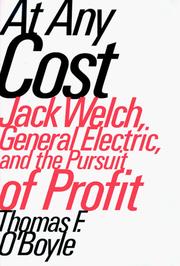
At Any Cost: Jack Welch, General Electric, a

At Any Cost: Jack Welch, General Electric, and the Pursuit of Profit

Thomas F. O'Boyle
1998
T3 465 pages · about 7h 45m to read Open Librarygoodreads

The contemporaneous dissent, twenty years ahead of the consensus.

Summary

O'Boyle, a Wall Street Journal reporter, wrote a critical account of Jack Welch's General Electric at the point when Welch's reputation was at its highest.

The argument is that the financial results were produced at costs that did not appear in the accounts. O'Boyle documents the employment reduction of well over a hundred thousand people and follows specific communities where plants closed, examining what happened to the workers and to the local economies. He argues that the pressure to deliver numbers every quarter produced behaviour throughout the organisation that senior management did not intend but did create, and he documents specific episodes: the Kidder Peabody trading fraud, in which a trader recorded fictitious profits for years; the diamond price-fixing case; the defence contracting fraud settlements; and the environmental disputes, particularly the PCB contamination of the Hudson River which General Electric fought for decades.

He also examines the vitality curve, under which the bottom ten per cent of managers were removed each year, and argues that this produced a culture in which failing to make the number was not survivable, which is the precondition for the conduct he documents.

The book was published in 1998 and reads as a minority report against the consensus of the period. Much of what O'Boyle argued was subsequently vindicated: the reliance on GE Capital, the earnings management that produced the smooth results, and the eventual dismantling of the company all support his general position. Cohan's Power Failure, also in this reference, covers the same ground with the outcome known.

O'Boyle is hostile throughout and the book does not seriously engage the case that the restructuring was necessary given General Electric's position in 1981, which is the strongest argument on the other side.

Key takeaways 7

  1. General Electric's reported results were produced at costs to employees and communities that did not appear in the accounts.
  2. Removing the bottom ten per cent of managers annually created a culture in which missing the number was not survivable.
  3. A culture where missing targets ends careers produces the conduct that leads to fraud and to accounting manipulation.
  4. The Kidder Peabody episode involved a trader recording fictitious profits over years without detection.
  5. The company faced repeated settlements over defence contracting, price fixing and environmental contamination during the period of its highest reputation.
  6. Consistently smooth quarterly results at a company with this many businesses indicated management of the numbers rather than of the businesses.
  7. A minority report written against consensus can be substantially correct and take twenty years to be recognised.

Who should read it

Executives and investors who want the contemporaneous critical case against a celebrated management record, and the connection between performance culture and misconduct.

Similar books 6

Chosen by shared topics, the entries that hold them, and the people who recommended both.
David Gelles · 2022

Polemic treating Welch's GE as the template for shareholder primacy.
Noel M. Tichy, Stratford Sherman · 1993

The admiring contemporary account of Welch's restructuring.
Robert Slater · 1998

Contemporary admiring account; useful as a record of what people believed.
Jeff Immelt, Amy Wallace · 2021

Insider account: Immelt's defence of his sixteen years as CEO.
Robert Iger · 2019

Running Disney and buying Pixar, Marvel, Lucasfilm and Fox to add creative talent.

Louis V. Gerstner · 2002

How IBM was kept whole in 1993 and turned from hardware toward services.

Recommended by: Mohnish Pabrai, Aaron Levie

Where it sits in the reference 3

Biographies
Business themes
Business themes

Topics

Company HistoriesBiography and MemoirLeadershipExecutives and Corporate Insiders