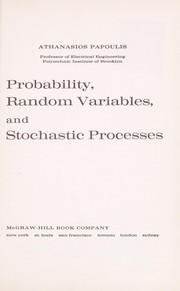
Probability, Random Variables and Stochastic Processes
The graduate engineering text on probability and stochastic processes.
The standard engineering text on probability and stochastic processes
Summary
Papoulis wrote the standard graduate engineering textbook on probability and stochastic processes, first published in 1965 and revised across editions with Pillai. It has been the reference text in electrical engineering and related fields for decades.
The coverage runs from the axioms of probability and the frequency interpretation, through random variables, distribution and density functions, expected values and moments, functions of random variables, multiple random variables and joint distributions, and the central limit theorem, into stochastic processes: stationarity, autocorrelation, power spectral density, linear systems driven by random inputs, Markov processes, Poisson processes, spectral estimation and mean square estimation.
The treatment is engineering-oriented rather than measure-theoretic, which makes it accessible to readers with calculus and linear algebra rather than requiring real analysis, and which is why it became the standard in engineering rather than mathematics departments. Papoulis is careful about the interpretation of probability and devotes attention to what the axioms do and do not commit a user to.
For investors and quantitative practitioners the relevant content is the treatment of stochastic processes, particularly stationarity and its absence, autocorrelation structure, spectral methods and estimation from finite samples, all of which underlie time series work in finance. The book is a reference and a course text rather than something to read through, and it contains extensive problems.
It is not a finance book and contains no financial applications. Readers wanting those should use a financial econometrics text built on this foundation.
Key takeaways 7
- Probability can be developed axiomatically without committing to any particular interpretation of what a probability means.
- A stochastic process is a family of random variables indexed by time, and its properties are determined by the joint distributions rather than by any single realisation.
- Stationarity is the assumption that makes estimation from a single realisation possible, and its absence invalidates most standard time series methods.
- Autocorrelation structure and power spectral density are alternative complete descriptions of a wide-sense stationary process.
- The central limit theorem explains why sums of many independent contributions converge to normality regardless of the individual distributions.
- Estimating a process's parameters from a finite sample introduces error that must be quantified separately from the process's own randomness.
- Linear systems driven by random inputs produce outputs whose statistics follow from the input statistics and the system, which is the foundation of filtering.
Who should read it
Quantitative practitioners and engineering-trained readers who need the standard reference on probability and stochastic processes.
Who recommended it 1
Similar books 6
Chosen by shared topics, the entries that hold them, and the people who recommended both.
What each econometric technique is for, what it assumes and what goes wrong.
Recommended by: Nassim Nicholas Taleb
Statistics without the maths, for reading claims: averages, correlation, regression.
Recommended by: Keith Rabois
Why standard finance models understate market risk, from fractal geometry's creator.
“(Italics added.) Mandelbrot on Risk, Ruin, and Reward The abstract theories of Karl Popper and Frank Knight can be directly applied to the financial markets, which is exactly what Benoit Mandelbrot, the brilliant inventor of fractal geometry, has done with Richard Hudson in his book The (Mis)Behavior of Markets, ominously subtitled “A Fractal View of Risk, Ruin, and Reward.” — John C. Bogle
Source: Black Monday and Black Swans, page 3
Recommended by: John C. Bogle, Mohnish Pabrai and 2 others
The mathematics of fat-tailed distributions and what they do to statistics.
Self-organised criticality: why earthquakes and crashes come in all sizes.
“Mark Buchanan, Ubiquity: The Science of History . . . Or Why the World is Simpler Than We Think (New York: Crown Publishers, 2000)” — Michael Mauboussin
Source: Interdisciplinary Perspectives on Risk, page 5
Recommended by: Michael Mauboussin
Why models are not theories, and the harm of mistaking them for reality.
Recommended by: Nassim Nicholas Taleb