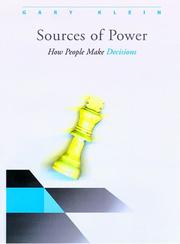
Sources of Power: How People Make Decisions
How firefighters, pilots and other experts decide under time pressure.
Summary
Gary Klein, one of the developers of naturalistic decision making, studies how experts make split-second decisions in real situations. Most studies of decision making use artificial laboratory tasks and portray people as biased and unskilled; naturalistic decision making instead treats people as skilled and experienced, and documents strengths that such studies have played down or ignored.
Since 1985 Klein had done fieldwork on how people handle hard, non-routine situations under real constraints: time pressure, high stakes, personal responsibility and shifting conditions. He studied firefighters, critical-care nurses, pilots, nuclear power plant operators, battle planners and chess masters, and each chapter builds on key incidents from that work. MIT Press published the book in 1998. It offers lessons for managers, psychologists, engineers and others, and gives an overview of the naturalistic research approach and of the strengths people bring to difficult tasks.
Key takeaways 4
- Real decisions are made under time pressure, high stakes and shifting conditions.
- Field studies show human skill that laboratory studies miss.
- Experienced professionals bring strengths to hard tasks that laboratory research overlooks.
- Naturalistic decision making studies people in real settings.
Who should read it
Managers, psychologists and engineers interested in how experts decide under pressure.
Who recommended it 2 · 2 direct
“Gary Klein, Sources of Power: How People Make Decisions (Cambridge, MA: MIT Press, 1998)”
Similar books 6
Chosen by shared topics, the entries that hold them, and the people who recommended both.
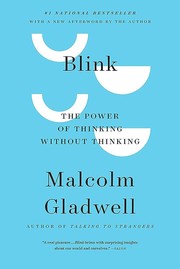
How snap judgments work, when to trust them and when they mislead.
“Malcolm Gladwell, Blink: The Power of Thinking Without Thinking (New York: Little, Brown and Company, 2005)” — Michael Mauboussin
Source: Are You an Expert? Experts and Markets, page 9
Recommended by: Michael Mauboussin, Mohnish Pabrai and 2 others
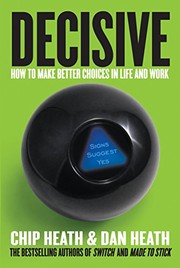
Four traps that ruin decisions, such as narrow framing, and a process to beat each.
“Interesting and insightful dive into the subject of how to make big decisions. Specific useful advice.” — Derek Sivers
Source: Derek Sivers book notes (primary, rated list) · Rating: 8/10
Recommended by: Andrew Wilkinson, Derek Sivers and 6 others
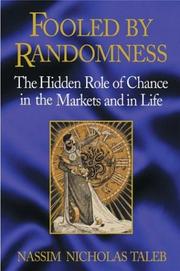
Why people mistake luck for skill, above all in markets.
“Fooled By Randomness was unquestionably the best non-fiction book I read in 2005.” — Brad Feld
Source: Book Review: Fooled By Randomness — Feld Thoughts
Recommended by: Barton Biggs, Brad Feld, Derek Sivers and 15 others
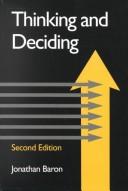
A text on human judgment, decision making and rationality.
“Baron, Jonathan, Thinking and Deciding, 3rd ed. (Cambridge, UK: Cambridge University Press, 2000)” — Michael Mauboussin
Source: Decision-Making for Investors: Theory, Practice, and Pitfalls, page 19
Recommended by: Michael Mauboussin, Mohnish Pabrai and 1 other

Principles of observation, inference and avoiding error, from the Holmes stories.
Recommended by: Mohnish Pabrai, Patrick O'Shaughnessy and 1 other
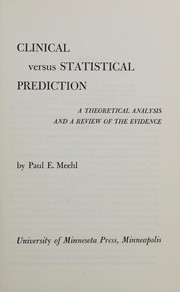
Whether clinical judgement or statistical formulas predict better in psychology.
“Paul E. Meehl, Clinical versus Statistical Prediction: A Theoretical Analysis and a Review of the Evidence (Minneapolis, MN: University of Minnesota Press, 1954)” — Michael Mauboussin
Source: BIN There, Done That: How to Reduce the Sources of Forecasting Error, page 14
Recommended by: Michael Mauboussin, Daniel Kahneman