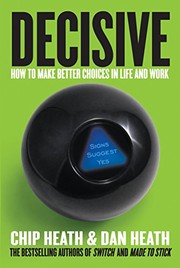
Decisive: How to Make Better Choices in Life and Work
Four traps that ruin decisions, such as narrow framing, and a process to beat each.
Summary
The Heath brothers identify four failures that damage decisions and give a process for countering each. The failures are narrow framing, meaning considering too few options; confirmation bias, meaning collecting evidence that supports the option already preferred; short-term emotion, meaning deciding while a temporary feeling dominates; and overconfidence about the future.
Their process is the WRAP sequence. Widen your options counters narrow framing, using techniques including the vanishing options test, which asks what you would do if none of the current options were available; multitracking, which means considering several options simultaneously rather than sequentially; and finding someone who has already solved the problem. Reality-test your assumptions counters confirmation bias, using ooching, which means running a small test rather than committing; deliberately seeking disconfirming information; and considering the base rate. Attain distance before deciding counters short-term emotion, using the ten-ten-ten test asking how the decision will feel in ten minutes, ten months and ten years, and asking what you would advise a friend to do. Prepare to be wrong counters overconfidence, using premortems, setting tripwires that trigger reconsideration, and bookending the range of possible outcomes rather than predicting a point.
The evidence comes from decision research including Paul Nutt's studies finding that whether-or-not decisions failed at much higher rates than decisions among multiple options.
The book is a synthesis rather than original research, and some cited studies have replicated poorly. The four failures overlap and the acronym is contrived. The specific techniques, particularly tripwires and the vanishing options test, are practical and are used by people who dislike the rest of the framework.
Key takeaways 8
- Decisions framed as whether or not to do one thing fail at much higher rates than decisions among several genuine options.
- Asking what you would do if the current options disappeared forces the generation of alternatives that were available all along.
- Considering several options simultaneously produces better outcomes than evaluating them one at a time in sequence.
- Running a small test before committing produces information that no amount of analysis will, which the authors call ooching.
- Asking how a decision will look in ten minutes, ten months and ten years removes the distortion of short-term emotion.
- Asking what you would advise a friend in the same position produces clearer answers than deliberating about yourself.
- Setting a tripwire, meaning a predefined condition that triggers reconsideration, prevents drift into commitments nobody decided to make.
- Estimating a range of outcomes rather than a point prediction produces better preparation, and most people set the range far too narrow.
Who should read it
Operators and investors who want a specific process for the four recurring decision failures, particularly tripwires and multitracking.
Who recommended it 8 · 6 direct
“Interesting and insightful dive into the subject of how to make big decisions. Specific useful advice.”
“There is also a clear discussion of this concept in Chip Heath and Dan Heath, Decisive: How to Make Better Choices in Life and Work (New York: Crown Business, 2013), 201203”
Similar books 6
Chosen by shared topics, the entries that hold them, and the people who recommended both.
Why people mistake luck for skill, above all in markets.
“Fooled By Randomness was unquestionably the best non-fiction book I read in 2005.” — Brad Feld
Source: Book Review: Fooled By Randomness — Feld Thoughts
Recommended by: Barton Biggs, Brad Feld, Derek Sivers and 15 others
Why people misjudge, with thinking tools from Munger, Buffett, Darwin and Feynman.
“…books I've recommended, highlighted to death, or forced on friends.” — Andrew Wilkinson
Source: Andrew Wilkinson's Bookshelf, neverenough.com
Recommended by: Andrew Wilkinson, David Perell, Derek Sivers and 9 others
How snap judgments work, when to trust them and when they mislead.
“Malcolm Gladwell, Blink: The Power of Thinking Without Thinking (New York: Little, Brown and Company, 2005)” — Michael Mauboussin
Source: Are You an Expert? Experts and Markets, page 9
Recommended by: Michael Mauboussin, Mohnish Pabrai and 2 others
How cognitive dissonance drives people to justify their mistakes, not admit them.
“We are wired for self-justification. We create fictions that absolve us of responsibility, restoring our belief that we are smart, moral, and right — a belief that often keeps us on a course that is dumb, immoral, and wrong.” — Derek Sivers
Source: Derek Sivers book notes (primary, rated list) · Rating: 3/10
Recommended by: Derek Sivers, Howard Marks, Mohnish Pabrai and 3 others
How firefighters, pilots and other experts decide under time pressure.
“Gary Klein, Sources of Power: How People Make Decisions (Cambridge, MA: MIT Press, 1998)” — Michael Mauboussin
Source: A Process for Outperformance: Thoughts on Organizing for Investing Success, page 4
Recommended by: Michael Mauboussin, Mohnish Pabrai
What a four-year forecasting tournament showed about the best forecasters' habits.
“In a book many in our research department have enjoyed, Superforecasting: The Art and Science of Prediction, Philip Tetlock and Dan Gardner state: “The humility required for good judgment is not self-doubt—the sense that you are untalented, unintelligent, or unworthy.” — Bill Nygren
Source: Bill Nygren Market Commentary | 1Q17
Recommended by: Bill Nygren, Mark Leonard and 11 others