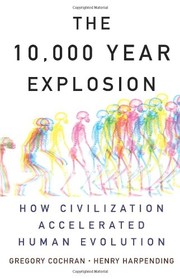
The 10,000 Year Explosion: How Civilization Accelerated Human Evolution
How lactose tolerance, malaria resistance and blue eyes evolved in 10,000 years.
Summary
Gregory Cochran and Henry Harpending, anthropologists, reject the long-held view that significant human biological evolution ended with the "great leap forward" in Europe 40,000 to 50,000 years ago. Malaria resistance, blue eyes and lactose tolerance have all emerged in the last 10,000 years, and the authors argue that human evolution has accelerated in that time.
Their central claim is that agriculture greatly increased the rate of human evolution, producing many adaptations to the new challenges and ways of life it created. These adaptations varied between populations, depending on when each adopted farming and how far it mixed genetically with others. They include skin colour, disease resistance and lactose tolerance, and, the authors argue, personality and cognitive traits such as reduced strength, longer-term planning or greater docility, favoured in a world of farming, trade, government and cities. They speculate that genetic change in Europe over the past millennium helped bring about the scientific and industrial revolutions. Some reviewers found the questions valuable but the views discredited; others criticised the book for oversimplifying history and treating race as fixed.
Key takeaways 4
- Cochran and Harpending argue that human evolution sped up after agriculture began.
- Lactose tolerance and malaria resistance arose within the last 10,000 years.
- They claim farming selected for cognitive and personality traits as well as physical ones.
- Critics charge the book with oversimplifying history and reifying race.
Who should read it
Readers interested in human evolution and in controversial arguments about genes and history.
Who recommended it 2 · 1 direct
Similar books 6
Chosen by shared topics, the entries that hold them, and the people who recommended both.
The genetic basis of race and its role in human history, from genome mapping.
Recommended by: Mohnish Pabrai
What in the few genes that separate us from apes made humans different.
Recommended by: Charlie Munger, Mohnish Pabrai
Population genetics as a new way to answer who the Jewish people are.
Recommended by: Patrick Collison
How ancient DNA has rewritten the story of human prehistory and migration.
Recommended by: Balaji S. Srinivasan, Marc Andreessen and 3 others
What the Americas were like before Europeans arrived, against the old view.
Recommended by: Mohnish Pabrai
The biological upheaval that followed Columbus's voyages, and the world it made.
Recommended by: Mohnish Pabrai