
The Age of Discontinuity
Four breaks with the postwar world, from a global economy to knowledge as capital.
Summary
Drucker argues that the postwar continuities were ending and identifies four discontinuities: new technologies creating new industries, a genuinely global economy replacing international trade between national economies, the growth of large institutions and the resulting problem of their governance, and the emergence of knowledge as the central economic resource.
The fourth is the one he is remembered for. Drucker introduced the term knowledge worker here and argued that the productivity of people who work with information, whose output cannot be measured by units produced and whose managers frequently know less about the work than they do, is the central management problem of the coming period. He argued that such workers own their means of production, that they are mobile in a way industrial labour was not, and that managing them requires setting objectives and then leaving them to determine method.
His institutional chapters argue that large organisations, public and private, had become the mechanism through which society performs its tasks, and that their governance and their tendency toward self-preservation is the political problem of the era. He proposes what he calls reprivatisation, arguing that government should decide and fund while other institutions perform, which anticipated a great deal of later policy.
The book is a work of forecasting from 1969 and readers should assess it as such. The knowledge work argument was correct and early. The predictions about specific technologies and industries were mixed. Drucker writes discursively and the book is long relative to its content.
Key takeaways 7
- Knowledge became the central economic resource, which means the productivity of knowledge workers is the primary management problem.
- Knowledge workers own their means of production and are therefore mobile in a way industrial workers were not, which changes the employment relationship permanently.
- Managing knowledge workers requires setting objectives and leaving method to the worker, because the manager frequently knows less about the work.
- The economy became genuinely global rather than a set of national economies trading, which means competition and supply operate on a different unit than policy does.
- Large institutions became the mechanism through which society performs its tasks, and their governance is the central political problem that follows.
- Government should decide and fund while other institutions perform, since government is poor at operating anything and reasonable at setting direction.
- New industries arise from technologies that do not fit existing industry boundaries, which is why established firms in adjacent sectors consistently miss them.
Who should read it
Executives interested in the origin of knowledge work as a management category, read as forecasting from 1969.
About Peter F. Drucker
Management writer and consultant; professor at Bennington, NYU and Claremont Graduate University
He invented management as a field of study, and The Practice of Management and The Effective Executive remain the primary sources every later writer builds on.
Who recommended it 1 · 1 direct
Similar books 6
Chosen by shared topics, the entries that hold them, and the people who recommended both.
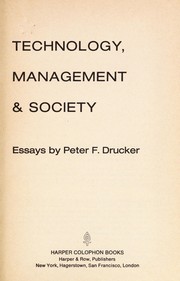
Essays on technology, its history and its link to management and society.
Recommended by: Patrick Collison

Essays from five decades on community, society and how they function.

The third of the early books on industrial society: work, management and labour.
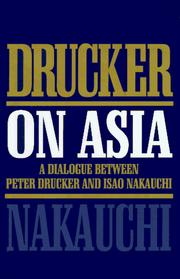
A dialogue by letter between Peter Drucker and Daiei's founder on Asia's economies.
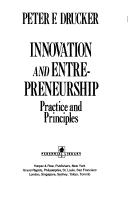
Innovation as a learnable discipline, with seven sources of opportunity to search.
Recommended by: Patrick Collison, Patrick O'Shaughnessy and 1 other

Knowledge workers must run their own careers by knowing their strengths and values.
Recommended by: Nat Eliason, Patrick Collison and 4 others