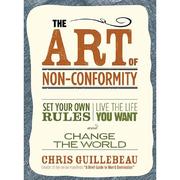
The Art of Non-Conformity
How to live and work on your own terms rather than as convention expects.
Summary
The reference has not verified this book in detail; the summary states only what the title, author and subject establish.
Chris Guillebeau builds the book on his online manifesto A Brief Guide to World Domination, written for readers who have thought there must be more to life than their current work. He challenges common assumptions about how a life and a career should run and offers tools for living differently.
The main subjects are creative self-employment, radical goal-setting, contrarian travel and treating life as a continuing adventure. Guillebeau uses his own story and those of other people who chose unconventional lives as examples, and asks readers to draw up their own plan for what he calls world domination, which he defines as living on one's own terms while making the world better at the same time.
Key takeaways 4
- Conventional career paths are assumptions that can be questioned.
- Self-employment can be designed around personal goals.
- Ambitious, specific goals give an unconventional life its direction.
- Travel and adventure can be planned into ordinary life.
Who should read it
Readers dissatisfied with a conventional job who are considering self-employment or an unconventional life.
Who recommended it 1 · 1 direct
Similar books 6
Chosen by shared topics, the entries that hold them, and the people who recommended both.
Applying product design methods to the way you organise your own work.
Recommended by: David Perell, Nat Eliason
How a person can live the life they want despite the constraints around them.
“Some fun "fist in the air" thoughts on freedom, from 1973. Includes related thoughts on parenting and honesty.” — Derek Sivers
Source: Derek Sivers book notes (primary, rated list) · Rating: 3/10
Recommended by: Derek Sivers, Nat Eliason
Knowledge workers must run their own careers by knowing their strengths and values.
Recommended by: Nat Eliason, Patrick Collison and 4 others
How masters from Leonardo to Faraday found a life's task and served apprenticeships.
“Mostly detailed historical biographical tales of ”masters” like DaVinci, Darwin, Mozart, Proust, Goethe, Wright Brothers, Einstein, Coltrane, Martha Graham, etc. Lessons dissected from their successes, and categorized. Similar format to his great book “48 Laws of Power”, but a little less effective here. The biographies were interesting, but lessons were mostly conventional wisdom.” — Derek Sivers
Source: Derek Sivers book notes (primary, rated list) · Rating: 5/10
Recommended by: Derek Sivers, Nat Eliason, Ryan Holiday and 6 others
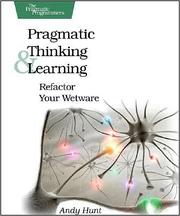
Cognitive science and learning theory applied to thinking and learning better.
“A great curated collection of facts about how to learn effectively and think clearly. Since it's written by a programmer, it makes many computer analogies that fellow programmers will appreciate. Non-programmers might feel a little left out.” — Derek Sivers
Source: Derek Sivers book notes (primary, rated list) · Rating: 5/10
Recommended by: Derek Sivers, Nat Eliason
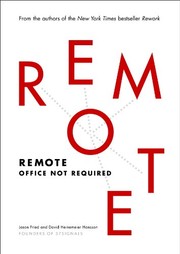
Why remote work beats office work for most knowledge workers, and how to run it.
“Speaking of being a distributed company with lots of text communication, I'm going to recommend a book called Remote, which is by the folks over at Basecamp, Jason Fried and David Heinemeier Hansson.” — Matt Mullenweg
Source: The Tim Ferriss Show Transcripts: Books I've Loved — Matt Mullenweg (#420)
Recommended by: Matt Mullenweg, Nat Eliason, Richard Branson and 3 others