The Bet
Julian Simon and Paul Ehrlich's wager on metal prices, and their fight over scarcity.
Summary
Paul Sabin tells the story of the wager that the economist Julian Simon offered the biologist Paul Ehrlich in 1980 on the future prices of five metals, which caught the public imagination as a test of whether prosperity or doom lay ahead. Ehrlich, author of The Population Bomb, predicted that growing populations would cause overconsumption, scarcity of resources and famine, with apocalyptic results. Simon countered that human welfare would improve thanks to flexible markets, technological change and human ingenuity.
Sabin weaves together the two men's lives and ideas with the partisan political battles of the period over the environment and the role of government. His narrative runs from the dawning environmentalism of the 1960s through the presidential contest between Jimmy Carter and Ronald Reagan and into the 1990s. He shows how the fight between Ehrlich and Simon, between environmental fear and confidence in free markets, helped shape the partisan divide over the environment and the role of government.
Key takeaways 4
- Simon and Ehrlich bet in 1980 on the prices of five metals.
- Ehrlich expected scarcity; Simon expected markets and technology to prevail.
- Their dispute mirrored a wider political divide over the environment.
- The quarrel fed a partisan divide over environmental policy.
Who should read it
Readers interested in environmental economics and the politics of scarcity.
Who recommended it 1 · 1 direct
Similar books 6
Chosen by shared topics, the entries that hold them, and the people who recommended both.
A computer model of exponential economic and population growth on finite resources.
Recommended by: Bill Gates
How global warming and environmental decline threaten economies, and what to do.
Recommended by: Bill Gates
A guide to carbon markets: allowances, offsets, registries and schemes.
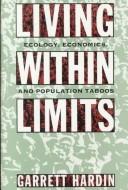
Population and consumption face physical limits that economics ignores.
“In Living Within Limits, Hardin focuses on the neglected problem of overpopulation, making a forceful case for dramatically changing the way we live in and manage our world. Our world itself, he writes, is in the dilemma of the lifeboat: it can only hold a certain number of people before it sinks-not everyone can be saved.” — Shane Parrish
Source: What Books Would You Recommend Someone Read to Improve their General Knowledge of the World?
Recommended by: Charlie Munger, Mohnish Pabrai and 1 other
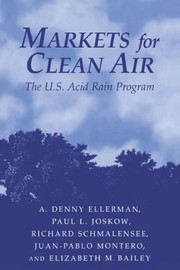
How the 1990 US sulphur dioxide allowance trading programme worked in practice.
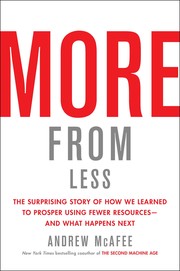
Evidence that rich economies now grow while using fewer physical resources.
“on how modern technological economies can build more outputs with less inputs” — Marc Andreessen
Source: @pmarca, companion thread to 'It's Time to Build'
Recommended by: Marc Andreessen