Updates

  1. Person pages list letters, writing, profiles and links as sortable tables with filters, and show each person's companies as links; Fund letters show each letter's description in its own column.
  2. Experts show a checked job title and a short description of each person; 30 more people have photographs.
  3. Every company, fund, university and publication the experts work for has a page listing the people there.
  4. Fund letters show each letter's thesis and filter by it; 225 person pages list the essays, columns and newsletter issues the person wrote.
  5. Person pages list every essay and newsletter issue a person wrote, and their own books as a table in List view.
  6. Recommends shows the five largest kinds of book and the rest under More; browse pictures load sooner.
  7. Podcasts and talks link the original episode, filter by Audio and video or Press, and list each publisher once.
  8. Pages are wider, Recommends has List and Grid, and a filter clicked again turns off.
  9. Book cards sit in a ruled grid with Open Library and Goodreads links and each book's one-line note.
  10. Funds is now Investors; each investor's styles are buttons that filter the table.
  11. Podcasts and talks on a person's page filter by year and publisher and show as a list or a grid of pictures.
  12. Quotes show only people's own words: 472 summaries written by list sites are gone.
  13. Country pages open from Browse again, and every link on the shelf lands on a page.
  14. Subject and person pages show their sections as tabs, and each book appears once on a person's page.
  15. Book cards show the quote, who said it and the source; grids show five cards to a row.
  16. On a phone, a menu holds the sections, search, Updates, Feedback and dark mode.
  17. Feedback takes a screenshot of the page with no browser prompt, opens a screenshot full size when you click it, and clears itself once sent.
  18. Book cards are centred, search names the topic each book sits in, and any text cut short shows whole on hover.
  19. Search groups its results by kind: people, companies, geographies, subjects, topics, books, funds, fund letters and papers.
  20. The Books table lists who recommended each book by name, and the browser tab names the section you are in.
  21. Feedback can take a screenshot of the page, or one you paste or choose, and opens in the corner beside Updates.
  22. Each rail button reopens its section where you left it, and Browse, Table and People show on every book and subject page.
  23. Filters grey out choices that hold nothing instead of hiding them, and Books › People filters by authors or recommenders.
  24. Feedback takes a subject line and up to three screenshots.
  25. Biographies are grouped by the person they are about: 41 new pages, from Abraham Lincoln to Lee Kuan Yew.
  26. Sport splits into 23 sports, and Religion into one topic per faith.
  27. Book lists show as cards: the cover, one recommendation quote and every recommender by name.
  28. Seventeen subjects that had two or three pages under different names now have one page each.
  29. Every page lists its Experts as authors and recommenders, with a link to them on the Experts tab.
  30. Economics, Financial history, Financial panics and Accounting are subjects of their own, with one page per financial crisis.
  31. Book, person and subject pages open inside the app, so the tabs stay in view.
  32. 996 more book covers, and photographs or logos for 227 more people and companies.
  33. Books › Browse shows every subject as cards, and the rail holds Fund letters, Papers, Experts, Books and Funds.
  34. Every topic over 150 books splits into narrower topics, each with a page of its own.

Send feedback

What is it?
Screenshots, up to 3 (optional)
or paste one with Ctrl+V

We use your email only to reply to you.

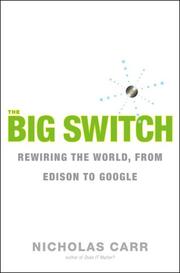
The Big Switch

The Big Switch

Nicholas G. Carr
2008
T2 276 pages · about 4h 36m to read Open Librarygoodreads

Computing as a utility; the argument that anticipated the cloud model.

Summary

Carr argues that computing is following the path electricity took: from something each organisation generated for itself to a utility supplied over a network by specialised providers at a scale no individual user could match.

The historical parallel occupies the first half. Factories in the nineteenth century generated their own power with waterwheels and steam engines, and each had a plant and staff to run it. Once alternating current made long-distance transmission viable, central generation became so much cheaper that private generation disappeared within about two decades. Carr argues the same economics apply to computing: data centres achieve utilisation, purchasing and operational efficiencies that an individual company's servers cannot, and the internet supplies the transmission.

His prediction, made in 2008, was correct. Corporate data centres have largely been replaced by cloud providers, and the internal information technology function's role has changed as he described.

The second half concerns consequences and is more speculative. Carr argues that utility computing concentrates enormous power in a small number of providers, that the economics produce fewer jobs than the industries they replace, that the personalisation the technology enables fragments shared culture and public discourse, and that the aggregate of individual choices produces outcomes nobody chose.

The utility argument was well made and correct. The social chapters are essayistic and their predictions are mixed. The book's value now is as a demonstration that a structural economic argument about technology can be correct while its social consequences remain unclear.

Key takeaways 7

  1. Computing follows the path electricity took, from private generation by each user to utility supply by specialised providers at unmatched scale.
  2. Central generation displaced private power within about two decades once transmission made it viable, which sets the base rate for such transitions.
  3. Data centre operators achieve utilisation, purchasing and operational efficiencies that an individual company's own servers cannot approach.
  4. Utility computing concentrates enormous power in a small number of providers, which is a structural consequence of the economics rather than a policy choice.
  5. The information technology function's role changes from operating infrastructure to selecting and integrating services once the utility model prevails.
  6. Digital industries generate far fewer jobs than the industries they replace, because their scale economics do not require proportionate labour.
  7. A structural economic argument about a technology can be correct while its social consequences remain genuinely unclear.

Who should read it

Operators and investors interested in the utility computing transition and in the pattern of infrastructure centralising once transmission is solved.

Who recommended it 1

Marc Benioffreported

Similar books 6

Chosen by shared topics, the entries that hold them, and the people who recommended both.
T2 Free
Chris Anderson · 2009

Digital costs near zero mean goods can be given away, which changes whole industries.
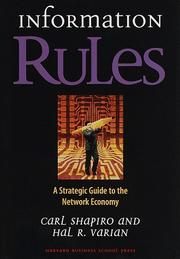
Carl Shapiro, Hal R. Varian · 1998

Economics for information goods: pricing, versioning, lock-in and network effects.

Adam B. Jaffe, Josh Lerner · 2004

How 1980s changes turned the US patent system from aid to obstacle for innovation.

Dan Breznitz · 2007

How Israel, Taiwan and Ireland each used the state to build IT industries.

David S. Evans, Andrei Hagiu, Richard Schmalensee · 2006

Software platforms as two-sided markets, and how they price and grow.

Where it sits in the reference 2

Business models
Economics

Topics

Technology and ComputingEconomicsTech strategy and platform economics