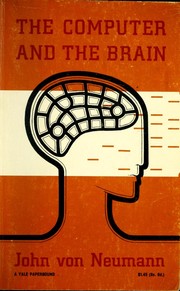
The Computer and the Brain
A computing pioneer on how the brain differs from computers as a computing machine.
Summary
John von Neumann, the mathematician and computing pioneer, began The Computer and the Brain shortly before his death; it was intended for Yale's Silliman Lectures and was published, unfinished, in 1958 with a preface by his widow, Klara Dan von Neumann. At only 96 pages, it discusses how the brain can be viewed as a computing machine.
The book is speculative, but von Neumann sets out important differences between brains and the computers of his day, such as processing speed and parallelism, and suggests directions for future research. He concludes that the brain operates partly digitally and partly analogically, and that it uses a peculiar statistical language unlike that of man-made computers. The second edition of 2000 adds a foreword by the philosophers Paul and Patricia Churchland placing his views in the science of his time; a third edition of 2012 has a foreword by Ray Kurzweil.
Key takeaways 4
- The brain works partly like a digital and partly like an analogue machine.
- Brains trade speed for massive parallelism compared with computers.
- The brain's internal language is statistical, unlike machine code.
- Von Neumann left the book unfinished at his death.
Who should read it
Readers interested in the history of computing and early ideas about the brain as a computer.
Who recommended it 1 · 1 direct
Similar books 6
Chosen by shared topics, the entries that hold them, and the people who recommended both.
Computer models of how minds make analogies and create.
Recommended by: Patrick Collison
A theory of how the human mind works and how thought arises.
Recommended by: Patrick Collison
How a future of abundant human and machine intelligence may change the world.
Recommended by: Patrick Collison
What happens as technology stands in for people's experience of nature.
Recommended by: Patrick Collison
An economist's forecast of a world of emulated human brains running as software.
Recommended by: Patrick Collison
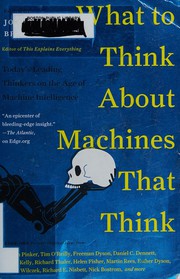
Nearly two hundred thinkers on artificial intelligence.
Recommended by: Patrick Collison