The Design of Everyday Things
Why objects confuse people, and how affordances, signifiers and feedback fix them.
The book that introduced affordances, signifiers, and feedback loops to a generation of designers. Norman's analysis of why doors, phones, and stoves confuse people is the clearest argument that bad design is a systems failure, not user error. Everything else on this list builds on this vocabulary.
Summary
Norman argues that when people struggle with an object, the fault is the design and not the user. He builds a vocabulary for analysing that failure: affordances, meaning the possible actions an object permits; signifiers, meaning the perceivable indications of where to act; mappings, meaning the relationship between controls and their effects; constraints, meaning what the design prevents; and feedback, meaning immediate information about the result of an action.
His central model is the gulf of execution and the gulf of evaluation, which describe the distance between what a person wants to do and what the system lets them do, and between what the system does and what the person can perceive of it. He also gives the seven stages of action and uses them to locate where a design fails.
The error chapters are the most consequential. Norman separates slips, where the intention was right and the execution wrong, from mistakes, where the intention itself was wrong, and argues that design should prevent errors by constraint and should make them recoverable when they occur. He attacks the practice of blaming human error in accident investigations, arguing that it stops the analysis at the point where design failure begins.
The revised edition adds material on human-centred design, iteration and complexity. Some readers find the door examples overused and the book repetitive. Critics have noted that Norman's later work walks back the strictest version of the simplicity argument, since he later published a defence of complexity. The vocabulary is now standard in product and interface design, which makes the book foundational rather than novel to anyone already working in the field.
Key takeaways 8
- When a person cannot operate an object, the design has failed rather than the user, and blaming human error prevents the actual diagnosis.
- Discoverability and understanding are the two properties a design must deliver, meaning a person can determine what actions are possible and what state the system is in.
- Affordances are the possible actions an object permits, and signifiers are the perceivable signals of where to act, which are different things that designers routinely conflate.
- Natural mapping between controls and their effects removes the need for labels, instructions and memory.
- Feedback must be immediate and informative, and delayed or absent feedback causes users to repeat actions and compound errors.
- Constraints built into a design prevent errors more reliably than warnings or training do.
- Slips and mistakes have different causes and require different design responses, since slips come from correct intentions executed wrongly.
- Root cause analysis that terminates at human error stops one step before the design decision that made the error likely.
Who should read it
Founders and product people making anything a person has to operate, who need a precise vocabulary for why an interface is failing.
Who recommended it 13 · 3 direct
“Designing software is difficult, to be sure, but designing a door is difficult too.”
Similar books 6
Chosen by shared topics, the entries that hold them, and the people who recommended both.
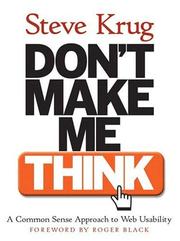
Web usability: why every page should be self-evident and how to test that it is.
“The classic book of web usability. Required reading for anyone who makes websites.” — Derek Sivers
Source: Derek Sivers book notes (primary, rated list) · Rating: 7/10
Recommended by: Brian Armstrong, Derek Sivers, Jeff Atwood and 8 others
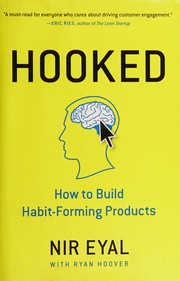
A four-step model for habit-forming products: trigger, action, reward, investment.
Recommended by: David Cancel, Nat Eliason, Nir Eyal and 6 others
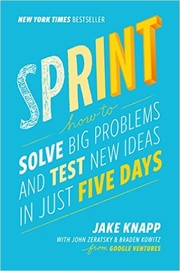
A five-day process for answering a business question by prototyping and testing.
Recommended by: Andy Budd, Jessica Hische, Marty Cagan and 1 other

Specific design tactics for developers: spacing, type, colour and shadows.
Recommended by: Charlie Marie Prangley, Jordan Hughes
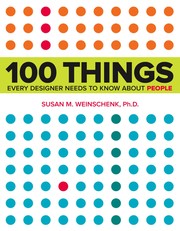
Research on how people see, remember, decide and feel, applied to design.
Recommended by: Jan Losert, Johnnie Gomez, Nir Eyal
Goal-directed design and personas: fitting software to how users think it works.
Recommended by: Jeff Atwood, Patrick Collison