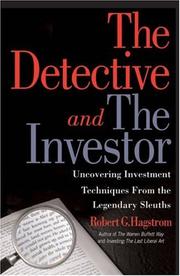
The Detective and the Investor: Uncovering Investment Techniques from the Legendary Sleuths
Summary
Hagstrom draws an extended analogy between detective fiction and security analysis, organising the book around three fictional detectives and the reasoning method each represents.
Auguste Dupin, from Poe's stories, represents what Hagstrom calls the analytical imagination: the detective who solves a case by reconstructing how the perpetrator thought rather than by collecting physical evidence, which he applies to understanding a company's management and competitive position from the inside out. Sherlock Holmes represents observation and inference from small details, and Hagstrom uses him for the argument that the significant evidence in an investment case is usually available and unexamined rather than hidden. Father Brown, from Chesterton's stories, represents intuition informed by understanding human motivation, and Hagstrom uses him to argue that a great deal of what determines an outcome is a question about people rather than about numbers.
The investment content covers scepticism about received explanations, the discipline of examining evidence that contradicts a thesis, the importance of understanding motivation, and the distinction between what is observed and what is inferred.
The reference has not verified the specific investment cases in this book. The analogy is extended further than it supports, and the practical content is thinner than the framing suggests. Readers wanting Hagstrom's arguments should use Investing: The Last Liberal Art or his Buffett books. This is a light treatment of familiar material through an unusual device.
Key takeaways 7
- The evidence that determines an investment case is usually available and unexamined rather than hidden or unavailable.
- Reconstructing how management thinks about their own business produces understanding that financial analysis alone does not.
- Evidence that contradicts a thesis must be actively sought, since the natural process of investigation collects confirming material.
- Distinguishing what is observed from what is inferred prevents an assumption from being treated as a fact later in the analysis.
- A great deal of what determines an investment outcome is a question about people and their motivations rather than about numbers.
- Received explanations for a company's situation should be treated as claims to be tested rather than as facts.
- The reference has not verified the specific investment cases in this book, and Hagstrom's other work covers the material more substantively.
Who should read it
Investors wanting a light treatment of investigative reasoning applied to analysis, with Hagstrom's other books as the substantive sources.
About Robert G. Hagstrom
American portfolio manager who ran Legg Mason's Focus Trust and later served as chief investment strategist at EquityCompass.
The Warren Buffett Way was the first book to reconstruct Buffett's purchases as a repeatable set of business, management, financial and valuation tests, and it set the template later Buffett books follow. Latticework and Investing: The Last Liberal Art carry the same argument into physics, biology and psychology as sources of investment models.
Who recommended it 1 · 1 direct
Similar books 6
Chosen by shared topics, the entries that hold them, and the people who recommended both.
Mental models from physics, biology and psychology, applied to investing.
“I'd recommend reading Robert Hagstrom's outstanding book, Latticework.” — Mohnish Pabrai
Source: Pabrai recommending Hagstrom's book on mental models
Recommended by: Mohnish Pabrai
What physics, biology, psychology and other fields teach about investing.
“here's a book I read, Robert Hagstrom, who has written a lot of books about Buffett” — Thomas Gayner
Source: Masters in Business transcript: Thomas S. Gayner, Markel Corp
Recommended by: Morgan Housel, Thomas Gayner
Recommended by: Mohnish Pabrai

Investing lessons from the career-defining mistakes of billionaire investors.
Recommended by: Mohnish Pabrai

Seventy questions to ask before buying any business.
Recommended by: Mohnish Pabrai and 1 other

How to separate skill from luck in business, sport and investing.
Recommended by: Mohnish Pabrai, Jessica Livingston and 3 others
Where it sits in the reference 2
Topics