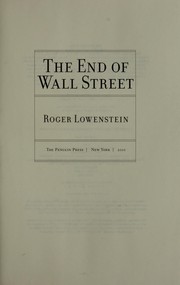
The End of Wall Street
The housing boom, the fall of the banks, and the government's rescues.
Summary
Lowenstein covers the 2008 financial crisis from the origins of the housing boom through the rescues, with more attention to the preceding decade than most crisis accounts give. His explanatory sequence starts with the change in mortgage lending, covering the growth of subprime origination, the deterioration in underwriting standards as originators sold loans rather than holding them, the role of Fannie Mae and Freddie Mac, and the regulatory decisions that permitted the growth. He then covers securitisation, the rating agencies' models and the collateralised debt obligation market, and the accumulation of exposure on bank balance sheets through vehicles that were not consolidated.
The institutional narrative covers Bear Stearns, Lehman, AIG, Merrill Lynch, the money market funds, and the official response, with Lowenstein's characteristic attention to the individuals making the decisions.
His analytical argument is that the crisis resulted from a widely shared belief that house prices would not fall nationally, that this belief was embedded in every model and every risk calculation, and that the leverage employed meant the belief did not need to be very wrong to produce insolvency. He also argues that the regulatory failure was less about the absence of rules than about regulators sharing the same beliefs as the institutions they supervised.
Lowenstein is a financial journalist and the finance is explained clearly for general readers. The book covers the same ground as several others and its distinguishing feature is the attention to the decade preceding the crisis rather than to the weeks of the collapse. His When Genius Failed remains the better book on the mechanism of leverage.
Key takeaways 8
- Mortgage underwriting standards deteriorated because originators sold the loans rather than holding them, which removed the consequence of poor lending.
- A widely shared belief that house prices would not fall nationally was embedded in every model and every risk calculation.
- The leverage employed meant that belief did not need to be very wrong to produce insolvency across the system.
- Rating agency models assumed regional rather than national default correlation, which invalidated every conclusion drawn from them.
- Exposure accumulated on bank balance sheets through vehicles that were not consolidated and therefore not visible in reported leverage.
- The regulatory failure was less about missing rules than about regulators sharing the same beliefs as the institutions they supervised.
- Money market funds breaking the buck transmitted the crisis from securities markets into short-term corporate funding within days.
- The preceding decade rather than the weeks of collapse contains the decisions that produced the outcome.
Who should read it
Readers who want a crisis account weighted toward the preceding decade rather than toward the weeks of the collapse.
About Roger Lowenstein
Financial journalist and author; Wall Street Journal reporter for over a decade
Buffett: The Making of an American Capitalist and When Genius Failed are the standard reference accounts of Buffett's rise and of the LTCM collapse.
Who recommended it 2 · 2 direct
“Andrew Ross Sorkin’s Too Big to Fail10 is fabulous, as is Roger Lowenstein’s The End of Wall Street.11 In fact, all of Roger Lowenstein’s books are excellent, and so we should read everything Roger has written.”
Similar books 6
Chosen by shared topics, the entries that hold them, and the people who recommended both.
How defined-benefit pension promises became unpayable, through three cases.
Recommended by: Mohnish Pabrai
Journalism written during four crises, from the 1987 crash to LTCM's collapse.
Recommended by: Mohnish Pabrai, Seth Klarman
The few investors who saw subprime mortgage bonds would fail, and bet against them.
“Lewis, Michael, The Big Short: Inside the Doomsday Machine (New York: W.W. Norton & Company, 2010)” — Michael Mauboussin
Source: Blaming the Rat: Incentives, Motivation, and How They Interact, page 15
Recommended by: Jim Collins, Michael Mauboussin and 7 others
Inside the meetings of bankers and regulators during the 2008 financial crisis.
“I thought Too Big to Fail was terrific, and Sorkin's newest book is just as thoroughly researched as his last one.” — Bill Gates
Source: My summer best list for 2026 — Gates Notes
Recommended by: Bill Gates, Mohnish Pabrai, Seth Klarman and 2 others
How a hedge fund's bond bets on borrowed money lost $4.6 billion in four months.
“Roger Lowenstein, When Genius Failed: The Rise and Fall of Long-Term Capital Management (New York: Random House, 2000), 72” — Michael Mauboussin
Source: A Tail of Two Worlds: Fat Tails and Investing, page 4
Recommended by: Bill Gurley, Michael Mauboussin and 9 others
Quantitative investors, from the field's rise to the crises that hit it.
Recommended by: Mohnish Pabrai
Where it sits in the reference 2
Topics 2
As an Amazon Associate I earn from qualifying purchases.