Updates

  1. Person pages list letters, writing, profiles and links as sortable tables with filters, and show each person's companies as links; Fund letters show each letter's description in its own column.
  2. Experts show a checked job title and a short description of each person; 30 more people have photographs.
  3. Every company, fund, university and publication the experts work for has a page listing the people there.
  4. Fund letters show each letter's thesis and filter by it; 225 person pages list the essays, columns and newsletter issues the person wrote.
  5. Person pages list every essay and newsletter issue a person wrote, and their own books as a table in List view.
  6. Recommends shows the five largest kinds of book and the rest under More; browse pictures load sooner.
  7. Podcasts and talks link the original episode, filter by Audio and video or Press, and list each publisher once.
  8. Pages are wider, Recommends has List and Grid, and a filter clicked again turns off.
  9. Book cards sit in a ruled grid with Open Library and Goodreads links and each book's one-line note.
  10. Funds is now Investors; each investor's styles are buttons that filter the table.
  11. Podcasts and talks on a person's page filter by year and publisher and show as a list or a grid of pictures.
  12. Quotes show only people's own words: 472 summaries written by list sites are gone.
  13. Country pages open from Browse again, and every link on the shelf lands on a page.
  14. Subject and person pages show their sections as tabs, and each book appears once on a person's page.
  15. Book cards show the quote, who said it and the source; grids show five cards to a row.
  16. On a phone, a menu holds the sections, search, Updates, Feedback and dark mode.
  17. Feedback takes a screenshot of the page with no browser prompt, opens a screenshot full size when you click it, and clears itself once sent.
  18. Book cards are centred, search names the topic each book sits in, and any text cut short shows whole on hover.
  19. Search groups its results by kind: people, companies, geographies, subjects, topics, books, funds, fund letters and papers.
  20. The Books table lists who recommended each book by name, and the browser tab names the section you are in.
  21. Feedback can take a screenshot of the page, or one you paste or choose, and opens in the corner beside Updates.
  22. Each rail button reopens its section where you left it, and Browse, Table and People show on every book and subject page.
  23. Filters grey out choices that hold nothing instead of hiding them, and Books › People filters by authors or recommenders.
  24. Feedback takes a subject line and up to three screenshots.
  25. Biographies are grouped by the person they are about: 41 new pages, from Abraham Lincoln to Lee Kuan Yew.
  26. Sport splits into 23 sports, and Religion into one topic per faith.
  27. Book lists show as cards: the cover, one recommendation quote and every recommender by name.
  28. Seventeen subjects that had two or three pages under different names now have one page each.
  29. Every page lists its Experts as authors and recommenders, with a link to them on the Experts tab.
  30. Economics, Financial history, Financial panics and Accounting are subjects of their own, with one page per financial crisis.
  31. Book, person and subject pages open inside the app, so the tabs stay in view.
  32. 996 more book covers, and photographs or logos for 227 more people and companies.
  33. Books › Browse shows every subject as cards, and the rail holds Fund letters, Papers, Experts, Books and Funds.
  34. Every topic over 150 books splits into narrower topics, each with a page of its own.

Send feedback

What is it?
Screenshots, up to 3 (optional)
or paste one with Ctrl+V

We use your email only to reply to you.

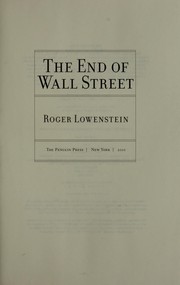
The End of Wall Street

The End of Wall Street

Roger Lowenstein
2010
T4 339 pages · about 5h 39m to read Open Librarygoodreads

Summary

Lowenstein covers the 2008 financial crisis from the origins of the housing boom through the rescues, with more attention to the preceding decade than most crisis accounts give. His explanatory sequence starts with the change in mortgage lending, covering the growth of subprime origination, the deterioration in underwriting standards as originators sold loans rather than holding them, the role of Fannie Mae and Freddie Mac, and the regulatory decisions that permitted the growth. He then covers securitisation, the rating agencies' models and the collateralised debt obligation market, and the accumulation of exposure on bank balance sheets through vehicles that were not consolidated.

The institutional narrative covers Bear Stearns, Lehman, AIG, Merrill Lynch, the money market funds, and the official response, with Lowenstein's characteristic attention to the individuals making the decisions.

His analytical argument is that the crisis resulted from a widely shared belief that house prices would not fall nationally, that this belief was embedded in every model and every risk calculation, and that the leverage employed meant the belief did not need to be very wrong to produce insolvency. He also argues that the regulatory failure was less about the absence of rules than about regulators sharing the same beliefs as the institutions they supervised.

Lowenstein is a financial journalist and the finance is explained clearly for general readers. The book covers the same ground as several others and its distinguishing feature is the attention to the decade preceding the crisis rather than to the weeks of the collapse. His When Genius Failed remains the better book on the mechanism of leverage.

Key takeaways 8

  1. Mortgage underwriting standards deteriorated because originators sold the loans rather than holding them, which removed the consequence of poor lending.
  2. A widely shared belief that house prices would not fall nationally was embedded in every model and every risk calculation.
  3. The leverage employed meant that belief did not need to be very wrong to produce insolvency across the system.
  4. Rating agency models assumed regional rather than national default correlation, which invalidated every conclusion drawn from them.
  5. Exposure accumulated on bank balance sheets through vehicles that were not consolidated and therefore not visible in reported leverage.
  6. The regulatory failure was less about missing rules than about regulators sharing the same beliefs as the institutions they supervised.
  7. Money market funds breaking the buck transmitted the crisis from securities markets into short-term corporate funding within days.
  8. The preceding decade rather than the weeks of collapse contains the decisions that produced the outcome.

Who should read it

Readers who want a crisis account weighted toward the preceding decade rather than toward the weeks of the collapse.

About Roger Lowenstein

Financial journalist and author; Wall Street Journal reporter for over a decade

Buffett: The Making of an American Capitalist and When Genius Failed are the standard reference accounts of Buffett's rise and of the LTCM collapse.

Sequoia Fund, The Wall Street Journal

Who recommended it 2 · 1 direct

Seth Klarmanreported

Similar books 6

Chosen by shared topics, the entries that hold them, and the people who recommended both.
Michael Lewis · 2008

Journalism written during four crises, from the 1987 crash to LTCM's collapse.

Recommended by: Mohnish Pabrai, Seth Klarman
Michael Lewis · 2010

The few investors who saw subprime mortgage bonds would fail, and bet against them.

Roger Lowenstein · 2000

How a hedge fund's bond bets on borrowed money lost $4.6 billion in four months.

Scott Patterson · 2010

The intellectual line from LTCM to the 2007 quant unwind.

Recommended by: Mohnish Pabrai
Andrew Ross Sorkin · 2009

Inside the meetings of bankers and regulators during the 2008 financial crisis.

Where it sits in the reference 2

Journalists
Financial panics

Topics

Financial HistoryFinance and Markets