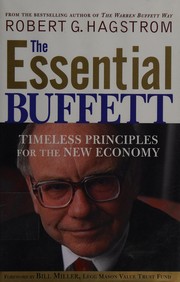
The Essential Buffett
Buffett's approach set out as tenets for judging businesses, managers and prices.
Buffett's principles restated as tenets a practitioner can apply
Summary
Hagstrom, who wrote The Warren Buffett Way, presents Buffett's approach organised into four sets of tenets: business tenets, meaning the business should be simple and understandable with consistent operating history and favourable long-term prospects; management tenets, meaning management should be rational, candid with shareholders and resistant to institutional imitation; financial tenets, meaning focus on return on equity, owner earnings, profit margins and the dollar of market value created per dollar retained; and market tenets, meaning determine intrinsic value and buy at a significant discount.
The distinctive material in this book relative to Hagstrom's earlier one is the emphasis on focus investing, meaning concentrated portfolios of a small number of holdings held for long periods. Hagstrom argues from the mathematics of portfolio concentration and from simulations that a concentrated portfolio has a higher probability of substantially outperforming and also of substantially underperforming, and that the approach requires an investor able to tolerate the volatility. He connects this to Kelly criterion reasoning about bet sizing and to Munger's arguments for concentration.
He also covers the behavioural material on why most investors cannot execute the approach and the psychology of holding through drawdowns.
The book is a secondary account and readers should note that Buffett's own writings, collected in the Berkshire letters and in Cunningham's edited Essays, state the position directly. Hagstrom's contribution is organisation and the focus investing argument, which is his own extension rather than Buffett's stated method. The empirical support for concentration is thin.
Key takeaways 7
- An investor should treat a share purchase as buying a fraction of a business and analyse it accordingly, which rules out any security the investor cannot understand.
- Return on equity and owner earnings, meaning reported earnings plus depreciation less the capital expenditure required to maintain the business, are the financial measures that matter.
- A dollar retained by management should create at least a dollar of market value, and failing that test means the earnings should be distributed.
- Concentrated portfolios of a few holdings raise both the probability of substantial outperformance and the probability of substantial underperformance.
- Position size should reflect the strength of the conviction and the odds, which is the Kelly criterion reasoning applied to equity investment.
- Management should be assessed on candour about mistakes and on resistance to imitating industry peers, both of which are observable from public statements over years.
- Most investors cannot execute a concentrated long-horizon approach because they cannot tolerate the interim volatility, which is why the opportunity persists.
Who should read it
Investors who want Buffett's criteria organised systematically alongside an argument for portfolio concentration, though Buffett's own letters state the method directly.
About Robert G. Hagstrom
American portfolio manager who ran Legg Mason's Focus Trust and later served as chief investment strategist at EquityCompass.
The Warren Buffett Way was the first book to reconstruct Buffett's purchases as a repeatable set of business, management, financial and valuation tests, and it set the template later Buffett books follow. Latticework and Investing: The Last Liberal Art carry the same argument into physics, biology and psychology as sources of investment models.
Who recommended it 2 · 2 direct
“Hagstrom, The Essential Buffett: Timeless Principles for the New Economy (New York: John Wiley & Sons, 2001), pp. 133-140. 10 Ibid., p. 137. 11 Hagstrom provides a wonderful example: “Let’s imagine you and a friend have spent the afternoon playing your favorite board game, and now, at the end of the game, you are chatting about this and that.”
“I recommend all of Hagstrom's books on Buffett.”
Similar books 6
Chosen by shared topics, the entries that hold them, and the people who recommended both.
Buffett's method as tests of the business, its managers, its finances and price.
“Tim, there's a book out called The Warren Buffett Way, and I was asked to write the foreword for the latest edition” — Howard Marks
Source: The Tim Ferriss Show Transcripts: Howard Marks (#338)
Recommended by: Howard Marks, Mohnish Pabrai, Bill Ackman and 1 other

Buffett's life to 2008, written with full access to his files and his friends.
“…books I've recommended, highlighted to death, or forced on friends.” — Andrew Wilkinson
Source: Andrew Wilkinson's Bookshelf, neverenough.com
Recommended by: Andrew Wilkinson, Austen Allred, Guy Spier and 8 others
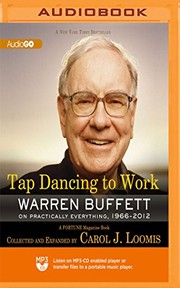
Fortune's articles by and about Buffett from 1966 to 2012, with commentary.
“I hope many people, even those who think they know Warren well, will read it cover to cover.” — Bill Gates
Source: Gates Notes review of Tap Dancing to Work
Recommended by: Bill Gates, Guy Spier, Mohnish Pabrai and 2 others
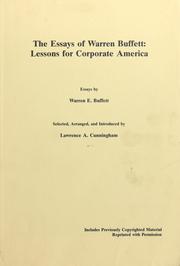
Berkshire's shareholder letters arranged by topic: governance, valuation, mergers.
“The resource is as valuable as Larry Cunningham's The Essays of Warren Buffett, which similarly organizes by subject matter” — Christopher Bloomstran
Source: Semper Augustus 2024 Letter to Clients, 'Books and Tunes for Walking', p. 96
Recommended by: Christopher Bloomstran, Francois Rochon and 11 others
Buffett's investments one by one, with the numbers and reasoning behind each.
Recommended by: Andrew Wilkinson
Stock prices follow a random walk, so a low-cost index fund beats stock picking.
“Even earlier, in 1973, in his classic A Random Walk Down Wall Street, Burton G. Malkiel had called for such a fund, although, alas, when we started it, I had yet to read his book.” — John C. Bogle
Source: CONVERGENCE!, page 1
Recommended by: Jason Zweig, John C. Bogle and 5 others
Where it sits in the reference 3
Topics 1
As an Amazon Associate I earn from qualifying purchases.