Updates

  1. Person pages list letters, writing, profiles and links as sortable tables with filters, and show each person's companies as links; Fund letters show each letter's description in its own column.
  2. Experts show a checked job title and a short description of each person; 30 more people have photographs.
  3. Every company, fund, university and publication the experts work for has a page listing the people there.
  4. Fund letters show each letter's thesis and filter by it; 225 person pages list the essays, columns and newsletter issues the person wrote.
  5. Person pages list every essay and newsletter issue a person wrote, and their own books as a table in List view.
  6. Recommends shows the five largest kinds of book and the rest under More; browse pictures load sooner.
  7. Podcasts and talks link the original episode, filter by Audio and video or Press, and list each publisher once.
  8. Pages are wider, Recommends has List and Grid, and a filter clicked again turns off.
  9. Book cards sit in a ruled grid with Open Library and Goodreads links and each book's one-line note.
  10. Funds is now Investors; each investor's styles are buttons that filter the table.
  11. Podcasts and talks on a person's page filter by year and publisher and show as a list or a grid of pictures.
  12. Quotes show only people's own words: 472 summaries written by list sites are gone.
  13. Country pages open from Browse again, and every link on the shelf lands on a page.
  14. Subject and person pages show their sections as tabs, and each book appears once on a person's page.
  15. Book cards show the quote, who said it and the source; grids show five cards to a row.
  16. On a phone, a menu holds the sections, search, Updates, Feedback and dark mode.
  17. Feedback takes a screenshot of the page with no browser prompt, opens a screenshot full size when you click it, and clears itself once sent.
  18. Book cards are centred, search names the topic each book sits in, and any text cut short shows whole on hover.
  19. Search groups its results by kind: people, companies, geographies, subjects, topics, books, funds, fund letters and papers.
  20. The Books table lists who recommended each book by name, and the browser tab names the section you are in.
  21. Feedback can take a screenshot of the page, or one you paste or choose, and opens in the corner beside Updates.
  22. Each rail button reopens its section where you left it, and Browse, Table and People show on every book and subject page.
  23. Filters grey out choices that hold nothing instead of hiding them, and Books › People filters by authors or recommenders.
  24. Feedback takes a subject line and up to three screenshots.
  25. Biographies are grouped by the person they are about: 41 new pages, from Abraham Lincoln to Lee Kuan Yew.
  26. Sport splits into 23 sports, and Religion into one topic per faith.
  27. Book lists show as cards: the cover, one recommendation quote and every recommender by name.
  28. Seventeen subjects that had two or three pages under different names now have one page each.
  29. Every page lists its Experts as authors and recommenders, with a link to them on the Experts tab.
  30. Economics, Financial history, Financial panics and Accounting are subjects of their own, with one page per financial crisis.
  31. Book, person and subject pages open inside the app, so the tabs stay in view.
  32. 996 more book covers, and photographs or logos for 227 more people and companies.
  33. Books › Browse shows every subject as cards, and the rail holds Fund letters, Papers, Experts, Books and Funds.
  34. Every topic over 150 books splits into narrower topics, each with a page of its own.

Send feedback

What is it?
Screenshots, up to 3 (optional)
or paste one with Ctrl+V

We use your email only to reply to you.

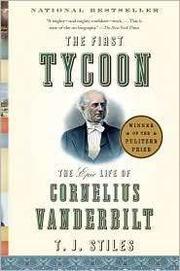
The First Tycoon: The Epic Life of Cornelius

The First Tycoon: The Epic Life of Cornelius Vanderbilt

T. J. Stiles
2009
T1 371 pages · about 6h 11m to read Open Librarygoodreads

Pulitzer and National Book Award winner; the definitive life.

Summary

Stiles won the Pulitzer Prize and the National Book Award for this biography, which is the definitive life of Cornelius Vanderbilt and is built on extensive archival research.

The business material traces a career across three industries. Vanderbilt began in Staten Island ferries and coastal steamboats, where he competed by cutting fares below cost until incumbents paid him to leave a route, a tactic he repeated for decades. He then built the Nicaragua transit route during the California gold rush, moving passengers across Central America faster and cheaper than the Panama alternative. He entered railroads late, in his seventies, and assembled the New York Central system through the Harlem, Hudson River and Central lines.

The financial material is what makes the book important. Stiles shows Vanderbilt operating in a period when the corporation as an institution was still being invented, when the distinction between a company's money and its owner's was not established, and when stock market manipulation including the Erie corner and the Harlem corners were legitimate competitive tactics. He argues Vanderbilt's real innovation was recognising that a corporation could be a vehicle for accumulating and deploying capital at a scale no individual could manage, and that his contemporaries had not grasped this.

The book is long and Stiles is careful about evidence, distinguishing what the records establish from what the legends assert. It is the best available account of American business during the corporation's formative period.

Key takeaways 7

  1. Vanderbilt competed by cutting fares below cost until incumbents paid him to leave a route, which he used repeatedly across decades and industries.
  2. His fortune was built across ferries, steamboats, ocean transit and railroads, and the common element was competing on cost and being willing to lose money longer than rivals could.
  3. The Nicaragua transit route during the gold rush moved passengers faster and cheaper than the Panama alternative and was built from nothing in months.
  4. He entered railroads in his seventies and assembled the New York Central system, which shows the capital and method transferred across industries.
  5. The corporation as an institution was still being invented, and the distinction between company money and owner money was not established.
  6. Stock market corners were legitimate competitive tactics in the period, and Vanderbilt used them against rivals as a normal part of business.
  7. His real innovation was recognising that a corporation could accumulate and deploy capital at a scale no individual could manage.

Who should read it

Investors and operators interested in American business during the corporation's formative period, in the definitive biography of its first great practitioner.

Who recommended it 1 · 1 direct

Similar books 6

Chosen by shared topics, the entries that hold them, and the people who recommended both.

Matthew Josephson · 1934

How Vanderbilt, Gould, Rockefeller, Morgan and others built 19th-century fortunes.

Recommended by: Larry Ellison
Ron Chernow · 1998

How Rockefeller built Standard Oil, faced its breakup and gave his fortune away.

“…books I've recommended, highlighted to death, or forced on friends.” — Andrew Wilkinson

Source: Andrew Wilkinson's Bookshelf, neverenough.com

Recommended by: Andrew Wilkinson, Charlie Munger and 12 others
Joseph Frazier Wall · 1970

The scholarly life of Carnegie, from Dunfermline and the railroad to steel.

Peter Krass · 2002

Harsher on the gap between Carnegie's preaching and his practice.

Recommended by: Mohnish Pabrai
Where it sits in the reference 2

Biographies
Financial history

Topics

Biography and MemoirFinancial HistoryCompany HistoriesTycoons and Business Dynasties