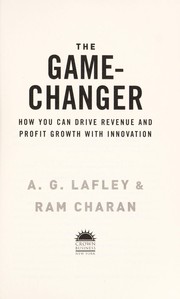
The Game-Changer
How Procter and Gamble made innovation a systematic, repeatable process.
Insider account: Lafley on making innovation a routine process.
Summary
A. G. Lafley ran Procter and Gamble from 2000 to 2010 and wrote this with Ram Charan about making innovation a systematic and repeatable process rather than an occasional achievement.
The organising claim is that the consumer is boss, meaning that innovation begins with a specific understanding of what people do and want rather than with technology. Lafley describes the research methods P and G used, including extended observation in homes and stores rather than focus groups, and the two moments of truth: when a shopper chooses the product on the shelf and when they use it at home.
The operational content covers Connect and Develop, the programme through which P and G sourced roughly half its innovation from outside the company, reversing a research culture that had prized internal invention. Lafley describes the mechanisms: technology briefs published externally, relationships with suppliers and universities, and networks of retired scientists. He also covers the integration of innovation into the strategy and budgeting process, the portfolio approach balancing incremental with transformational projects, the organisational structures that support each, and the treatment of innovation as a social process requiring cross-functional teams rather than an isolated research function. The book is a chief executive's account and does not examine failures rigorously. The Connect and Develop material is the most transferable content.
Key takeaways 7
- Innovation should begin with observed consumer behaviour rather than with available technology.
- Lafley identifies two moments of truth, the shelf decision and the use at home, and argues that products must win both.
- Connect and Develop sourced roughly half of P and G's innovation externally, which required abandoning a research culture that valued internal invention.
- Innovation must be integrated into the strategy and budgeting process rather than run as a separate function.
- A portfolio balancing incremental with transformational projects prevents an organisation from funding only the safe ones.
- Different types of innovation require different organisational structures, and forcing all of them through one process kills the disruptive ones.
- Lafley argues that innovation is a social process requiring cross-functional teams rather than an activity of specialists.
Who should read it
Executives in consumer businesses who want a chief executive's account of making innovation repeatable, particularly the external sourcing model.
Similar books 6
Chosen by shared topics, the entries that hold them, and the people who recommended both.
Why social tools should be the backbone of a business model, not just its media.
Recommended by: Kathryn Minshew
Forecasts of how information technology and biotechnology will change business.
Recommended by: Mohnish Pabrai
How the new economics of information ends the trade-off between richness and reach.
“Evans, Philip, and Thomas S. Wurster, Blown to Bits: How the New Economics of Information Transforms Strategy (Boston: Harvard Business School Press, 1999)” — Michael Mauboussin
Source: Measuring the Moat: Assessing the Magnitude and Sustainability of Value Creation, page 48
Recommended by: Michael Mauboussin, Mohnish Pabrai
How technology can run businesses better and change the nature of business.
Recommended by: Mohnish Pabrai
Mathematical models of when renting cloud computing beats owning capacity.
Customers hire products to do a job; innovate by finding the job, not the buyer type.
“Clayton M. Christensen, Taddy Hall, Karen Dillon, and David S. Duncan, Competing Against Luck: The Story of Innovation and Customer Choice (New York: HarperBusiness, 2016)” — Michael Mauboussin
Source: Measuring the Moat: Assessing the Magnitude and Sustainability of Value Creation, page 64
Recommended by: Michael Mauboussin